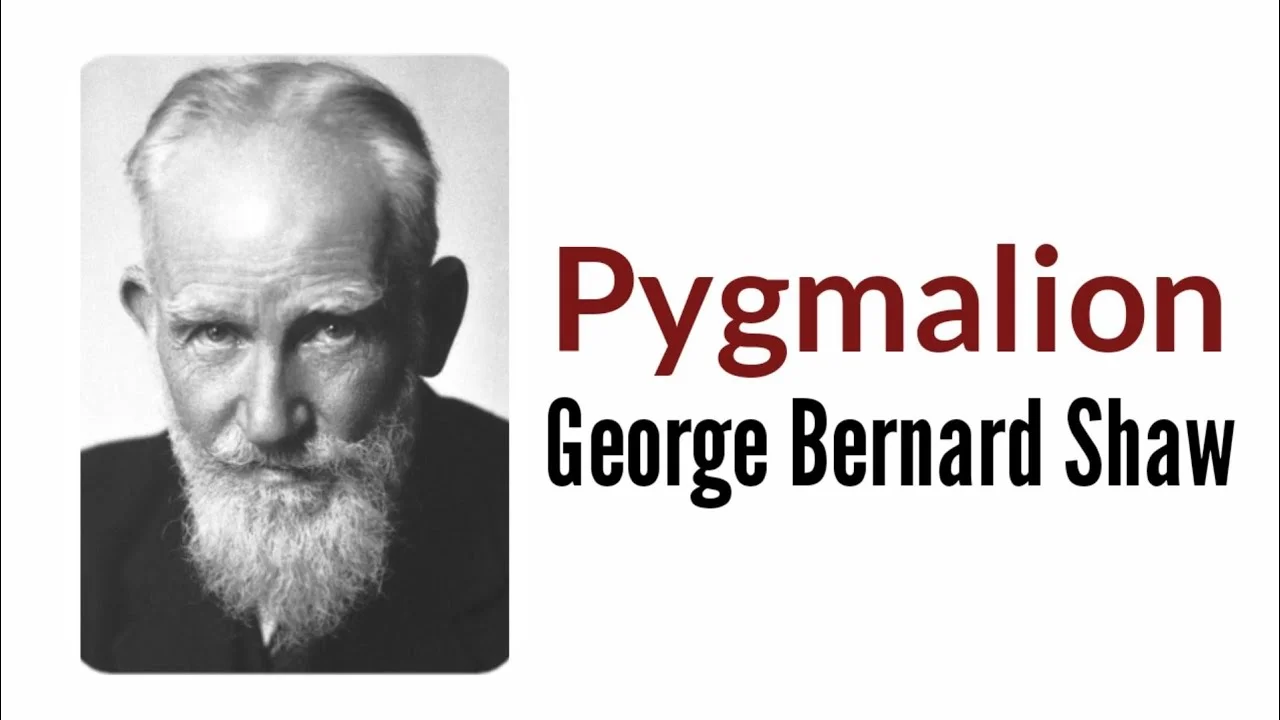
George Bernard Shaw's play Pygmalion, written and published in 1912, is a popular work in English literature. The play explores themes of class, language, and identity through the story of Eliza Doolittle, a flower girl who is transformed by phonetics professor Henry Higgins.
Introduction and Background ⏱ 0:00
•Pygmalion is a play by George Bernard Shaw, written and published in 1912.•Shaw received both a Nobel Prize and an Oscar; he declined the Nobel Prize money.•The play was inspired by various sources and is one of Shaw's most popular works.Act 1: The Encounter at Covent Garden ⏱ 1:01
•On a rainy night in London's Covent Garden, people take shelter under a church portico.•Among them are Mrs. Eynsford Hill and her daughter Clara, waiting for Freddie who went to find a taxi.•Freddie returns without a taxi, and his mother and sister scold him.•A flower girl, Eliza Doolittle, tries to sell flowers to a gentleman who gives her some coins.•A man in the crowd, Henry Higgins, is taking notes and impresses everyone by identifying where people are from based on their accent.•Higgins is a phonetics expert; he meets Colonel Pickering, who has come from India and shares an interest in linguistics.•Higgins boasts that he could train Eliza to speak like a duchess in a few months.•The rain stops, and everyone disperses; Freddie is left alone as Eliza takes the taxi he had fetched.Act 2: The Bet and Eliza's Arrival ⏱ 6:19
•The next morning, Higgins and Pickering are in Higgins's lab, filled with recording devices and tools for studying speech.•Mrs. Pearce, Higgins's housekeeper, announces that a girl has come to see him.•Eliza arrives and asks Higgins to teach her to speak like a lady so she can work in a flower shop.•Higgins is amused and boasts he could pass her off as a duchess at an ambassador's party.•Pickering bets Higgins that he cannot do it, and they agree on the challenge.•Higgins orders Mrs. Pearce to clean Eliza up and burn her old clothes.•Alfred Doolittle, Eliza's father, appears and demands five pounds for his daughter; Higgins pays him.•Doolittle refuses Higgins's offer to improve his speech, saying he is content as he is.•On his way out, Doolittle encounters Eliza but does not recognize her due to her new appearance.Act 3: The Test at Mrs. Higgins's At-Home ⏱ 11:57
•Higgins visits his mother, who is surprised and not pleased to see him because she expects guests.•Higgins asks his mother to host Eliza at her at-home day to test her progress.•The guests include Mrs. Eynsford Hill, Clara, and Freddie.•Eliza arrives and speaks with exaggerated politeness, but her lower-class origins are still detectable.•Clara and Mrs. Eynsford Hill think they have seen Eliza somewhere before.•After the guests leave, Mrs. Higgins criticizes Higgins and Pickering for not considering Eliza's future; they dismiss her concerns.•Freddie expresses admiration for Eliza.Act 4: The Experiment's Aftermath ⏱ 14:38
•Eliza successfully passes as a duchess at the ambassador's party, a dinner party, and the opera.•Higgins wins the bet and his experiment is complete.•At home, Higgins and Pickering ignore Eliza and talk about her as if she were an object.•Eliza, frustrated, throws Higgins's slippers at him and accuses him of selfishness.•She says she has been made a lady but has no future; she cannot go back to selling flowers.•Higgins suggests she marry someone rich, which insults her further.•Eliza leaves, returning the clothes and jewelry Higgins gave her.Act 5: Resolution and Eliza's Independence ⏱ 16:39
•The next morning, Higgins and Pickering go to Mrs. Higgins's house and report that Eliza has run away.•Alfred Doolittle arrives, angry at Higgins because Higgins's praise led to a wealthy benefactor leaving him money, making him rich and miserable.•Eliza appears and thanks Pickering for treating her like a lady, while ignoring Higgins.•Higgins asks Eliza to come back, admitting he misses her.•Eliza says she wants independence and plans to become a phonetics teacher.•She leaves, and Higgins is left alone as the play ends.Key Takeaways
•George Bernard Shaw wrote Pygmalion in 1912, and it is one of his most famous works.•Henry Higgins, a phonetics expert, makes a bet with Colonel Pickering that he can pass Eliza Doolittle, a flower girl, off as a duchess.•Eliza undergoes training but is treated as an experiment, leading to her frustration and eventual departure.•The play ends with Eliza asserting her independence and planning to become a phonetics teacher.•Shaw received both a Nobel Prize and an Oscar, but declined the Nobel Prize money.Conclusion
Pygmalion is a classic play that examines social class, language, and identity through the transformation of Eliza Doolittle and her relationship with Henry Higgins.