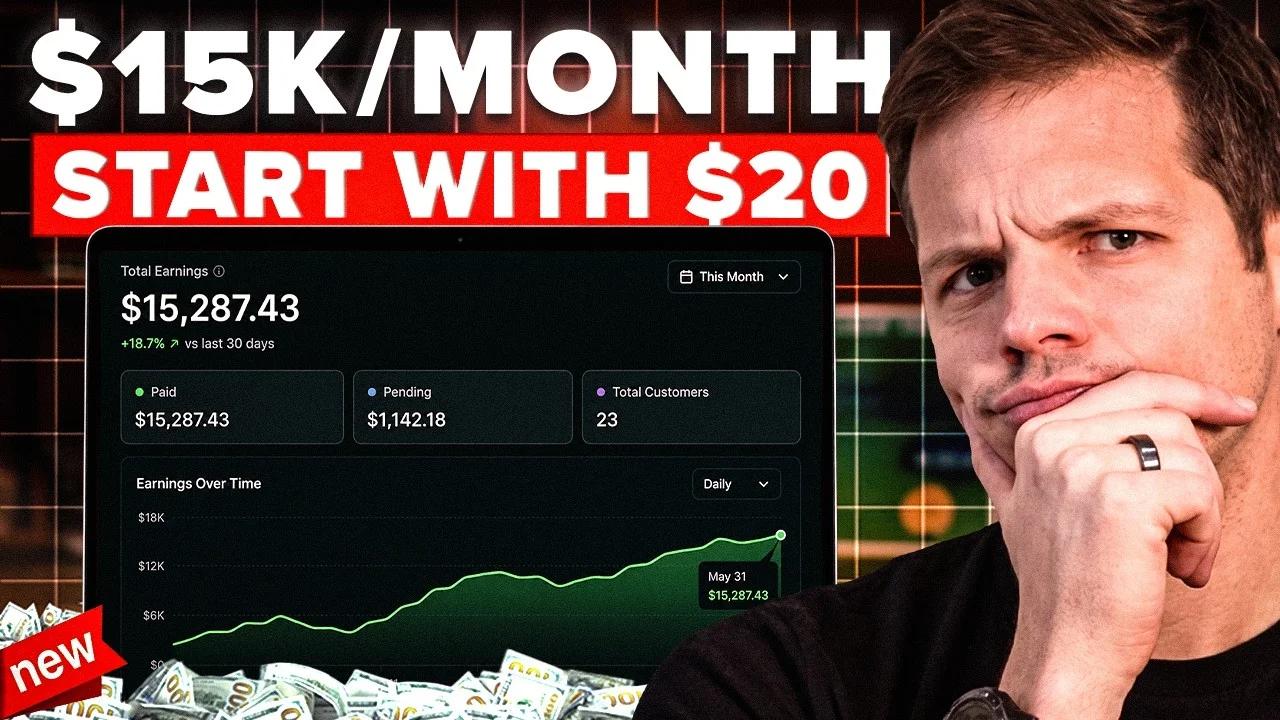
Ryan, a 24-year-old introvert, shares how he started and grew an AI implementation business for small businesses, earning $15,000 per month in profit with only $20 in startup costs.
Ryan's AI Implementation Business for Introverts ⏱ 0:00
•Ryan, a 24-year-old shy introvert from Cincinnati, makes $15,000 per month profit implementing AI for small businesses, costing only $20 to start.•He targets startup founders (pre-revenue to $20M revenue, typically under $10M) who understand AI but whose teams underuse it; charges $1,000 to $20,000 per project.•His initial strategy: 100 free, hour-long Google Meet calls with people in his network (60% from four business/AI groups, 40% from personal contacts) to provide value without selling; reached 100 conversations within three months.•He personalized outreach (e.g., referencing specific life events) and avoided sales pitches, leading to second conversations and eventual paying clients; now focuses on education offers teaching clients to build AI tools themselves.Sales Funnel Progress and Outcomes ⏱ 20:01
•After 30 first conversations, about half led to second conversations; then roughly 15 third conversations.\n- 2 people closed on the second conversation at $500-$1,000 each; about 10 closed from third conversations, totaling 12 paying customers from 150 reachouts (~8% close rate).\n- Effort: ~350 hours conservative, equating to about $2/hour initially; later paid $50-$100/hour when considering implementation time.\n- In-person interactions could double close rates; most calls were via Google Meet.Offers, Pricing, and Revenue ⏱ 31:50
•Private coaching: 3-month deep dive, $5,000-$10,000/month, ~10 hours/week per client, max 1-2 clients.\n- Cohort groups: month-long sprints, $1,000 per person, ~10 people per cohort, ~10 hours/week, potential to scale to 20 people.\n- Implementation builds: $200/hour, average project $2,000, ranging $1,000-$20,000.\n- First 12 customers generated ~$25,000 lifetime; projected best month at $15,000.Business Growth, Tools, and Networking ⏱ 40:03
•Revenue grew from $4,000/month at a 9-to-5 to $10–15,000/month working for himself in 1.5 years, without formal training.•50% of current revenue comes from first-engagement clients; the rest from referrals or network expansion.•Key tools: GoHighLevel (CRM, starting at $97/month), Make.com for automation; Claude is recommended for AI learning.•Networking groups and in-person connections are critical; he reaches out to 10 people daily and emphasizes mentorship through 'seek to serve' and 'pay to play'.•He gives away all trade secrets, believing it attracts clients and builds trust.DASA Framework, Client Acquisition, and Advice ⏱ 48:47
•DASA framework: Diagnose (find the problem), Articulate (describe the dream solution), Systemize (create SOPs and systems), then implement AI.•Asks questions like 'What keeps you up at night?' to uncover client pain points.•Small businesses pay up to $15,000 for his services; he started his business with $20 (Chad GPT subscription).•He avoids OpenClaw for business due to security risks; advises beginners to start with a fun project like making a video game.•He positions himself as a 'true go-giver' and finds clients locally in Cincinnati, where he serves people he grew up with.Key Takeaways
•Ryan makes $15,000 per month profit implementing AI for small businesses, with only $20 to start.•After 30 first conversations, about half led to second conversations, and roughly 15 third conversations.•Private coaching is offered at $5,000-$10,000 per month for a 3-month deep dive, with about 10 hours per week per client, and a maximum of 1-2 clients.•Cohort groups are month-long sprints priced at $1,000 per person.•Revenue grew from $4,000 per month at a 9-to-5 to $10-15,000 per month working for himself in 1.5 years, without formal training.•50% of current revenue comes from [incomplete information].Conclusion
The video outlines Ryan's journey and business model, including his sales funnel, pricing, and the DASA framework for client acquisition and implementation.