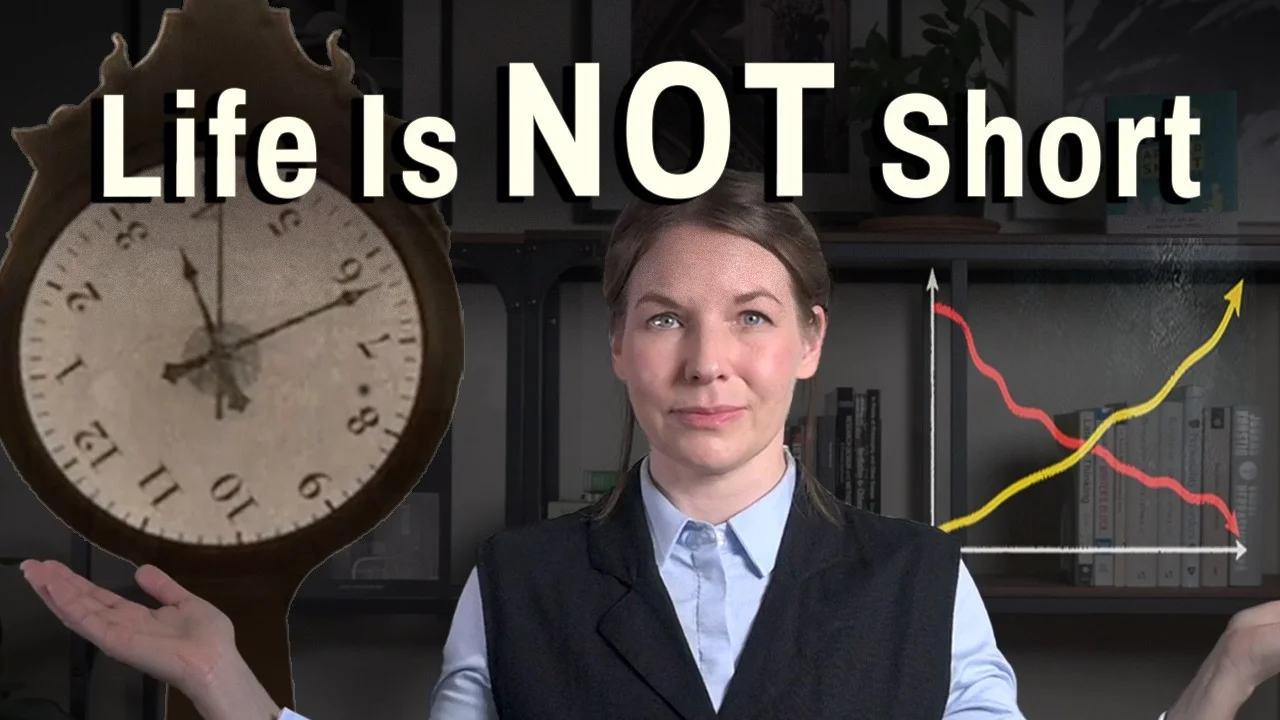
The phrase 'life is short' is logically incoherent and serves as a rhetorical device to induce urgency. This article explores its cultural origins, psychological effects, and alternative ways of experiencing time.
The Logical Failure and Rhetorical Purpose of 'Life Is Short' ⏱ 0:08
•The phrase 'life is short' lacks a point of comparison; life is its own category and cannot be compared to other durations.•It is not an empirical or logical statement but a rhetorical device designed to generate urgency and make you act.•It appears in social media advice, mindset hacks, and an achievement-oriented environment that fosters constant guilt and a feeling of being behind.•The phrase arises from a cultural mindset where life and time are treated as commodities to be utilized efficiently.•This perspective can make life feel anxious and may cause valuable experiences to be missed if they don't fit a predefined plan.Cultural and Philosophical Origins of the Commodified Time Mindset ⏱ 6:29
•Benjamin Franklin's 'time is money' (from 'Advice to a Young Tradesman') shifted perspective, making time a moral currency.•Max Weber connected this to Protestant ethics, where systematic labor was a sign of religious discipline; this is the ultimate embodiment of modern capitalism.•Henri Bergson's concept of durée suggests that measuring life by the clock is a mistake; deep immersion feels continuous, not linear.•The proportionality theory by Paul Janet (1897) claimed time perception is relative to total life lived (e.g., 1 year is 10% of a 10-year-old's life, 2% of a 50-year-old's).•Cognitive psychology favors memory density theories: time feels longer when many new memories are formed; routine compresses time.Aging as Decay vs. Open-Ended Development ⏱ 14:40
•In Western culture, aging is often seen as decay, a reduction in quality, and the body is treated as a problem to be solved.•The 'accumulation model' views the body as collecting illnesses and damages over time.•Eastern traditions like Taoism and Qigong view the body as a landscape to be cultivated, emphasizing refinement and efficiency of movement.•Philosophers like Maurice Merleau-Ponty and Jean-Luc Nancy have critiqued the detachment of body from thinking in Western philosophy.•The speaker argues that the body can become more optimized with age, with less energy spent on navigating basic situations and potentially lower stress levels.Beyond the Rat Race and Romantic Retreat: The Open-Ended Approach ⏱ 23:58
•The romantic retreat (stepping off the treadmill, meditating) is criticized as a passive reaction that doesn't change the underlying paradigm.•Efficiency and optimization are not inherently part of the rat race; they can be used to unlock time and space for exploration.•The open-ended approach involves being hyperactive but non-linear, with goals arising from a less linear mindset and an internal navigation tool.•Montage technique from music composition is presented as a method: assembling fragments without a linear plan, then creating incoherency within the system.•A montage lifestyle means embracing detours and surprises; statistically, the most successful startups are started at age 45 on average, and a startup by someone in their 60s is 3 times more likely to succeed than one by someone in their 30s.Practical Implications and Conclusion ⏱ 37:20
•The speaker suggests adopting a montage lifestyle: start doing things before knowing what they will mean, and value past experiences even if they don't fit a linear plan.•The ability to hold the tension of not knowing where life is going is a superpower.•The closing message: 'May your dreams not come true. May something you never dreamed about happen instead.'•'Go waste your time. Life is not short, and instead of being a treadmill optimizer, be a doer.'Key Takeaways
•The phrase 'life is short' is not logical or empirical but rhetorical, designed to generate urgency and action.•The commodification of time can be traced to Benjamin Franklin's 'time is money' and Max Weber's analysis of Protestant ethics and capitalism.•The experience of time accelerating is largely due to routine and lack of new memories, not biological necessity; memory density theories support this.•Aging can be viewed as open-ended development rather than inevitable decay; the body can adapt and refine itself.•Statistically, late blooming is beneficial: the most successful startups are started at age 45 on average, and startups by founders in their 60s are three times more likely to succeed than those by founders in their 30s.Conclusion
Efficiency and optimization are not the problem; the linear, commodifying view of time is. By embracing an open-ended approach and allowing ourselves to 'waste' time, we can have deeper experiences and a more meaningful life.