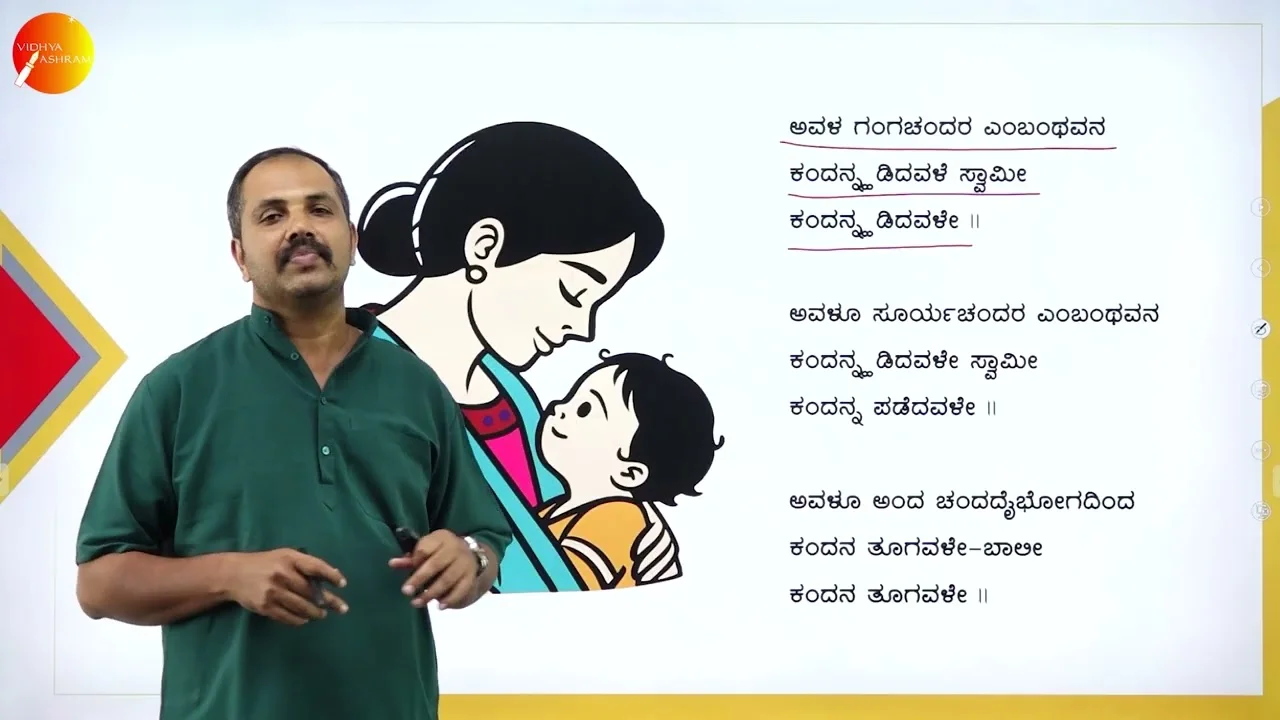
This lecture introduces the folk narrative poem “The Song of the Chaste Woman and the Men,” collected and edited by H. L. Nagegowda. The instructor recounts its tragic plot and discusses the poem’s portrayal of secrecy, betrayal, and the consequences of the woman’s actions.
H. L. Nagegowda and the poem’s background ⏱ 1:00
•H. L. Nagegowda was a noted Kannada folklore scholar and writer who worked to preserve and promote folk traditions.•He was born in Eraganahalli village in Mandya district, earned degrees in science and law, and served in the Indian Administrative Service.•He wrote novels, poetry collections, short stories, travel writing, and essays. His notable novel was “Doddmane.”•He established the Karnataka Janapada Parishat in 1979 and the Janapada Loka folk museum in Ramanagara in 1980. He also served as a member of the Karnataka Legislative Council and received honors including the Rajyotsava and Nadoja awards.•“The Song of the Chaste Woman and the Men” is a love-related narrative poem selected from a collection of Kannada folk narrative poems. It was sung by Chowdike Subbayya of Nelamangala and edited by Nagegowda.The poem’s folk-literary tradition and central conflict ⏱ 4:40
•The instructor cites the saying “the people’s speech is the root, and the poet’s speech is the flower” to describe folk literature as a source from which formal literary traditions grow.•The poem tells of a woman involved with two men. After her husband leaves for war, she secretly brings her lover home.•The woman’s young son discovers the lover and asks who he is, since his father has gone away. The mother tries to deceive the child, but he threatens to tell his father when he returns.•To keep the affair secret, the mother first injures the child and then has her lover kill him. A neighboring woman witnesses the crime and protests; the mother then has that woman killed as well.The husband leaves and the affair begins ⏱ 12:33
•The husband says he is going to war and expects to return after eight months. His wife asks when he will come back, and he promises to return by then.•Before he leaves, she prepares food and accompanies him toward the river, asking what gifts he will bring for their son and for her.•After seeing her husband off, she goes to fetch water with her companions, signals to her lover, and invites him home while her husband is away.•She cooks rice and holige with ghee for the lover, serves him, and prepares a bed. She sends her son outside with a bundle of coconut and jaggery, telling him not to come home soon.The ending and the instructor’s stated lesson ⏱ 29:37
•When the boy returns and questions his mother about the man in the house, she claims he is the child’s uncle. The child says he will tell his father after the promised eight months.•Fearing exposure, the mother arranges for her lover to kill the boy. After a neighbor sees what happened and condemns the killing, the mother arranges for the neighbor to be killed too.•The instructor says the poem depicts how the woman’s effort to conceal her desire and wrongdoing leads to cruelty, including the killing of her own child.•He emphasizes that the child’s life should not be taken to satisfy desire or hide a secret. He concludes that relationships should be strengthened through love, affection, and emotional commitment, rather than allowing desire to justify harm.Key Takeaways
•H. L. Nagegowda collected and edited the poem, which was sung by Chowdike Subbayya of Nelamangala.•The story begins when the husband leaves for war and tells his wife he expects to return after eight months.•The wife brings her lover home while her husband is away, and her son discovers them.•The mother arranges the deaths of her son and a neighbor who learns of the crime.•The instructor stresses that no desire or secret can justify taking a life and urges love and emotional strength in relationships.Conclusion
The instructor presents the poem as a warning about the extreme harm caused by attempts to conceal wrongdoing. He closes by urging listeners to value love and build healthy relationships.