

Steganography: Hiding Messages in Digital Images
المصدر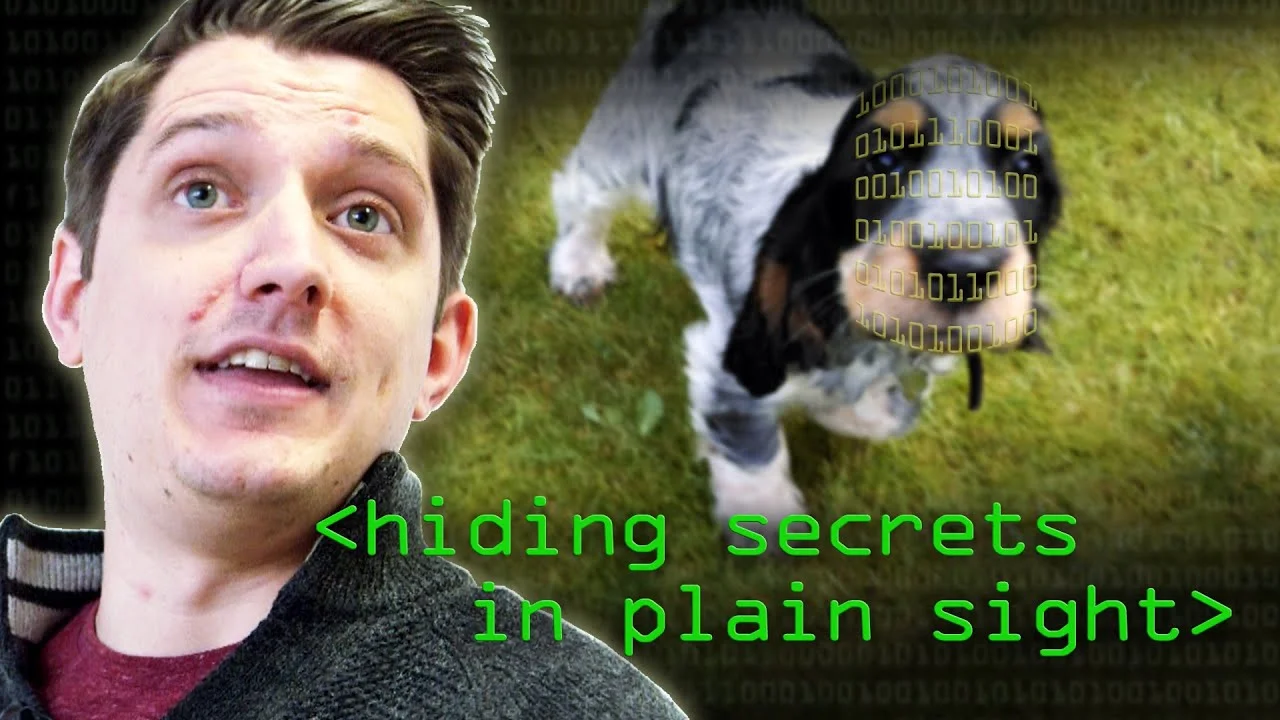
This video explains steganography, the practice of hiding the existence of a message, and focuses on digital image steganography. It covers methods like least significant bit insertion and DCT coefficient manipulation, along with techniques for detecting hidden messages and practical applications such as watermarking.
Introduction to Steganography ⏱ 0:00
Steganography is distinct from cryptography: while cryptography encrypts a message so that even if its transmission is known, its content remains secret, steganography aims to hide the fact that a message has been sent at all. A classic example is writing a letter in invisible ink between the lines of another letter, so that only the intended recipient knows to look for it. In the digital realm, images provide a vast scope for hiding data because they can be megabytes in size, allowing files of megabytes or more to be concealed within them. However, as the amount of steganography in images increases, so do attempts to detect it, leading to many statistical approaches designed to find hidden messages. The video focuses on digital image steganography, exploring both hiding techniques and the methods used to uncover them.
Least Significant Bit Steganography ⏱ 0:31
The simplest form of image steganography is least significant bit (LSB) steganography. In a bitmap image (such as PNG or BMP), the lowest bits of each byte can be replaced with message bits, causing an almost imperceptible change in the image's appearance. The speaker compares this to changing the number 800,351 by altering the 1 or the 51: in such a large number, it makes no difference. In an image, every byte consists of eight bits; typically, the last bit or the last two bits are changed if a large amount of data needs to be crammed in. With two bits per byte, six bits remain for the regular image, so a quarter of the message is hidden. For each pixel, which is 4 bytes long, the last two bits of each byte can be modified. For example, if the message to encode is 10 11 01, and the first two bits of a byte are already 1 and 0, that byte remains unchanged. If the next byte's last two bits are 0 and 1 and the message bits are 1 and 1, the second least significant bit is changed from 0 to 1, increasing the value by two. Changing bits by two levels in one channel of a huge image is unlikely to be noticeable, whereas altering the most significant bits would be problematic. The speaker demonstrates a program that hides a large file (about 1.5 MB zipped, containing the entire works of Shakespeare) inside a 3-megapixel image of a tree, and the change is imperceptible to the naked eye. However, LSB steganography is detectable by comparing the original and steganographic images, or by examining only the last two bits of each channel, which reveals noise that betrays the hidden message.
Detection of LSB Steganography ⏱ 4:15
The simple LSB steganography method is detectable. By taking only the last two bits of each channel and discarding the rest, one can create a visual representation where pixel values range from 0 (black) to 3 (white). Applying this to the original tree image shows a recognizable tree shape, with the sky being particularly bland. But when the same filter is applied to the steganographic image, the amount of noise increases massively because the hidden message resides in those least significant bits. Comparing the bit representations of the original and steganographic images reveals a clear difference, making LSB steganography obvious, especially when the original is available for comparison. The difference image, scaled up, shows white and black pixels representing intensity changes of plus or minus 3, evenly distributed as noise throughout the image. In the difference image, the tree is no longer visible, which itself could be a clue that something has been hidden. The speaker notes that it is really good practice to never release the original source image, because without a reference, no one can tell that the image has been imperceptibly changed. However, if a public domain image is used and then altered, it is easy to look for the original source.
DCT Coefficient Steganography ⏱ 5:17
A more sophisticated method of hiding data in an image is to embed it in the Discrete Cosine Transform (DCT) coefficients of a JPEG. The DCT converts an image into a series of cosine waves, each with a coefficient indicating how much of that wave is present. Changing these coefficients instead of raw pixel values has a much less predictable effect on the image. For example, changing an alternating current coefficient from 202 to 201 produces a very imperceptible difference over the entire 8x8 block, avoiding the clear steganographic noise seen with LSB. A common algorithm is JSteg, which crams DCT coefficients with as much data as possible. It avoids coefficients that are 0 or 1 (which might be obvious) and typically uses low-frequency coefficients that change up or down. The speaker demonstrates hiding data in a panda image using JSteg, resulting in a very slight difference (plus or minus 1 or 2 in pixel values). Crucially, JPEG compression already scrambles the least significant bits, so a visual attack that examines only the last two bits will show only general JPEG noise, which looks the same in the steganographic image. The 8x8 block structure is visible, but the distribution of noise remains unchanged, making it difficult to detect the hidden message and even harder to determine which parts of the image contain data if the message only occupies a portion.
Extracting the Hidden Message ⏱ 7:55
To extract a hidden message, the recipient must know the process used. Typically, the message is also encrypted for safety. The sender encrypts the message, embeds it in DCT coefficients or least significant bits, and sends the image. The recipient, knowing the method (e.g., JSteg or F5), runs the corresponding program and enters the decryption key, which removes the encryption and reveals the message. When JSteg was first invented, it was robust against visual attacks, so researchers had to find other detection methods. They discovered that JSteg subtly alters the distribution of DCT coefficients. Because quantization sets most coefficients to zero, and JSteg avoids zero coefficients, it only modifies a few large coefficients at the top corner. This creates a subtle imbalance: most coefficients are 0, many are -1 or 1, and -2 and 2 are close to zero. However, unexpected 3s and 4s appear, and the histogram of coefficients shifts. This anomaly can be detected per 8x8 block, allowing identification of which blocks contain messages. For instance, if the first 60% of the file has a message and then it abruptly stops, that is a blatant clue that the message does not fill the whole image but was written sequentially. By plotting the frequency of each DCT coefficient (a histogram), one can determine whether the coefficients have been imperceptibly changed.
Advances in DCT Steganography and Detection ⏱ 10:33
Once JSteg detection became routine, researchers developed more subtle DCT steganography methods that pay attention to the statistics of coefficients and try to keep them balanced. For example, if they insert a 1, they try to remove a 1 elsewhere to keep the histogram and probabilities unchanged. This makes standard histogram analysis much less effective. However, machine learning can be used: with a thousand images, 10 of which may contain hidden data, a classifier can effectively identify which ones have messages, provided there are enough positive and negative samples. The speaker notes that such techniques are not just for spies; a common use is digital watermarking. In watermarking, the goal is to fingerprint a file to prove ownership or trace distribution of illegal material. Instead of maximizing payload, a watermark typically embeds a small logo or text repeated over and over so that it survives cropping or recompression. Stock photo companies might use this to prevent unauthorized distribution and can search the web for images watermarked in their particular way. Similarly, pre-release DVDs of films can be watermarked with unique identifiers for each recipient; if a copy leaks, the watermark reveals who leaked it. Each file can be tailored to the person it was sent to, so when that file appears on the internet, that person is implicated.
Key Takeaways
Conclusion
The video explored the principles and techniques of digital image steganography, from the straightforward LSB method to the more sophisticated DCT-based approaches, and discussed the ongoing cat-and-mouse game between hiding and detecting hidden messages, culminating in practical uses like watermarking.
تم التحقق عبر بحث مباشر على الويب — تُقارن الادعاءات بمصادر حقيقية ولا تُخمَّن.
اسأل الذكاء الاصطناعي عن هذا الفيديو