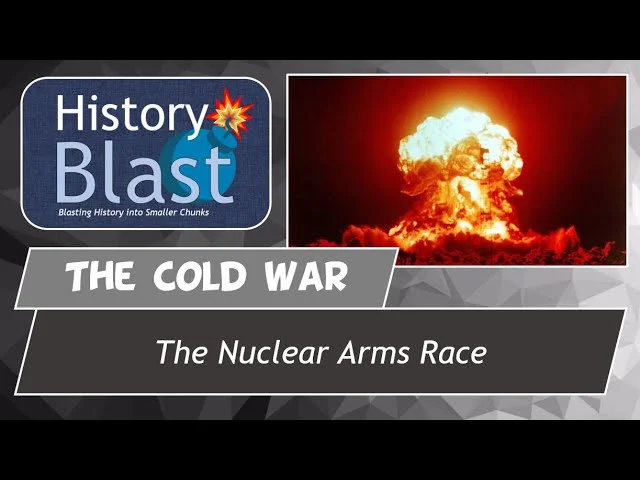
The Cold War arms race between the USA and USSR saw the development of over 100,000 nuclear weapons from 1945 to 1991, as both superpowers sought to outdo each other in destructive capability.
The Start of the Nuclear Arms Race (1945-1949) ⏱ 0:00
•The USA tested the first atomic bomb on 16 July 1945 at the Trinity site in New Mexico, yielding 19 kilotons and creating a crater over 300 meters wide.•President Truman informed Stalin about the weapon at Potsdam, hoping for an edge, but it only increased distrust.•The USA dropped the uranium-powered Little Boy on Hiroshima on 6 August 1945, causing at least 140,000 deaths, and another bomb on Nagasaki on 9 August, leading to Japan's surrender less than a week later.•Stalin felt intimidated and became more determined to acquire nuclear weapons, tightening his grip on Eastern Europe.•The USSR tested its first atomic bomb, First Lightning (20 kilotons), on 29 August 1949, aided by spy Klaus Fuchs who smuggled plans to the Soviets.•US analysts had not expected the Soviets to have nuclear energy until the 1950s, and Truman only learned of the test through spy planes picking up radiation signals.Escalation to Hydrogen Bombs and ICBMs (1952-1961) ⏱ 3:34
•The USA exploded its first hydrogen bomb in November 1952, 1,000 times more powerful than the atomic bombs used in Japan, restoring its advantage.•The Soviets exploded their own hydrogen bomb in August 1953.•In March 1954, the USA tested Castle Bravo in the Pacific, the largest nuclear bomb it ever tested at 14.8 megatons; radiation affected nearby Japanese islands and inspired Godzilla stories.•The USA developed the first ICBM in June 1957, capable of delivering warheads over 4,000 kilometers, but the USSR tested its own ICBM in August 1957.•In October 1961, the USSR exploded the Tsar Bomb, a 50-megaton weapon with a mushroom cloud 65 kilometers high, seven times the size of Mount Everest—the largest nuclear weapon ever exploded.The Policy of Mutually Assured Destruction (MAD) and the End of the Arms Race ⏱ 5:36
•The development of hydrogen bombs and ICBMs led to the theory of mutually assured destruction (MAD), where both sides knew that an attack would result in equally devastating retaliation and total destruction.•Nuclear weapons shifted from being used to wage war to being used to prevent one.•Throughout the 1950s, anti-nuclear protests erupted worldwide; the 1952 film 'Duck and Cover' advised US schoolchildren on nuclear warfare realities.•The arms race continued into the 1970s and 1980s, with discussions to reduce weapons, and did not end until the dissolution of the USSR on 25 December 1991.Key Takeaways
•The USA and USSR built more than 100,000 nuclear weapons between 1945 and 1991.•The USA conducted the first atomic test in July 1945 and dropped atomic bombs on Hiroshima and Nagasaki in August 1945.•The USSR tested its first atomic bomb in August 1949, aided by espionage.•Both sides developed hydrogen bombs in the early 1950s and ICBMs in 1957, leading to the policy of mutually assured destruction.•The arms race ended with the dissolution of the USSR on 25 December 1991.Conclusion
The nuclear arms race between the USA and USSR defined the Cold War, driving the creation of ever more powerful weapons until the collapse of the Soviet Union in 1991.