

Inside the Studio of a Manga Artist with 700 Million Yen in Sales
المصدر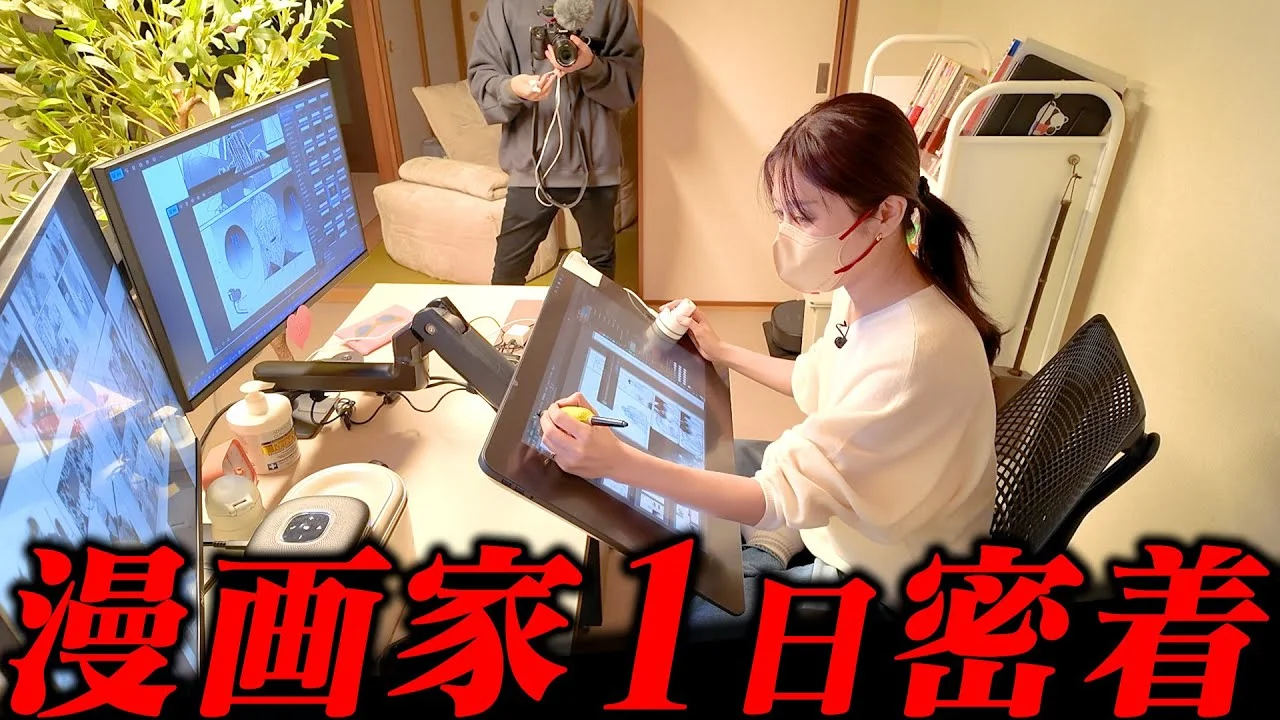
This video takes viewers on a tour of the home and workspace of Watanabe, the manga artist behind 'Gunshin to Itsuwari no Hanayome,' and follows a day of drawing.
Introduction and Studio Tour ⏱ 0:31
The video begins with the host entering Watanabe's home, greeted by her cat, Maru. Watanabe explains that she has been too busy to cook since moving to this apartment, despite having a kitchen. She shows a collection of frozen meat buns, about 30, from a Chinese acquaintance named Jo, which she steams during deadlines. She also points out items that inspire her work, such as a Chinese artificial flower that resembles a character from her manga and a cheap olive plant she bought when she had no money, noting she plucked and discarded all the olives because they didn't match her image. She mentions buying some items in installments because she was short on funds. The tour continues to her work area, where she has three monitors: one for reference materials and two for work, including Discord. She uses a stand-up desk so she can work standing, and she demonstrates how it adjusts. She also shows a custom 3D-printed stand for her keyboard.
Artistic Process and Use of 3D Backgrounds ⏱ 7:36
Watanabe explains that she spends a lot of time adjusting facial expressions, as even a slight change in eyebrow angle or hair covering the eyes can alter the character's look. She mentions that she separates layers for hair and eyes, a habit from her analog days. She originally wanted to be a painter and never aimed to be a manga artist; she fell into manga after receiving an offer, thinking she could make a living drawing. She admits she lacked social skills and was naive about the world. For backgrounds, she uses SketchUp, a 3D modeling software, and has an assistant who used to work in architecture and is skilled at 3D modeling. She purchases 3D assets from a Korean website used by webtoon creators. She says that ideally she would draw everything by hand, but the cost of drawing makes that impossible. She also shows a plot document that outlines upcoming story developments, noting that she includes scenes readers want to see, such as the main characters getting along, and that she prioritizes reader satisfaction over her own preferences.
Balancing Creative Freedom and Reader Expectations ⏱ 11:21
Watanabe discusses her approach to creating manga for readers. She says she doesn't experience much inner conflict between what she wants to draw and what readers want, especially for this work, because she is writing for readers to enjoy. She loves reading comments and knowing that readers look forward to each chapter. She feels she doesn't have a strong personal desire to express herself, and she doesn't think her own ideas are particularly valuable. Instead, she believes it's better to do what makes many people happy, especially since she is paid for her work. She acknowledges that pursuing self-expression while earning money might not be ideal, though it's not inherently bad if it leads to success. She wonders if, after writing manga for a long time, she might develop a personal creative desire, but for now, she is content with her approach. She notes that drawing manga occupies most of her time, and she is grateful for that.
Past Work and the Business of Manga ⏱ 12:52
Watanabe reflects on a previous work that was 'immoral' and likely didn't bring the publisher much profit. She says that even if it wasn't lucrative, she was able to do what she wanted, and that was meaningful. She contrasts this with her current work, where she focuses on what readers enjoy. She also touches on the business side, mentioning that when she was starting out, her compensation was high compared to other offers, and that her current publisher set her rate based on a reverse calculation from revenue and tax. She emphasizes the importance of communication between editors and artists, noting that new artists often blindly follow editors' advice because they think editors know best, but this can lead to works that don't feel like the artist's own. She warns that if artists just follow orders, they may end up with a work that no one takes responsibility for, and that artists must protect their own work and align with editors on the same direction, keeping the reader in mind.
Cat, Routine, and Closing Thoughts ⏱ 14:01
The host asks about the cat, and Watanabe explains that Maru often sits on her chair, sometimes taking up more than half of it, and she sits in the remaining space because it makes her happy. She mentions that the cat sometimes walks on the desk. The conversation then shifts to a previous comment someone made to her: 'Your manga has no value. Your drawings of beautiful girls have value, but your manga doesn't.' She reflects on this, saying that manga is simply about drawing, and that there is no right answer to what makes a manga valuable or how to survive in the industry. She seems to ponder the question of how to live and what to do, but doesn't provide a definitive answer.
Key Takeaways
Conclusion
This tour and interview reveal Watanabe's practical approach to manga creation, from her ergonomic workspace and use of 3D assets to her reader-focused mindset and thoughts on artistic value.
تم التحقق عبر بحث مباشر على الويب — تُقارن الادعاءات بمصادر حقيقية ولا تُخمَّن.
اسأل الذكاء الاصطناعي عن هذا الفيديو