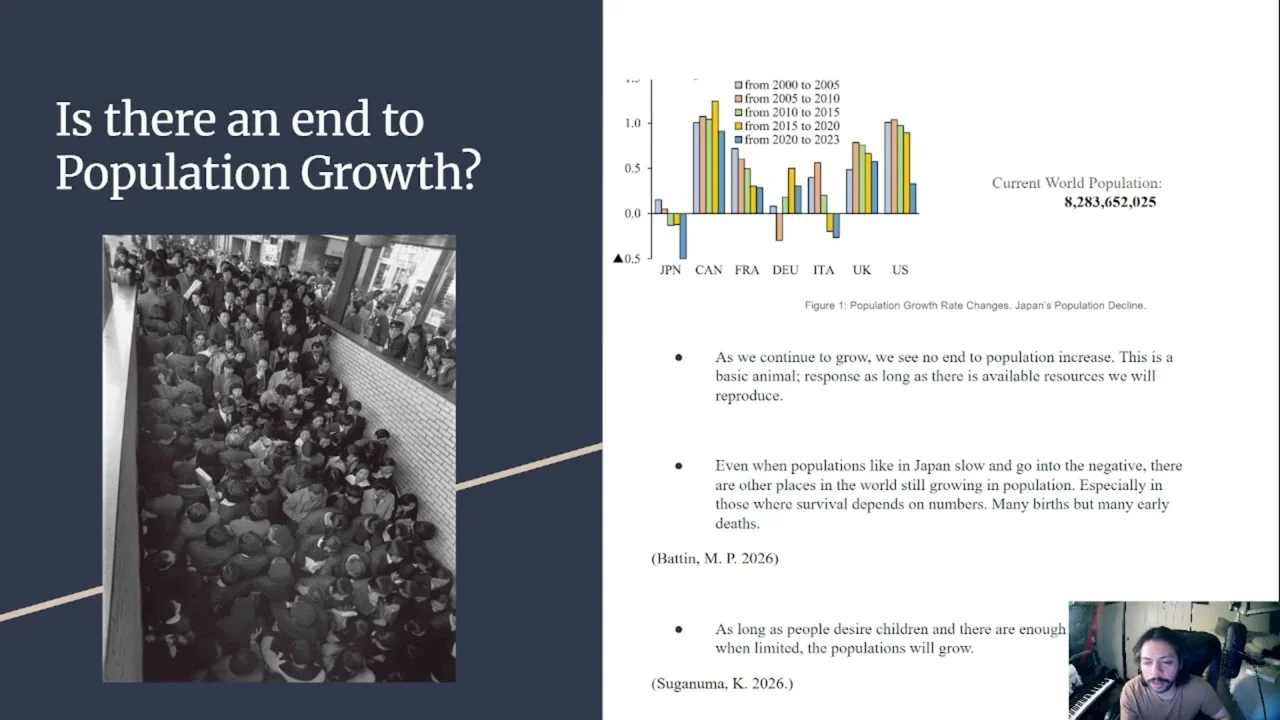
Marvin Haris discusses population ethics, focusing on stabilization, redistribution, migration, and the dynamics of population growth and decline, exploring historical context and contemporary challenges.
Historical Foundations and Policy Impacts
•The history of population ethics can be traced back to nomadic tribes and the agricultural revolution, which changed how humans perceived themselves.- Early political policies, such as those in China and Singapore that limited the number of children, backfired by leading to lower fertility rates.- These countries later reversed their policies, encouraging people to have more children.- The industrial revolution led to automated farmwork, migration to cities for education, and advancements in medicine that extended lives, contributing to population growth.Migration and Demographic Shifts
•Migration is a key factor in the growth, decline, and shifting of populations across the world.- Historical colonization, exemplified by the Spaniards in Mexico or France in Algeria, influenced people to seek opportunities in the colonizers' countries.- Currently, industrialized nations like Japan experience population decline as educated young generations postpone having children for career growth.- Rural areas in Japan, Spain, and Italy are becoming ghost towns as residents migrate to cities for better opportunities or access to medical resources.Addressing Future Population Challenges
•There is a fundamental universal human right to resources sufficient for basic survival.- Solutions could involve redistributing people from resource-scarce regions to underpopulated rural areas or ghost towns.- Programs could educate migrants with the stipulation that they return to their home countries to contribute to development and sustainable infrastructure.- Sustainable practices, including desert farms, solar farms, and desalinization plants powered by renewable energy, are crucial for supporting future populations and managing resources.Key Takeaways
•Population ethics has evolved from ancient nomadic tribes through agricultural and industrial revolutions, shaping human societies.•Governmental policies aimed at controlling birth rates have often had unintended consequences, leading to reversals.•Migration, frequently driven by historical colonization and the pursuit of opportunities, significantly influences global population distribution.•Postponing childbearing by educated young adults in industrialized regions contributes to declining birth rates and aging populations.•Sustainable resource management and strategic redistribution of people are vital for addressing the complex issues of population growth and resource strain.Conclusion
Understanding population ethics is crucial for developing proper policies and laws to address future issues related to migration and resource distribution.