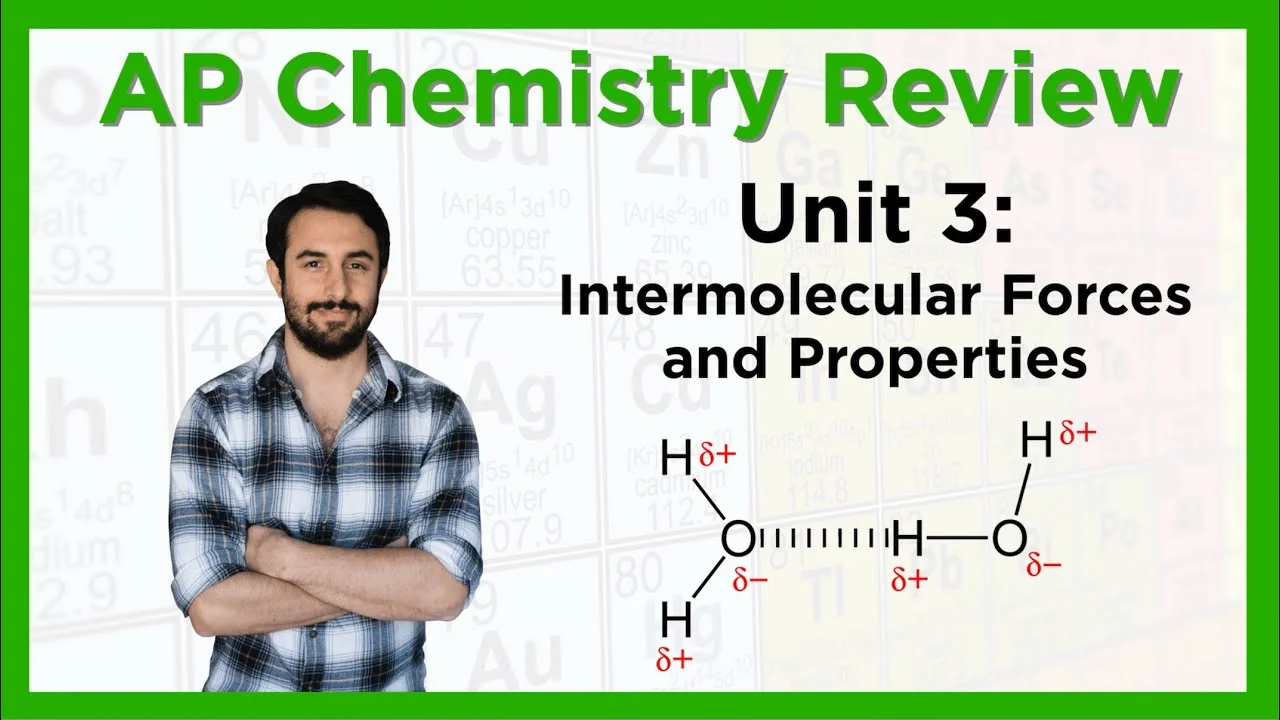
This article reviews key concepts from AP Chemistry Unit 3, focusing on intermolecular forces, their impact on physical properties, and the behavior of gases and solutions.
Types and Hierarchy of Intermolecular Forces
•Ion-ion interactions are the strongest, involving formal charges in ionic solids.•Ion-dipole interactions occur between ions and polar molecules, explaining solubility like NaCl in water.•Dipole-dipole interactions, including hydrogen bonds in NH, OH, or FH bonds, are strong due to partial charges.•London dispersion forces are the weakest and universal, arising from momentary dipoles in all substances.Impact on Physical Properties and Phases
•Stronger intermolecular forces lead to higher boiling and melting points, as seen in polar vs. nonpolar molecules.•Solids maximize interactions in lattices (crystalline types: molecular, network, ionic, metallic), while gases have negligible forces.•Phase changes depend on kinetic energy overcoming attractions, with compact molecules melting higher due to better lattice fit.Ideal Gases and Deviations
•Kinetic molecular theory assumes particles as dimensionless, non-interacting points in constant motion.•Gas laws (Boyle's, Charles's, Avogadro's) relate pressure, volume, temperature, and moles, summarized in PV = nRT.•Real gases deviate at high pressure/low temperature, corrected by the van der Waals equation with factors for particle volume and attraction.Key Takeaways
•Intermolecular forces range from strong ion-ion to weak dispersion, dictating physical properties like boiling points.•Phase behavior is governed by the balance between kinetic energy and intermolecular attractions.•Ideal gases follow simple laws under standard conditions, but real gases require corrections at extremes.Conclusion
Mastering these principles is essential for predicting chemical behavior in diverse contexts.