This lecture derives the differential equation for heat conduction using an energy balance approach.
Motivation for Temperature Distribution ⏱ 0:46
•In metal processing, temperature gradients dictate microstructure and mechanical properties.•In laser surgery, temperature distribution in tissue determines which cells are damaged.•Analytical or numerical solutions allow finding temperature at every point.Energy Balance Analogy with Bank Account ⏱ 5:24
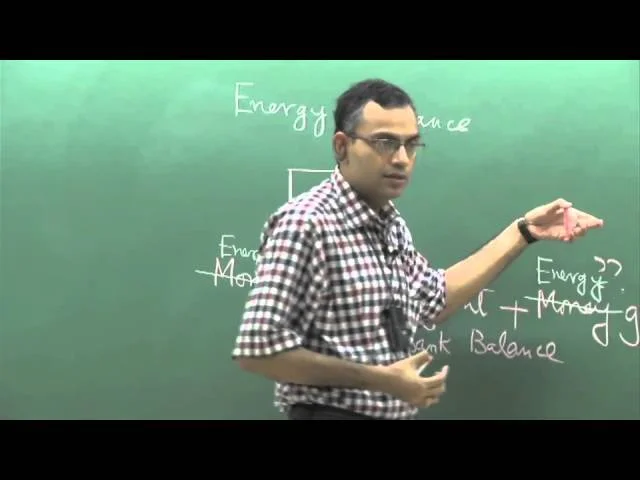
•Energy in - energy out + energy generated = net change of energy within control volume.•Analogous to money in - money out + interest = net bank balance.•This is expressed as a rate equation for heat transfer.Derivation in Cartesian Coordinates ⏱ 14:11
•Consider a control volume of dimensions Δx, Δy, Δz.•Heat flux q″ enters and leaves through faces; use Taylor series to relate q″ at x+Δx to q″ at x.•Sum contributions in x, y, z; include volumetric heat generation q‴.•Take limit Δx,Δy,Δz→0 to obtain the differential equation: ∂(ρi)/∂t = -∇·q″ + q‴.Fourier's Law and Simplifications for Solids ⏱ 31:40
•Fourier's law: q″ = -k ∇T; assumes infinite propagation speed of thermal disturbance.•Not applicable for very short pulses (e.g., femtosecond laser) where finite speed effects matter.•Internal energy i expressed via enthalpy; for solids, pressure term is negligible leading to ρc_p ∂T/∂t = ∇·(k∇T) + q‴.Key Takeaways
•Temperature distribution is critical in manufacturing and medical applications.•Energy balance forms the foundation: rate of energy in - out + generated = rate of change.•The derivation uses a differential control volume, Taylor series, and limiting process.•Fourier's law is a linear constitutive relation with limitations for non-Fourier conduction.•For solids, the heat conduction equation simplifies to ρc_p ∂T/∂t = ∇·(k∇T) + q‴.Conclusion
The heat conduction equation is an initial-boundary value problem that requires specification of initial and boundary conditions for solution.