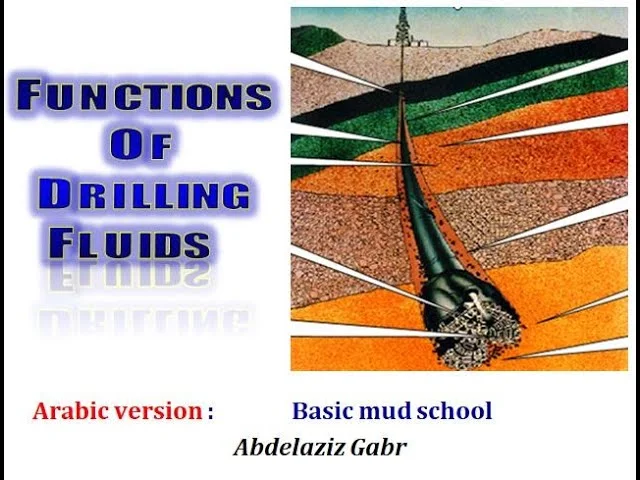
This lesson introduces the basic functions of drilling fluids, emphasizing their critical role in drilling operations. The speaker compares drilling fluid to blood in the human body, highlighting that its quality directly affects drilling success.
Why Drilling Fluids Are Critical ⏱ 1:04
•Drilling fluid is like blood to the body; if it is poor, the body cannot perform well.•The speaker states that 90% of drilling problems are related to drilling fluid, and 90% of solutions come from it.•Problems can arise from the formation, the fluid, or the drill string, but the fluid is often the main cause.•Quality of drilling fluid equals quality of drilling.Functions of Drilling Fluids ⏱ 3:16
•1. Prevent formation damage/flash: The fluid creates a filter cake on the wellbore wall to seal it, preventing reservoir damage. Additives like fluid loss reducers plug the filter cake's pores.•2. Prevent kicks and blowouts: The fluid's weight (density) is adjusted to provide overbalance (100-200 psi in the stack) to control formation pressures.•3. Cool and lubricate the bit: Circulation cools the bit and reduces friction, similar to drilling with a hot nail.•4. Carry cuttings to surface: The fluid transports drilled cuttings out of the hole.•5. Clean the hole: The fluid helps clean the wellbore and prevent cuttings accumulation.•6. Transmit hydraulic power to the bit: The fluid's hydraulics help the bit drill efficiently; improper parameters can cause washouts.•7. Minimize shale hydration and dispersion: The fluid must prevent shale swelling (hydration) and breaking into small particles (dispersion). Special treatments like KCl, silicate, or polymer systems are used.•8. Control corrosion: The fluid protects the drill string and casing from corrosion.•9. Reduce reservoir damage: Choose compatible brines and reservoir-friendly chemicals (e.g., calcium carbonate, avoid salt-based fluids).•10. Transmit information: The fluid helps transmit data via mud pulse or other telemetry methods.Key Takeaways
•Drilling fluid is essential to drilling success; poor fluid quality leads to most problems.•Key functions include preventing formation damage, controlling formation pressure, cooling the bit, carrying cuttings, cleaning the hole, and transmitting hydraulic power.•Shale hydration and dispersion must be minimized using specialized fluids like KCl or silicate-based systems.•To reduce reservoir damage, use reservoir-friendly chemicals (e.g., calcium carbonate, avoid salt-based fluids).Conclusion
Drilling fluid is the backbone of successful drilling, and its proper management is crucial to avoid costly problems and ensure efficient operations.