

Understanding Solids, Liquids, and Gases: Density, Pressure, and States of Matter
Source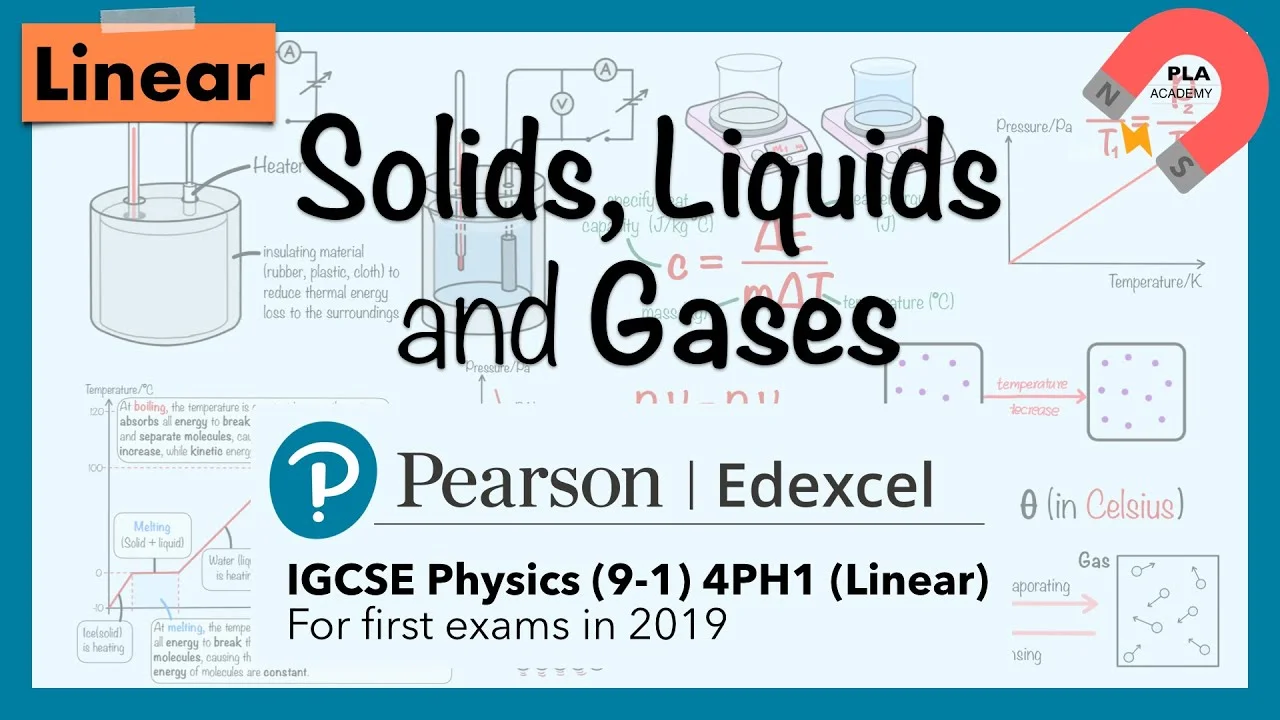
This video provides a comprehensive revision of Unit 5 on solids, liquids, and gases for the Edexcel IGCSE Physics (9-1) syllabus. It covers the fundamental concepts of density, pressure, and the different states of matter, including their properties and transitions.
Density and Its Applications
Density is defined as mass per unit volume (ρ = m/V). It's a characteristic property of materials and helps determine if an object will float or sink in a liquid. The video explains methods to calculate the density of both regular and irregular objects using mass and volume measurements.
Pressure and Its Factors
Pressure is defined as force per unit area (P = F/A). It is influenced by both the magnitude of the force and the area over which it is applied. The video explores applications of pressure in everyday life, such as sharp edges creating high pressure and wide bases reducing pressure. Pressure in liquids increases with depth and is calculated using P = ρgh.
States of Matter and Internal Energy
Matter exists as solid, liquid, or gas, each with distinct particle arrangements and intermolecular forces. Internal energy is the sum of kinetic and potential energies of molecules. Temperature affects kinetic energy, while the space between molecules influences potential energy. Changes of state (melting, boiling, freezing, condensation, sublimation, deposition) involve energy absorption or release, altering potential energy while kinetic energy (and thus temperature) remains constant during the transition.
Heating, Cooling, and Specific Heat Capacity
Heating increases internal energy by increasing kinetic energy, while cooling decreases it. Specific heat capacity (C) quantifies the energy needed to raise the temperature of a unit mass by 1°C (ΔE = mcΔT). Experiments are outlined to measure the specific heat capacity of solids and liquids, noting potential sources of error like heat loss.
Gas Laws and Molecular Behavior
The pressure of a gas is caused by molecular collisions. Absolute temperature (Kelvin scale) is directly proportional to the average kinetic energy of gas molecules. Boyle's Law states that for a fixed mass and temperature, pressure is inversely proportional to volume (P₁V₁ = P₂V₂). The Pressure Law states that for a fixed volume and mass, pressure is directly proportional to absolute temperature (P ∝ T).
Key Takeaways
Conclusion
This revision covers essential concepts of density, pressure, states of matter, energy transfer, and gas laws, providing a solid foundation for understanding the physical properties of matter.
Ask AI about this video