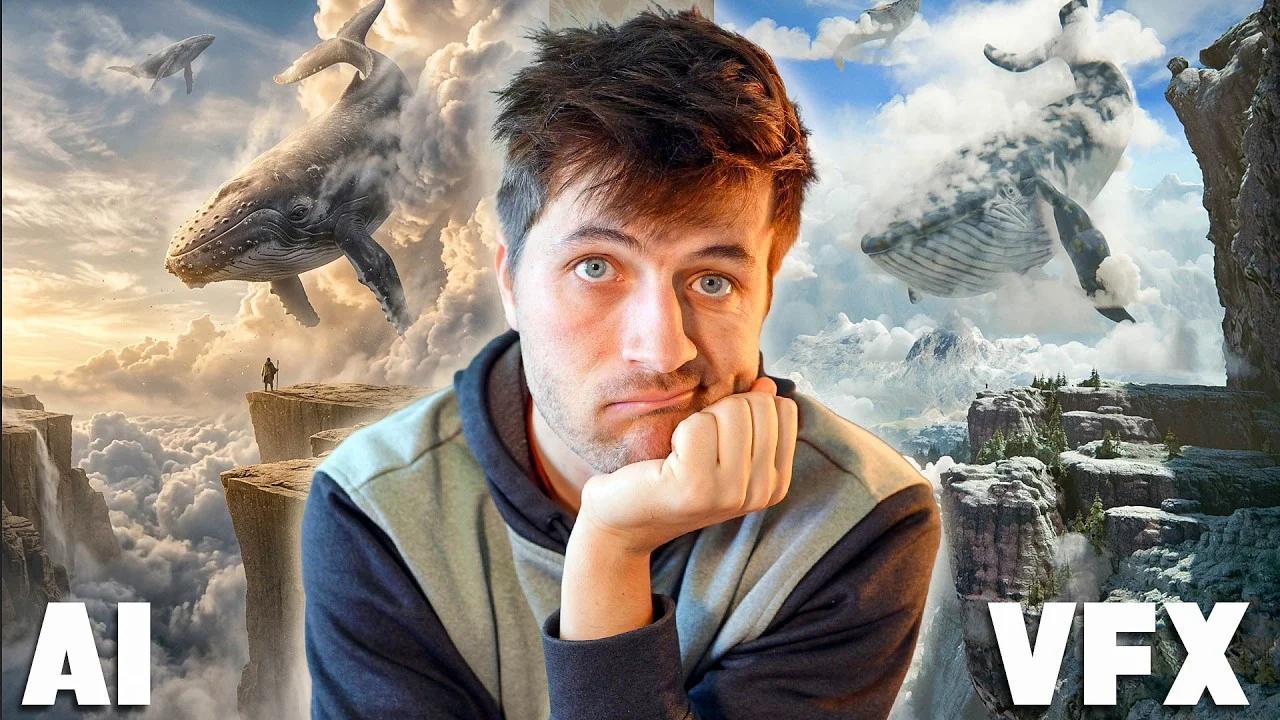
A professional 3D artist confronts the rise of AI image generation by staging a head-to-head competition, creating a fantasy scene from his own sketch while feeding the same drawing to AI tools like Gemini and ChatGPT to compare the results.
The Human Creative Process ⏱ 0:00
•The artist believes AI references existing work to create something similar, but humans also draw inspiration from other humans and their art.•He argues there is a tiny bit of uniqueness in every human that expands creativeness, citing innovative films like "Everything Everywhere All at Once" and the art style of "Into the Spider-Verse" as examples AI could not have originated first.•The competition begins with a hand-drawn sketch on an iPad, used as direct concept art for a 3D scene, created despite the artist describing himself as "an elephant on skates when it comes to drawing."Building the 3D Environment in Blender ⏱ 4:05
•The scene concept features a fantastical nature environment with giant sea creatures normally found underwater placed in the sky, specifically a giant whale inspired partly by watching One Piece.•Distant mountains were generated using Blender's ant landscape add-on, while canyon meshes near the camera came from drone photogrammetry sourced from Sketchfab.•Pine trees were distributed realistically using a simple geometry node setup that allowed painting with curves and brush strokes, using resample and instances on points nodes with randomized scale (0.3 to 1) and rotation on the Z axis.Modeling, Texturing, and Volumetric Effects ⏱ 7:39
•The whale was modeled from scratch using low-poly base mesh techniques, then detailed in sculpting mode with rolls of fat, creases, warts, and wrinkles to make it look like an older creature.•Whale texturing was done entirely by hand painting in layers, starting with a lighter underside and darker top, using brushes with cloud noise textures for added interest.•Mountain texturing used a projected image texture instead of complex procedural materials, while clouds were created by placing imported VDB files and using a large smoke simulation domain for the main whale.•Cloud materials used a specific trick learned from a fellow Blender YouTuber: two volume scatter nodes with negative and positive anisotropy, a light path node taking ray depth mapped to a maximum of 16, and render volume bounces also set to 16 to eliminate unwanted ambient occlusion.Comparing AI-Generated Results ⏱ 15:13
•The original sketch was fed to ChatGPT and Gemini as a prompt to generate a realistic image, using only free and publicly available services to match Blender's free and open model.•Gemini's result kept the canyon feel from the sketch better but lacked the same sense of scale, making the whale look like an oversized smaller fish attached to the canyon.•ChatGPT produced some interesting simplicity but had clouds the artist did not love.•Side-by-side comparison showed the artist preferred his own result's sense of scale, noting AI images could be refined with more prompts just as the 3D scene was refined iteratively.Key Takeaways
•AI can create scenes in seconds that take a human artist weeks, but it can only remix what already exists.•The artist hand-drew a concept sketch and built the entire 3D scene himself, learning new skills in the process, unlike prompting AI which "does really nothing for yourself."•A cloud shading trick using light path node with ray depth limited to 16 bounces eliminates ambient occlusion for more realistic cloud volumes.•When fed the same sketch, AI-generated images lacked the accurate sense of scale the human-made 3D scene achieved.•The value of art may lie not in the final image alone but in the human story and creative journey behind it.Conclusion
The competition showed that while AI can produce impressive results quickly, the human artist retained full control, creative intent, and the personal growth that comes from the artistic process, leaving the question of whether viewers care more about the story behind art than the art itself.