This video explains how to decode medical terms by breaking them into prefixes, root words, and suffixes, most of which originate from Latin and Greek.
Word Parts Structure ⏱ 0:33
•Prefix + Root Word + Suffix•Root word indicates the basic meaning, usually the involved body part•Prefix always comes at the beginning of a word•Suffix usually indicates a procedure, condition, disorder, or disease; all medical words have a suffix•Combining vowel (usually O) links root to suffix or another root; omitted if suffix starts with a vowelCommon Root Words and Examples ⏱ 2:17
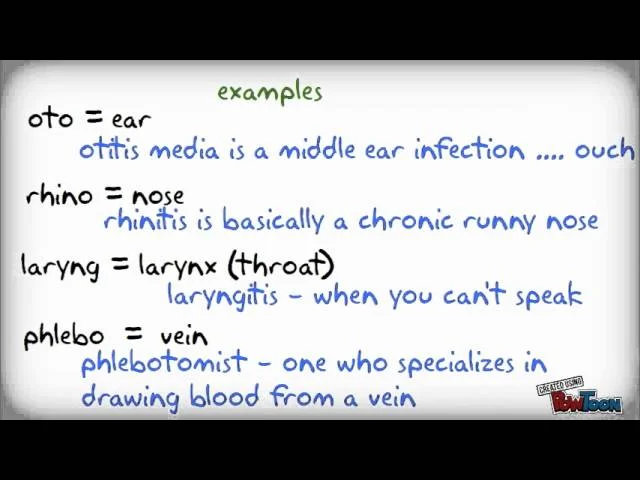
•cardi = heart: cardiac arrest is a heart attack•tend/tendo = tendon: tendonitis is inflammation of the tendon•colo = colon: colonoscopy is a procedure viewing the colon•arthr = joint: arthritis is inflammation of a joint•nat = birth: prenatal means before birth•radi = radiation: radiology studies x-rays•entero = intestines: enteritis is inflammation of intestines resulting in diarrhea•gastro = stomach: gastritis is inflammation of the stomach•derm/dermato = skin: dermatologist is a specialist in diagnoses of the skin•oto = ear: otitis media is a middle ear infection•rhino = nose: rhinitis is a chronic runny nose•laryng = larynx: laryngitis when you can't speak•phlebo = vein: phlebotomist draws blood from a vein•Combining oto + rhino + laryng + ologist gives otorhinolaryngologist (ENT)Prefixes and Suffixes ⏱ 5:12
•Prefixes: pre (before), inter (between), tachy (rapid), brady (slow), post (after/behind), anti (against)•Examples: prenatal (before birth), tachycardia (rapid heart beat), bradycardia (slow heart beat), postnatal (after birth)•Suffixes: ology (study of), itis (inflammation), ectomy (surgical removal), ologist (one who studies), oma (tumor/mass), rrhea (excess flow/discharge), rrhage (bursting forth)•Examples: hematology (study of blood disorders), dermatitis (inflammation of skin), appendectomy (removal of appendix), cardiologist (heart specialist), hematoma (mass of blood), diarrhea, hemorrhage (lots of blood flowing freely)Key Takeaways
•Medical terms are built from prefixes, root words, and suffixes of Latin and Greek origin.•Root words usually indicate the body part involved; all medical terms have a root and a suffix.•Prefixes like tachy- (fast) and brady- (slow) modify meaning; suffixes like -itis (inflammation) and -ectomy (removal) indicate conditions or procedures.•Examples include tachycardia (rapid heartbeat), bradycardia (slow heartbeat), and appendectomy (removal of appendix).Conclusion
Understanding word parts makes deciphering medical terminology easier. A short quiz will follow by Thursday.