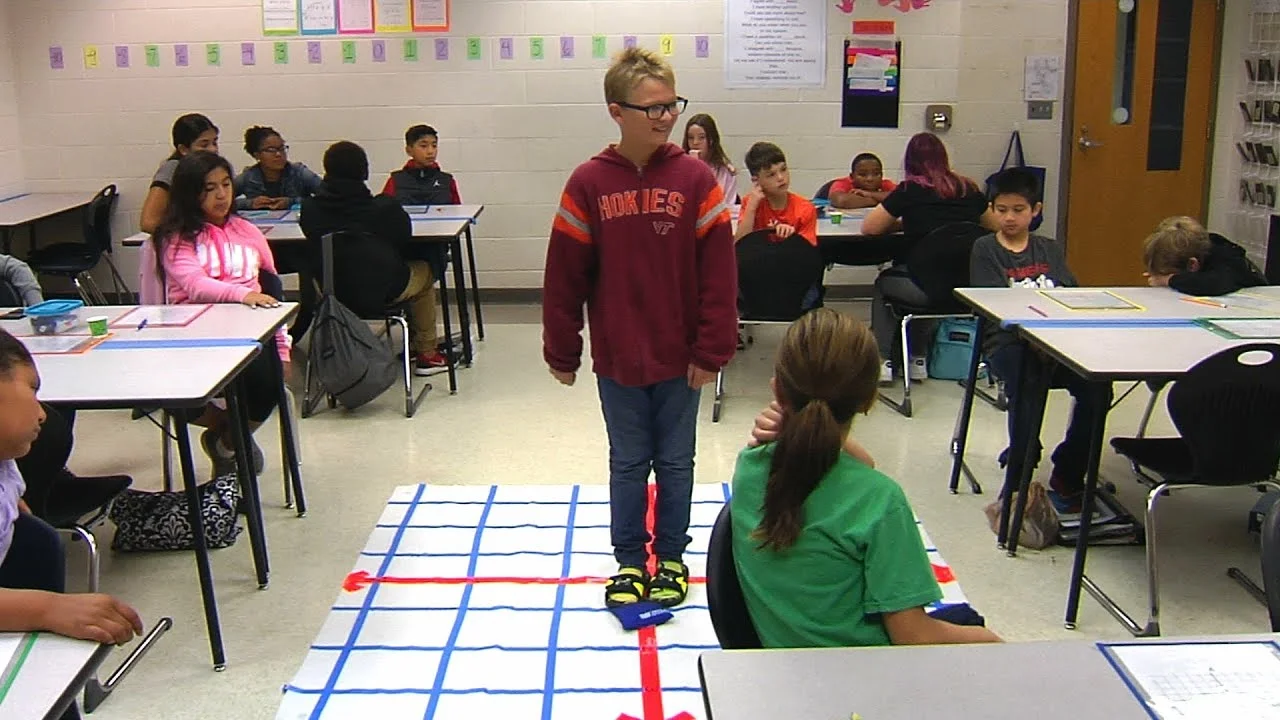
A sixth-grade collaborative math class at Elko Middle School engages students in an interactive lesson on coordinate planes, using physical activities and partner work to explore quadrants, ordered pairs, and graphing principles.
Understanding the Coordinate Plane Basics
•The coordinate plane consists of an x-axis (horizontal) and y-axis (vertical) that intersect at the origin (0,0).•It is divided into four quadrants, labeled counterclockwise: Quadrant I (positive, positive), Quadrant II (negative, positive), Quadrant III (negative, negative), and Quadrant IV (positive, negative).•Students compare it to familiar concepts like battleship games and graphs, noting it extends beyond the visible grid with arrows indicating infinite continuation.Interactive Learning with Ordered Pairs
•Students practice plotting points by tossing bean bags onto a large floor coordinate plane and determining their locations using ordered pairs (e.g., (1,0), (2,-2), (-1,1)).•The 'crawl before you walk' mnemonic helps remember to move along the x-axis first, then the y-axis, to find a point's coordinates.•Partner activities involve dropping pom-poms on smaller coordinate planes and recording the quadrant and ordered pair for each point, reinforcing graphing skills through collaboration.Key Takeaways
•Coordinate planes are foundational tools for graphing, with axes meeting at the origin and dividing into four quadrants based on positive and negative values.•Ordered pairs (x,y) specify point locations, following the rule of moving horizontally first on the x-axis, then vertically on the y-axis.•Hands-on activities, such as bean bag tosses and pom-pom drops, make abstract math concepts tangible and engaging for middle school students.Conclusion
This dynamic lesson at Elko Middle School demonstrates how interactive methods can effectively teach coordinate geometry, building a solid foundation for future math skills.