The Golden Gate Bridge's construction involved groundbreaking engineering solutions, from tower assembly to underwater foundations, showcasing human ingenuity in overcoming immense challenges.
Tower Construction and Assembly
•Climbing derricks with plunger mechanisms allowed workers to build steel cell towers layer by layer, climbing 12 meters every 10 minutes.•Rivets were heated and transported pneumatically to connect tower cells, with work done from inside using double-deck scaffolding.•Built-in elevators within the towers provided access for assembly and later inspection, planned from the start.Underwater Foundation and Concreting Techniques
•Divers used explosion tubes to level the seabed with dynamite, followed by cleaning with high-pressure hoses and dredges.•Tremie concreting with special marine cement (PCC) prevented water mixing, allowing concrete to be placed from the bottom up via segmented pipes.•A compressed air chamber enabled workers to drill beneath a concrete slab, sinking fender walls to bedrock for a stable foundation.Cable Installation and Deck Construction
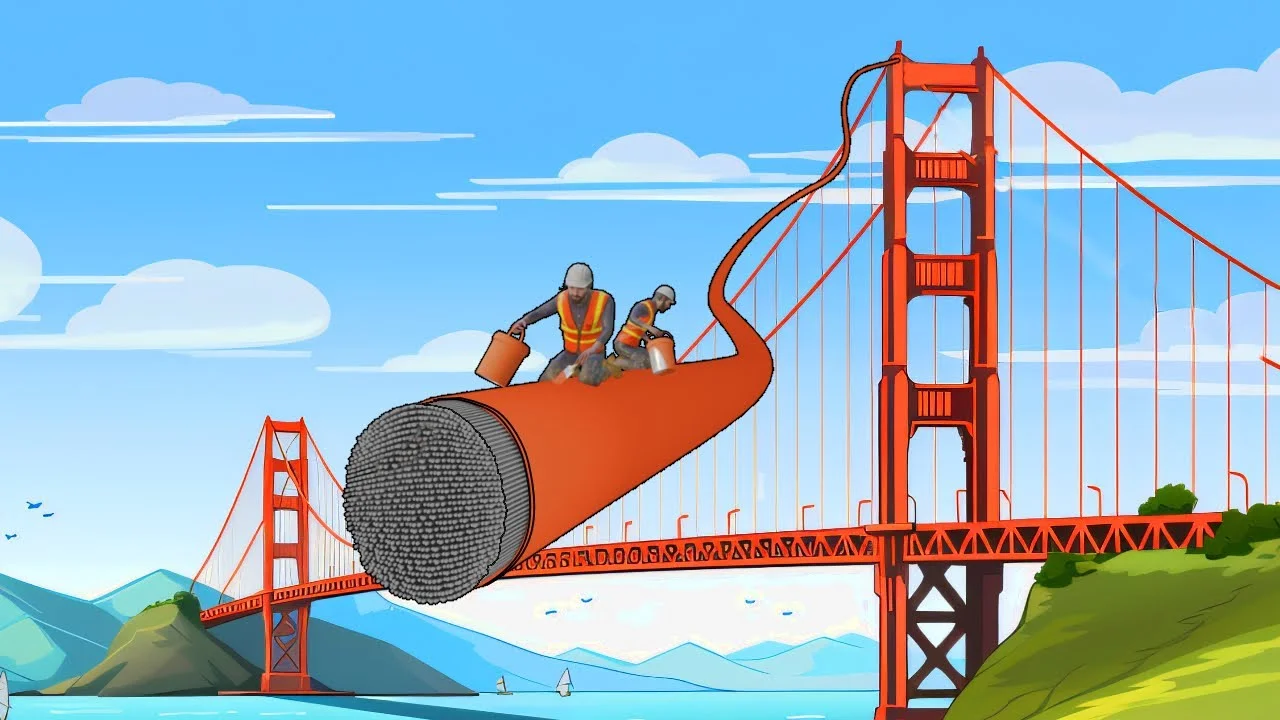
•Main cables, made of 27,000 steel wires, were spun across catwalks using spinning wheels and clamped with hydraulic presses.•The road deck was prefabricated and assembled with derricks and rivets, with safety nets installed underneath.•A special International Orange paint was applied after construction, with concrete roadways laid using formwork, steel bars, and needle vibrators.Key Takeaways
•Innovative climbing derricks and pneumatic riveting enabled efficient tower construction despite extreme heights.•Underwater foundations relied on explosion tubes, tremie concreting, and compressed air chambers to combat ocean currents.•Cable spinning and prefabricated deck assembly ensured structural integrity, with safety measures like nets and specialized materials.Conclusion
The Golden Gate Bridge stands as a testament to creative engineering solutions that tackled formidable natural obstacles.