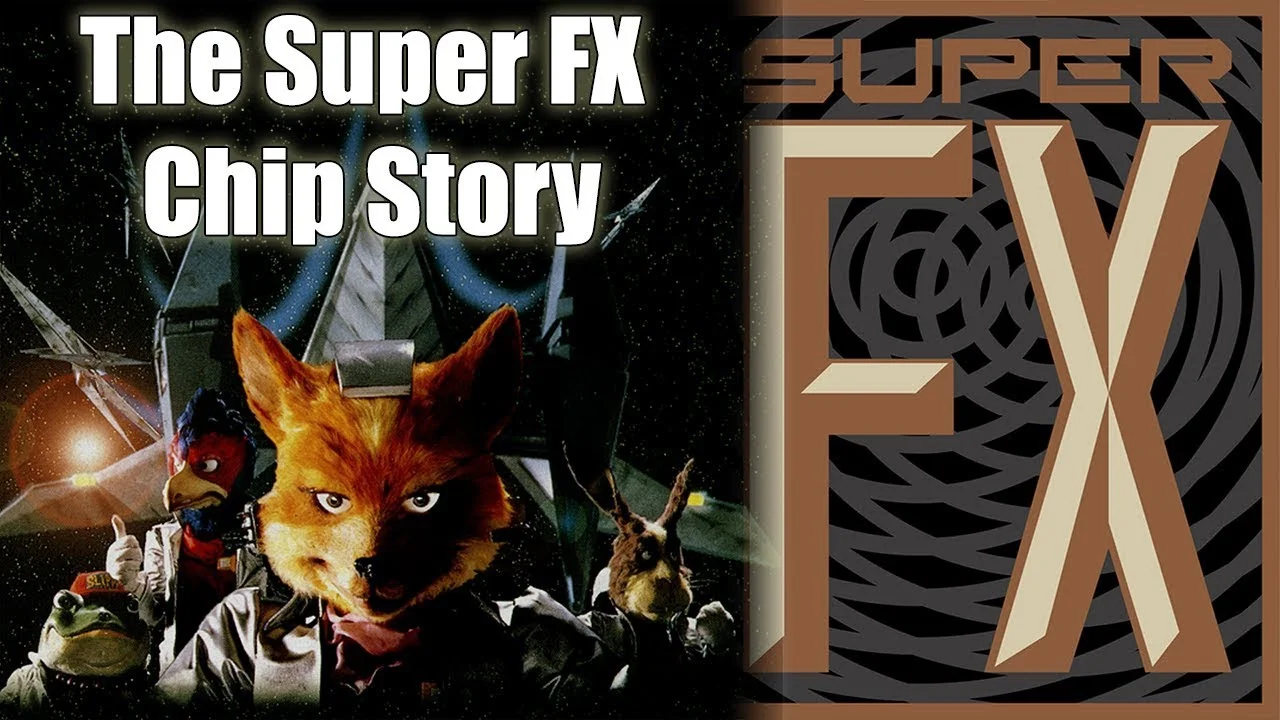
The Super FX chip was a custom processor developed by Argonaut Software that enabled true 3D polygon graphics on the Super Nintendo, debuting with Star Fox in 1993. This article recounts the chip's development, its impact, and the eventual dissolution of the partnership between Argonaut and Nintendo.
Background and the Need for 3D ⏱ 0:00
•The Super Famicom's mode 7 graphics provided faux 3D effects, but couldn't produce true 3D.•Shigeru Miyamoto believed the Super Nintendo would be limited to 2D games.•Star Fox (1993) surprised gamers with true 3D polygon graphics.Argonaut Software and the Super FX Chip's Origins ⏱ 1:00
•Argonaut Software was founded in 1982 by then-teenager Jez San.•Released Star Glider (1986) and Star Glider 2 (1988), both 3D flight simulators.•In 1988, Dylan Cuthbert joined at age 16 and created a 3D wireframe engine for the Game Boy.•Jez San showed the demo to Nintendo at 1989 CES, impressing them and bypassing Game Boy's copyright protection.•Nintendo offered a three-game deal and showed interest in Argonaut's 3D technology.Development of the Super FX Chip ⏱ 3:33
•In July 1990, Dylan and Jez visited Nintendo, where Miyamoto showed them Pilot Wings and expressed disappointment about limited sprite rotation.•They initially ported NES Glider to the Super Nintendo, but results were underwhelming.•Jez proposed designing a 3D chip to increase Super Nintendo's 3D capabilities tenfold.•Although Argonaut had never designed a chip, Nintendo agreed.•The chip was codenamed "Mario" (Mathematical Argonaut Rotation and Input/Output).•The chip clocked at 21.4 MHz (divided internally to 10.7 MHz), with 32 KB RAM and 1 MB ROM.•It achieved nearly 40 times faster 3D performance, and up to 100 times faster in some math computations.•A second version, Super FX GSU (Super FX chip 2), released in 1995, ran at full 21.4 MHz with 64 KB RAM (expandable to 128 KB).•The chip worked by rendering polygons, sprites, and 2D effects to a frame buffer.•It also supported texture mapping, sprite rotation/scaling, and parallax layers.•Cartridges were thicker, making them incompatible with some adapters like Game Genie.•There were discussions about integrating the chip into the US Super Nintendo, but it was decided to keep console costs down by embedding it in cartridges.Star Fox and Aftermath ⏱ 7:08
•Star Fox was the first game to use the Super FX chip, with Argonaut staff relocated to Japan.•Nintendo handled creative aspects (characters, story, gameplay mechanics) while Argonaut did most coding.•Star Fox was a critical and commercial success.•Between 1993 and 1996, eight Super FX titles were released, including Doom and Super Mario World 2: Yoshi's Island (which used sprite scaling/rotation).•Argonaut completed a sequel, Star Fox 2, but Miyamoto cancelled it fearing it would be compared unfavorably to next-generation consoles.•The cancellation was financially detrimental to Argonaut; Nintendo covered development costs but paid no royalties.•The exclusivity clause prevented Argonaut from developing for other platforms without Nintendo's approval (which was refused until near contract end).•Argonaut pitched a 3D platformer prototype using Yoshi, but Nintendo passed; Argonaut later developed it into Croc: Legend of the Gobbos for PlayStation, Saturn, and PC.•Nintendo later released Super Mario 64 and Star Fox 64 (which used ideas from Star Fox 2).Legacy and Dissolution ⏱ 10:44
•Argonaut designed chips for other companies' consoles (e.g., CD-i 2), but none were released.•Argonaut continued making games until 2004, but due to cash flow problems, it went into liquidation in 2005 and dissolved in 2006.•Jez San now owns an online gambling site (pk.com).•Dylan Cuthbert worked at Sony, then founded Q Games in 2001, and co-developed Star Fox Command with Nintendo in 2006.•The Super FX chip had limited third-party adoption due to longer development times and higher production costs.•It influenced Nintendo's views on 3D games and gave many gamers their first taste of 3D graphics.Key Takeaways
•The Super FX chip was developed by Argonaut Software, not Nintendo, and was proposed by 23-year-old Jez San.•Argonaut promised a tenfold increase in 3D performance but delivered nearly 40 times (and up to 100 times in some calculations).•The chip was coded "Mario" and featured 32 KB RAM, 1 MB ROM, and a clock speed of 21.4 MHz (halved internally to 10.7 MHz).•Star Fox (1993) was the first game to use the chip, and it was a critical and commercial success, but only eight Super FX games were released in total.•The cancellation of Star Fox 2 led to the end of the Argonaut-Nintendo partnership, and Argonaut later dissolved in 2006.Conclusion
The Super FX chip was a groundbreaking technology that enabled true 3D graphics on the Super Nintendo, but its limited adoption and the cancellation of Star Fox 2 strained relations between Argonaut and Nintendo. Ultimately, Argonaut dissolved, but the chip's impact on Nintendo's approach to 3D gaming was lasting.