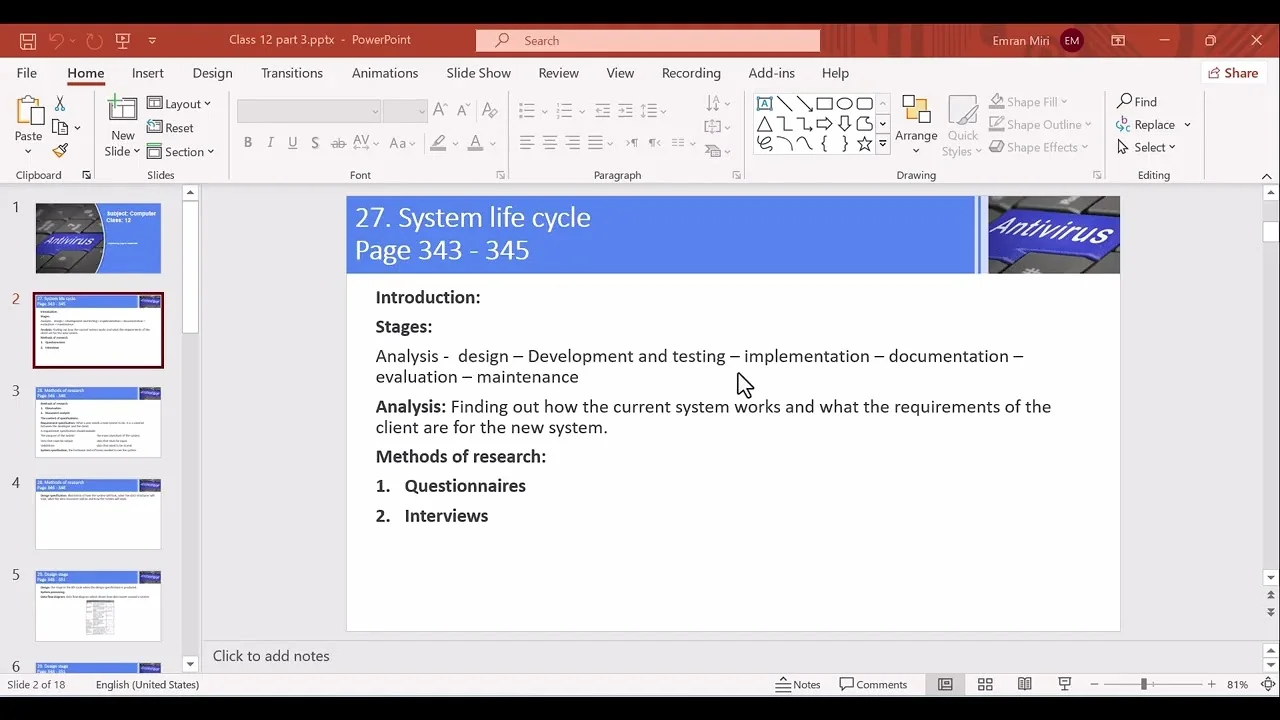
This video introduces the concept of a system life cycle, explaining its stages and the importance of the analysis stage, including research methods like questionnaires and interviews.
What is System Life Cycle? ⏱ 0:00
•System life cycle is a cycle, not a lifetime, because it has a starting point and continues like a circle until the system is complete or successful.•A system can be an IT system like Microsoft Office, Photoshop, or any application.•If another system with better features appears, the previous system will be removed from the world.Stages of System Life Cycle ⏱ 2:41
•The stages are: analysis, design, development and testing, implementation, documentation, evaluation, and maintenance.•It starts from analysis, then design, development and testing, implementation, documentation, evaluation, and maintenance.Analysis Stage and Research Methods ⏱ 3:42
•Analysis: Finding out how the current system works and what the requirements of the client are for the new system.•Example: A school wants a database; the analyzer checks the current system (e.g., Excel, Word, Access) and gathers requirements from departments like admission, financial, curriculum, principal, teachers, and students.•If analysis fails, the whole system fails.•Research methods: - Questionnaire: Analyzer gives a sheet with questions; advantage: collects a lot of information from many clients/staff without interrupting work; disadvantage: no space for detailed answers.
- Interview: Face-to-face between two people; advantage: can share more opinions and find more details; disadvantage: interrupts work, takes lots of time, and not all clients can be interviewed.
Key Takeaways
•System life cycle is a cycle with a starting point that continues until the system is successful, then may be replaced by a better system.•The stages are: analysis, design, development and testing, implementation, documentation, evaluation, and maintenance.•Analysis is the most important stage; if it fails, all other stages will fail.•Research methods for analysis include questionnaires (with advantages like gathering bulk information and disadvantages like limited space) and interviews (with advantages like face-to-face detail and disadvantages like time consumption).Conclusion
The lesson covered the definition and stages of the system life cycle, emphasizing the critical role of the analysis stage and briefly introducing two research methods: questionnaire and interview.