

In Japanese, verb conjugation forms the foundation for expressing complex thoughts, polite requests, continuous actions, and social offers. This guide covers the essential vocabulary of Minna no Nihongo Lesson 14, explains how to categorize Japanese verbs into three distinct groups, details the rules for conjugating between masu-form, dictionary-form, and te-form, and breaks down key sentence patterns including ~てください (please do), ~ています (continuous action), and ~ましょうか (shall I/we do).
Lesson 14 Essential Vocabulary▶ 0:10
Mastering these foundational verbs, nouns, and expressions is necessary for practicing the conjugation patterns and grammar structures in this lesson.
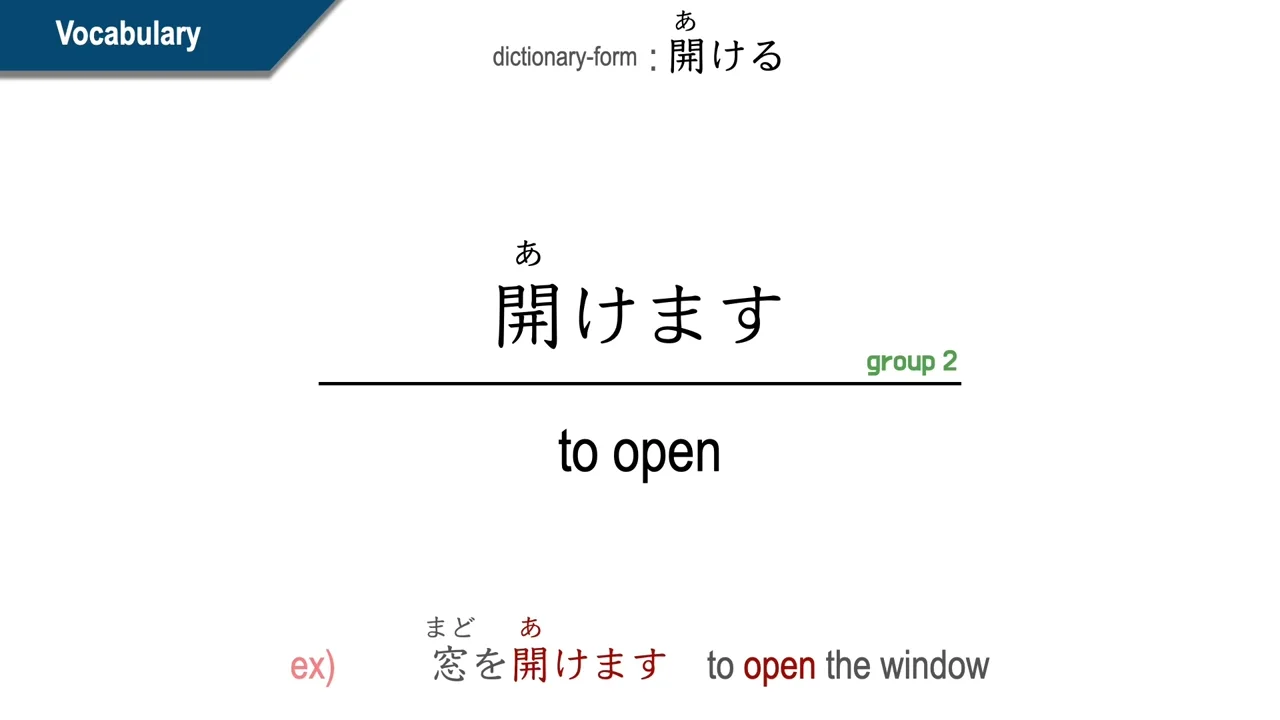
Verbs and Actions▶ 0:20
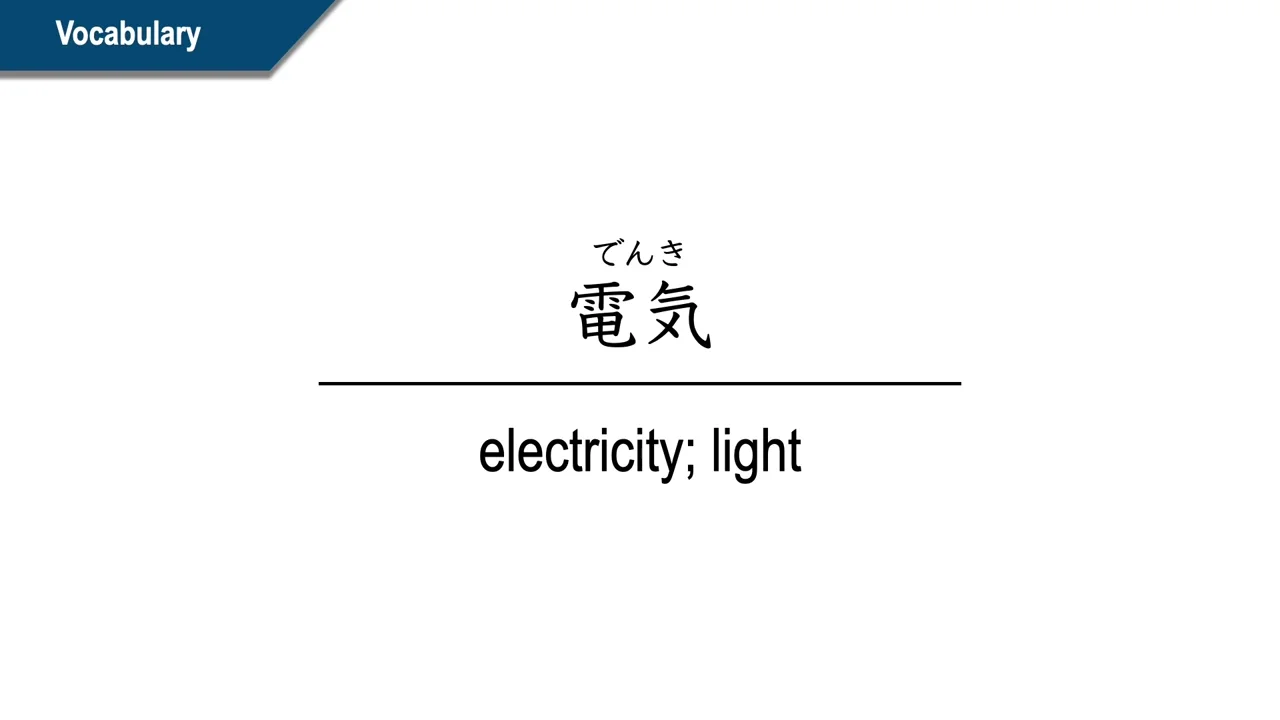
Nouns and Descriptive Words▶ 4:50
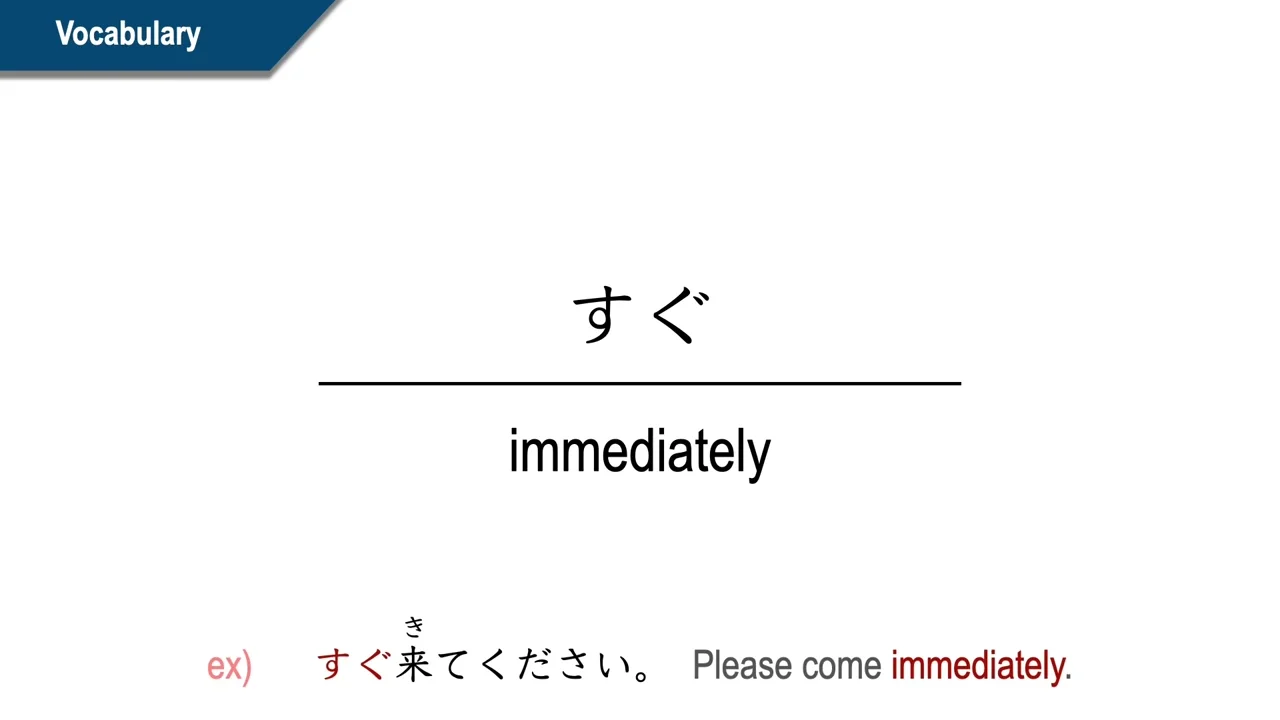
Adverbs, Phrases, and Patterns▶ 6:50
Categorizing Japanese Verbs into Three Groups▶ 9:40
All Japanese verbs belong to one of three groups. Conjugation rules depend entirely on which group a verb belongs to.
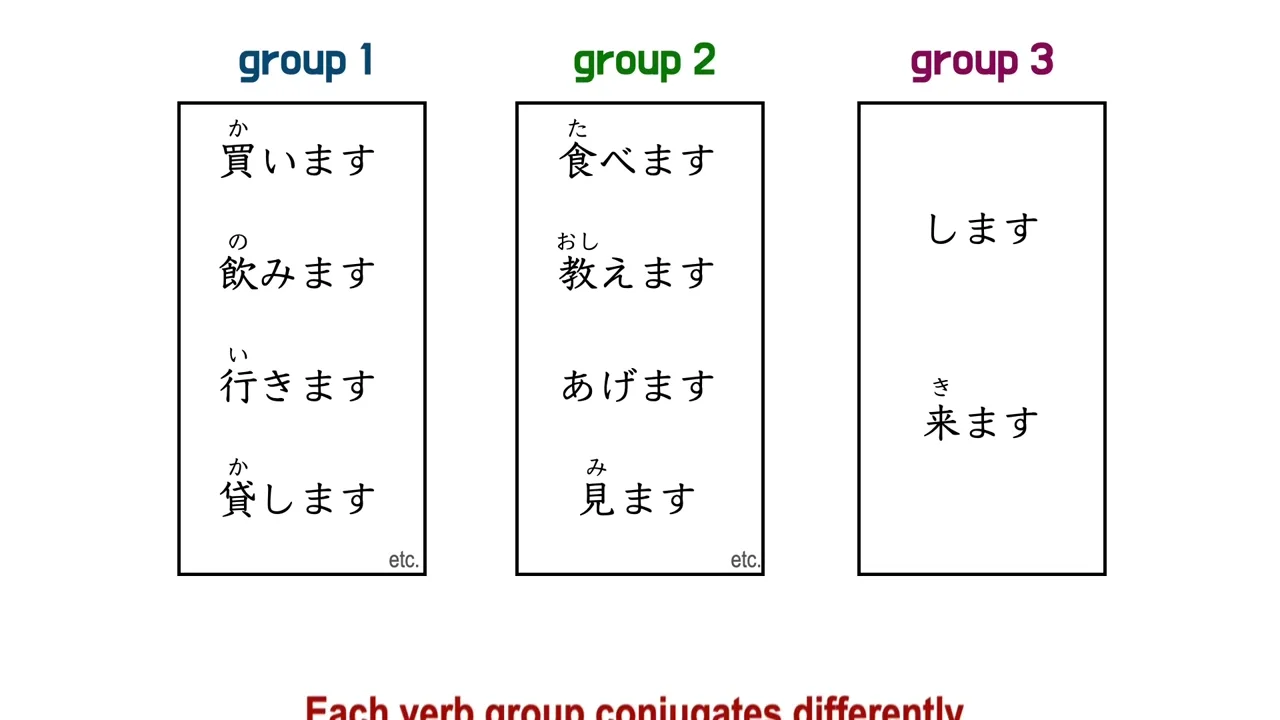
Identifying Verb Groups from Masu-Form▶ 12:15
To determine the group of any verb ending in ます (masu), use this three-step process:
1. Check for Group 3: If the verb is します (shimasu), きます (kimasu), or a compound noun + します, it is Group 3. Note that verbs like はなします (hanashimasu, to speak) are not Group 3 because hanashi is part of the root verb, not a separate noun attached to the verb "to do."
2. Check for -e sound: If the syllable before ます ends in an -e vowel sound (e.g., たべます tabemasu, おしえます oshiemasu), it is Group 2.
3. Check for -i sound: If the syllable before ます ends in an -i vowel sound (e.g., かいます kaimasu, のみます nomimasu), it is Group 1, with a few specific exceptions that belong to Group 2.
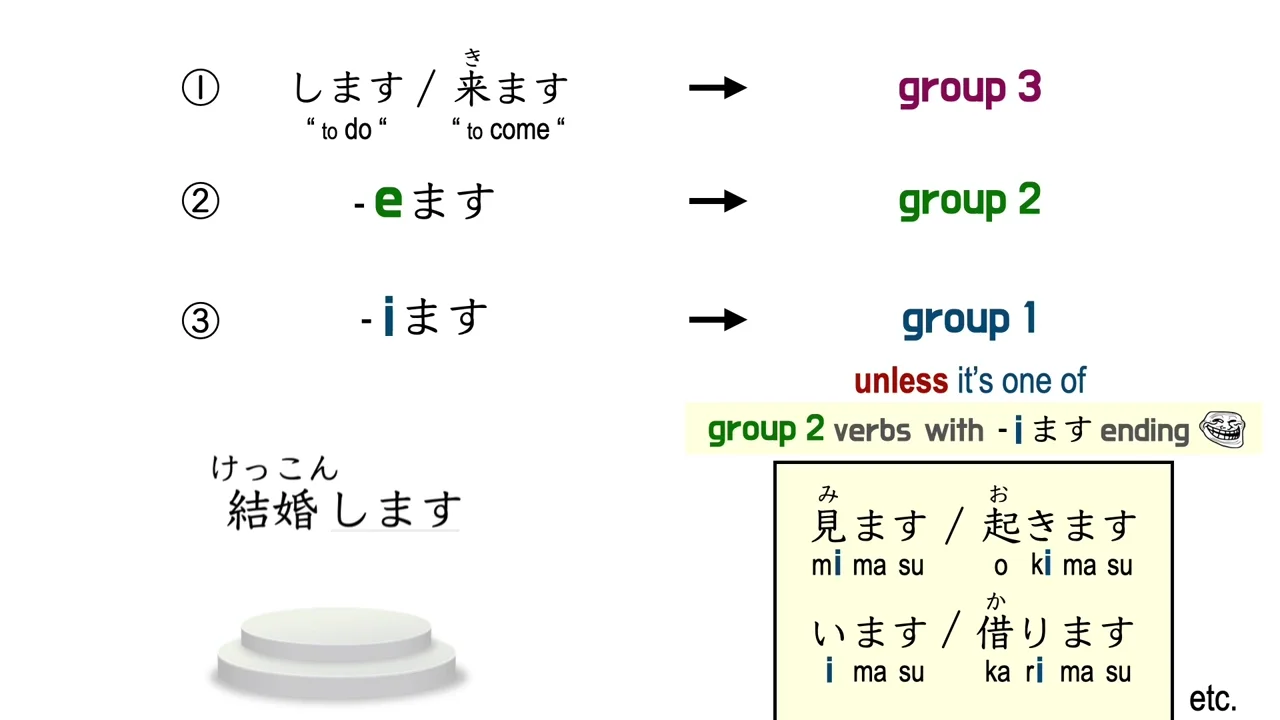
The primary Group 2 exceptions ending in -i ます include:
Conjugating Masu-Form to Te-Form▶ 14:40
The te-form (て形) is used for linking sentences, making requests, expressing continuous actions, and asking for permission.
Group 2 and Group 3 Verbs▶ 15:00
For Group 2 and Group 3 verbs, replace ます with て:
Group 1 Verbs▶ 15:45
Group 1 verbs follow specific phonetic changes based on the syllable directly preceding ます:
| Ending Sound before ます | Replacement | Masu-Form Example | Te-Form Example |
|---|---|---|---|
| :--- | :--- | :--- | :--- |
| ~い / ~ち / ~り (-i / -chi / -ri) | ~って (-tte) | かいます / まちます / かえります | かって / まって / かえって |
| ~み / ~び / ~に (-mi / -bi / -ni) | ~んで (-nde) | のみます / よびます / しにます | のんで / よんで / しんで |
| ~き (-ki) | ~いて (-ite) | かきます | かいて |
| ~ぎ (-gi) | ~いで (-ide) | いそぎます | いそいで |
| ~し (-shi) | ~して (-shite) | かします / はなします | かして / はなして |
Special Exception: The verb いきます (ikimasu, to go) ends in き, but conjugates irregularly to いって (itte), not iite.
Masu-Form and Dictionary-Form Conversions▶ 17:40
The dictionary-form (辞書形, jishokei) is the plain, uninflected form of a verb found in dictionaries and casual speech.
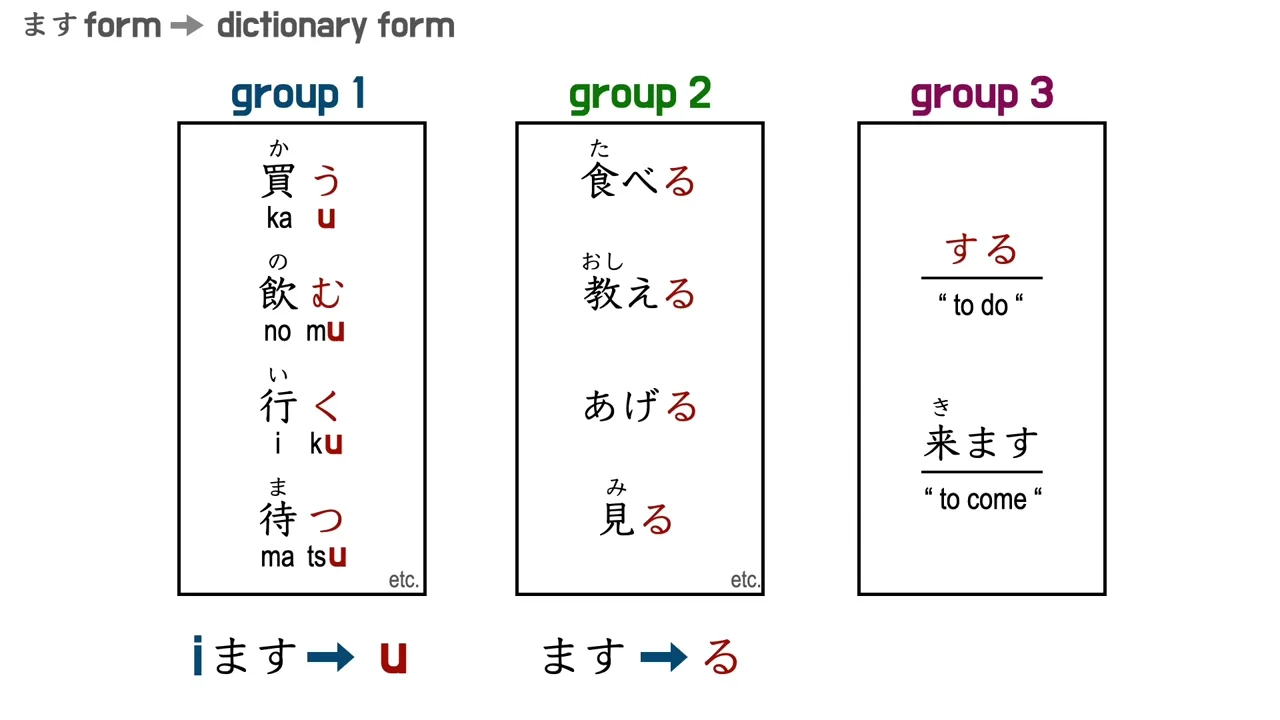
Masu-Form to Dictionary-Form▶ 18:00
かいます (ka-i-masu) → かう (kau*)
のみます (no-mi-masu) → のむ (nomu*)
いきます (i-ki-masu) → いく (iku*)
まちます (ma-chi-masu) → まつ (matsu*)
たべます (tabemasu) → たべる (taberu*)
みます (mimasu) → みる (miru*)
します (shimasu) → する (suru*)
きます (kimasu) → くる (kuru*)
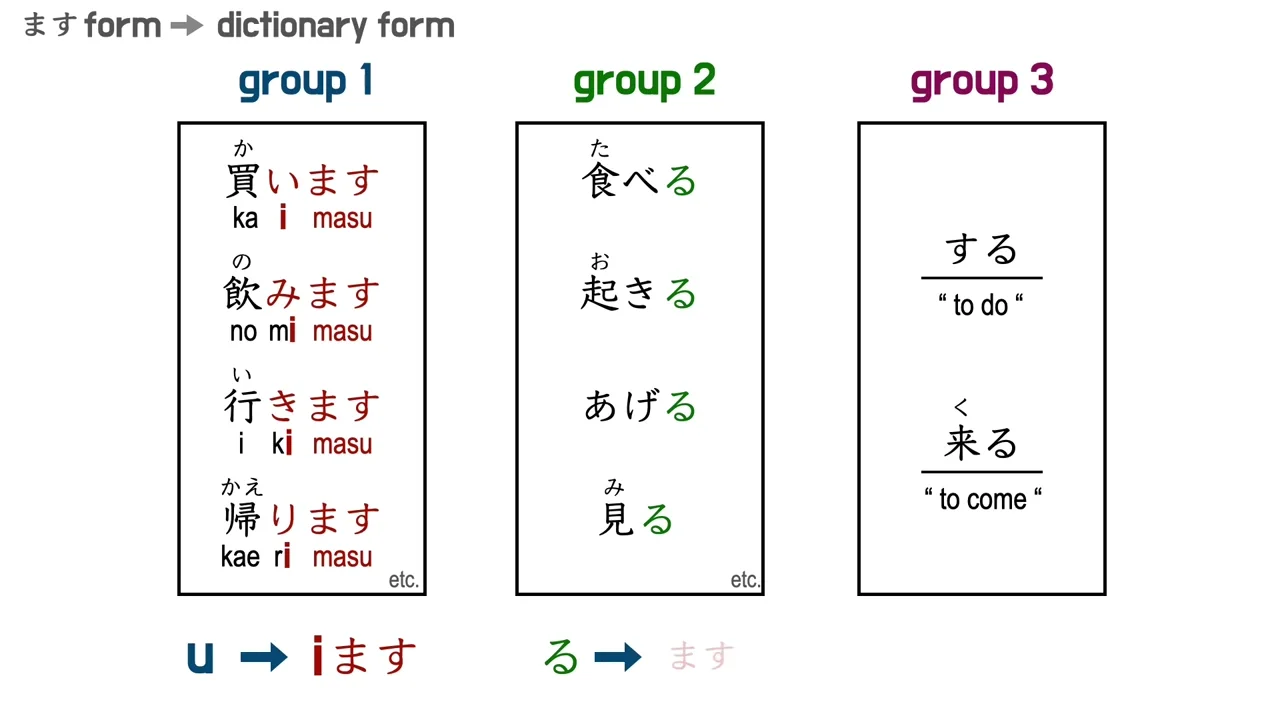
Dictionary-Form to Masu-Form▶ 23:40
かう (kau) → かいます (kaimasu*)
のむ (nomu) → のみます (nomimasu*)
かえる (kaeru) → かえります (kaerimasu*)
たべる (taberu) → たべます (tabemasu*)
おきる (okiru) → おきます (okimasu*)
する (suru) → します (shimasu*)
くる (kuru) → きます (kimasu*)
Conjugating Dictionary-Form to Te-Form▶ 19:15
For learners identifying verbs directly from their dictionary forms, the identification and conjugation rules are structured as follows:
Identifying Verb Groups from Dictionary-Form▶ 19:40
1. Group 3: The verbs する (suru), くる (kuru), and noun + する combinations.
2. Group 2: Verbs ending in either -える (-eru) or -いる (-iru), such as たべる (taberu) and みる (miru).
3. Group 1: All verbs ending in -u, -tsu, -mu, -bu, -nu, -ku, -gu, -su, or -ru preceded by a, u, or o.
Exceptions that end in -eru or -iru but belong to Group 1 include:
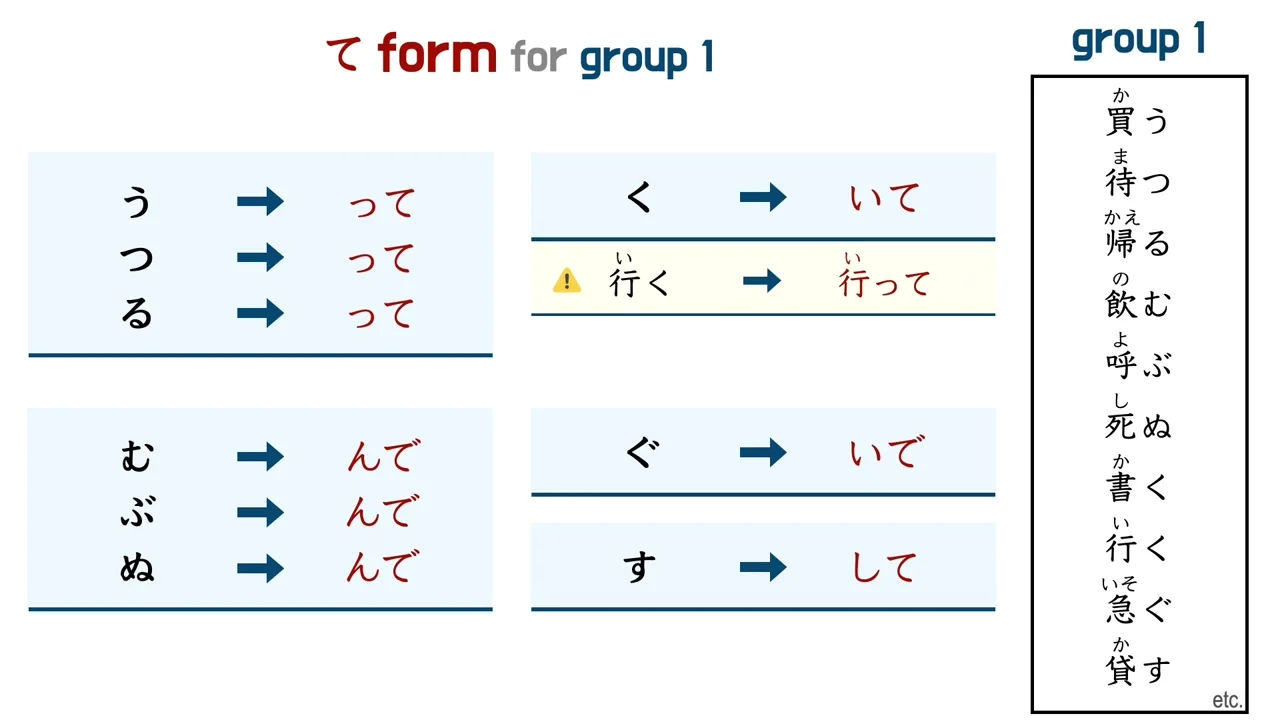
Dictionary-Form to Te-Form Rules▶ 21:20
う, つ, る → って (e.g., かう → かって; まつ → まって; かえる → かえって*)
む, ぶ, ぬ → んで (e.g., のむ → のんで; よぶ → よんで; しぬ → しんで*)
く → いて (e.g., かく → かいて; Exception: いく → いって*)
ぐ → いで (e.g., いそぐ → いそいで*)
す → して (e.g., かす → かして*)
Making Polite Requests: Verb [Te-Form] + ください▶ 25:20
To politely ask someone to perform an action, attach ください (kudasai) to the te-form of the verb. In casual speech among close peers, ください is omitted, leaving only the te-form.
Core Examples▶ 25:40
Polite Softening with すみませんが▶ 26:40
When requesting assistance from strangers or in formal situations, preface the request with すみません (sumimasen) or すみませんが (sumimasen ga, excuse me / I am sorry, but...):
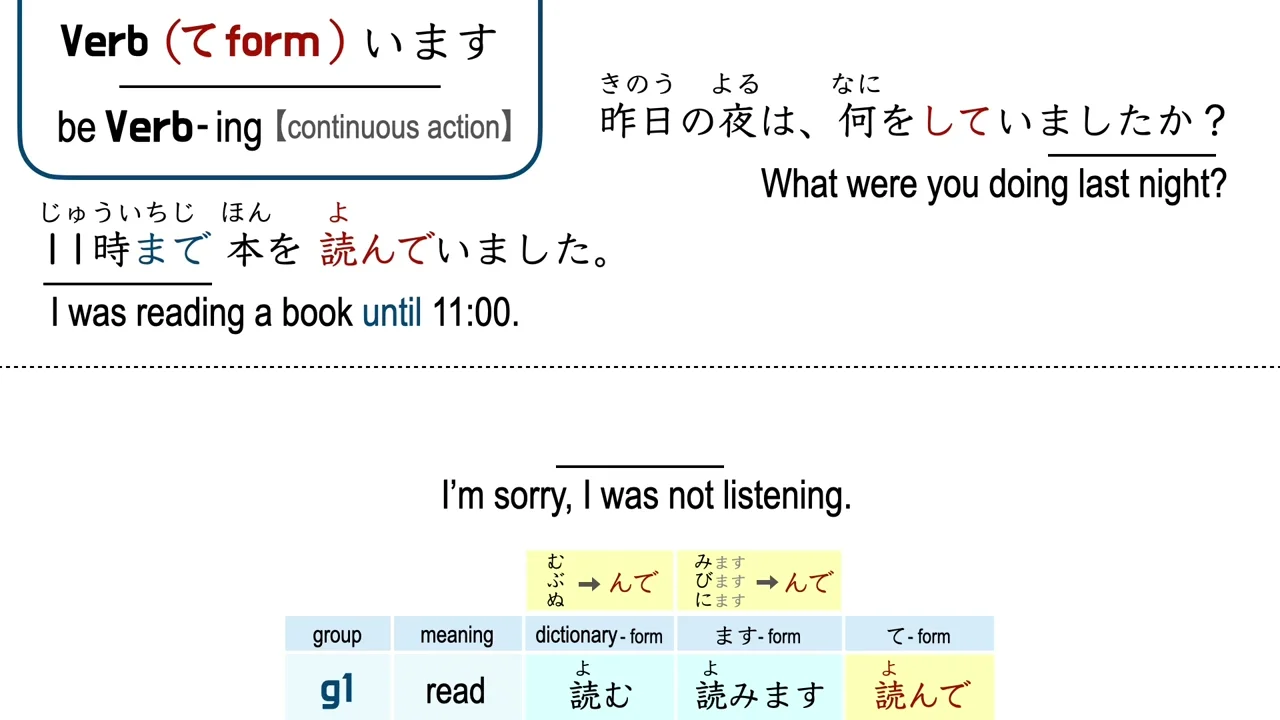
Expressing Continuous Actions: Verb [Te-Form] + います▶ 27:10
The pattern Verb [Te-form] + います (imasu) indicates an action currently ongoing at the present moment (equivalent to the English present continuous "be [verb]-ing").
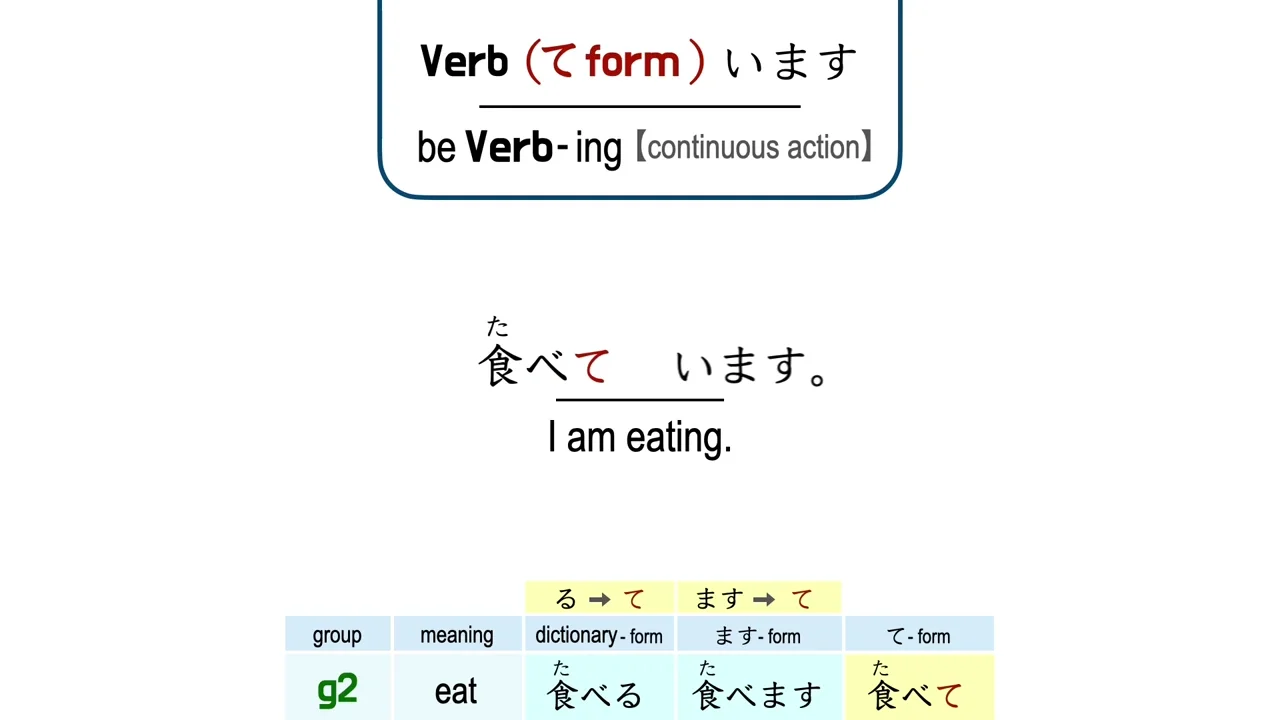
In casual conversation and informal writing, the い (i) sound in います is often dropped (e.g., たべてます tabetemasu instead of たべています tabete imasu).
Tense and Polarity Conjugation▶ 28:40
This construction inflects like any standard ます verb:
Practical Examples▶ 29:10
Offering Assistance: Verb [Masu-Stem] + ましょうか▶ 30:45
The pattern ~ましょうか (mashou ka) translates to "Shall I do [action]?" when offering help to someone, or "Shall we do [action]?" when proposing a joint activity depending on context.
To conjugate, remove ます from the polite verb form and attach ましょうか:
Dialogue Examples and Responses▶ 31:10
Accepting: はい、おねがいします。 (Hai, onegai shimasu.* – Yes, please.)
Declining: いいえ、けっこうです。 (Iie, kekkou desu.* – No, thank you / It is fine.)
Response: はい、おねがいします。10じにきてください。 (Hai, onegai shimasu. Juu-ji ni kite kudasai.* – Yes, please. Please come at 10:00 AM.)
Response: はい、そうしましょう。 (Hai, sou shimashou.* – Yes, let's do that.)
Offer: ちずをかきましょうか。 (Chizu o kakimashou ka.* – Shall I draw a map for you?)
Response: はい、おねがいします。 (Hai, onegai shimasu.* – Yes, please.)
Summary of Key Concepts▶ 32:00
1. Verb Group Identification:
Group 3: します (shimasu), きます (kimasu), and compound noun + します* verbs.
Group 2: Verbs with an -e vowel sound before ます, plus exceptions like みます, おきます, います, and かります*.
Group 1: Verbs with an -i vowel sound before ます*.
2. Te-Form Rules:
Group 2 & 3: Drop ます and add て (して / きて*).
Group 1: い/ち/り → って; み/び/に → んで; き → いて (Exception: いきます → いって); ぎ → いで; し → して*.
3. Key Sentence Patterns:
[Te-form] + ください:* Polite requests ("Please do...").
[Te-form] + います:* Continuous ongoing actions ("Currently doing...").
[Masu-stem] + ましょうか:* Offering help or joint action ("Shall I / Shall we...?").
AI Perspective
The summary focuses on Japanese grammar instruction, so most claims are pedagogical rather than factual. I evaluated the linguistic rules and examples as presented.
| Claim | Verdict | Comment |
|---|---|---|
| All Japanese verbs belong to one of three groups | ✅ Confirmed | Standard linguistic classification: godan, ichidan, and irregular verbs. |
| Group 3 contains only します and きます as core irregular verbs | ✅ Confirmed | Standard textbook teaching; suru and kuru are the only fully irregular verbs. |
| Compound suru-verbs (noun + します) are Group 3 | ✅ Confirmed | Benkyou shimasu, kekkon shimasu, etc. follow suru conjugation. |
| はなします is not Group 3 because hanashi is not a separate noun | ✅ Confirmed | Hanasu is a single Group 1 verb root meaning “to speak.” |
| みます, おきます, います, かります are Group 2 exceptions ending in -i masu | ✅ Confirmed | These are standard ichidan verbs despite -i before masu. |
| Te-form of いきます is いって, not いいて | ✅ Confirmed | iku is the one godan -ku verb with irregular te-form. |
| Dictionary form of Group 1 verbs ends in -u and matches -i masu pattern | ✅ Confirmed | kaimasu → kau, nomimasu → nomu, machimasu → matsu are correct. |
| Dictionary form of Group 2 verbs replaces ます with る | ✅ Confirmed | tabemasu → taberu, mimasu → miru follow ichidan pattern. |
| する and くる become します and きます in polite form | ✅ Confirmed | Standard irregular verb conjugation. |
| Some -eru/-iru dictionary verbs are Group 1 exceptions | ✅ Confirmed | kaeru, shiru, hairu, kiru (to cut) are well-known godan exceptions. |
| Te-form + います expresses ongoing action (present continuous) | ✅ Confirmed | Standard Japanese grammar for progressive aspect. |
| The い in ています is often dropped in casual speech | ✅ Confirmed | Common colloquial contraction: tabetemasu, mitemasu, etc. |
| Te-form + ください makes a polite request | ✅ Confirmed | Standard imperative-softening construction. |
| Masu-stem + ましょうか offers help or proposes joint action | ✅ Confirmed | shimashou ka / ikimashou ka correctly convey “shall I/we.” |
| すみませんが softens requests to strangers or in formal settings | ✅ Confirmed | Common politeness strategy in Japanese conversation. |
इस वीडियो के बारे में पूछें