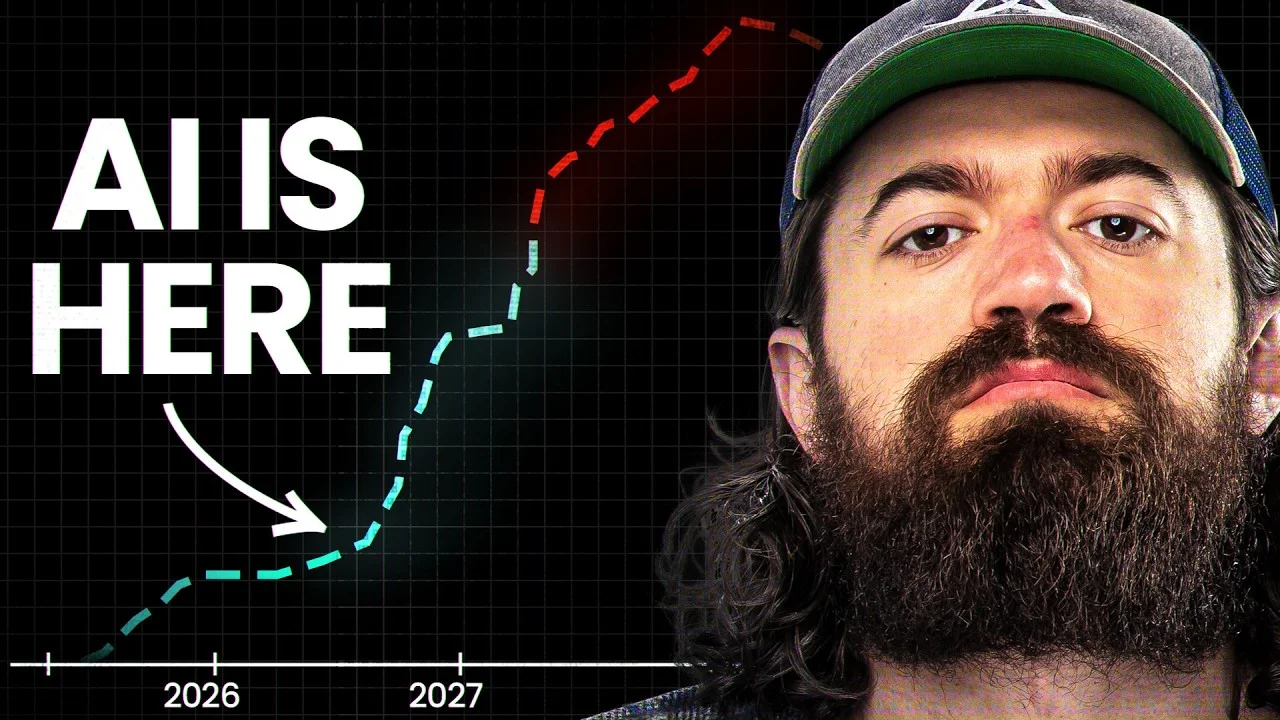
The speaker argues that AI is the biggest shift coming to Main Street and that learning to use it should be your top priority. He provides tactical advice for individuals and businesses to adapt and thrive in an AI-driven world.
The Urgency of Adapting to AI ⏱ 0:00
•AI will never be worse than it is right now; assuming any rate of improvement, learning AI should be your top priority.•The 'Open Claw moment' happened over President's Day weekend and was acquired for a billion dollars by OpenAI.•There's never been a better time to start an AI-first business to disrupt existing markets because competitors are busy running their businesses rather than learning AI.•Companies started with an AI-first approach from day one can achieve revenue per employee in the millions per year.•Jerome Powell stated there was zero net job creation in the private sector, indicating automation is taking jobs.•In game theory, the most flexible system survives; it's not the strongest or smartest, but the most adaptable.•People often risk more by not adopting new technology than by fearing potential downsides experienced by a small percentage.•Complacency and short-term thinking prevent adoption; it takes about 20 hours to become proficient in any new skill, but people delay the first hour for decades.Shift from Role-Based to Workflow-Based Thinking ⏱ 4:32
•Stop thinking in terms of roles and start thinking in terms of workflows.•For every hire, write down the 4-6 things (or up to 10) that the person actually does, and ask if each activity could live inside a workflow instead of headcount.•Example: instead of hiring an editor, identify the five things an editor does to create a video and turn each into a workflow.•Organizations are designed to organize humans, not inputs and outputs; businesses should operate more like manufacturing, where raw inputs are transformed into more valuable outputs.•Automate tasks one layer below the role: identify the 10 things a person does and automate one task at a time.•If you're not automating your own job, you're missing the boat; take 20% of your time to try to put yourself out of a job, because if you don't adapt, you'll eventually be out of a job.•The future of business is BYOS (bring your own software) or BYOA (bring your own agent); employees can have tremendous earning power by offering entire departments as a service.•Example: Anthropic has one person in their marketing department who uses agents to do the work of many.•Businesses need functions and outputs; erase the titleism that exists in the private market.Training AI Like You Would Train an Employee ⏱ 8:36
•People fail with AI because they don't train it the way they would train a new employee.•When an agent produces poor output, don't give up; remember this is the worst AI will ever be, and you would train a new employee rather than fire them immediately.•Humans learn through reinforcement: do a thing, get an outcome, and adjust; computers are even better at recognizing patterns.•To train AI effectively, remove emotional and intangible words and define exactly what you want to happen; most people don't define what good looks like.•Example: for copywriting, provide 12 rules and 16 writing samples; the output will be about five times as good.•Repeating the feedback loop 100 times with AI takes 100 minutes, whereas with a person it might take a year and a half.•Throughout history, humans plus superior technology beat humans with inferior technology; as long as it's humans plus tools vs. humans with other tools, you're still competing against humans.•The day you try to beat the machine, you will lose.The Future of Work and a Barbell Strategy ⏱ 13:43
•In a world of infinite AI labor, the cost of intelligence and labor go to functionally zero, and the last valuable thing a human will get paid to do is take risk.•Money will still exist, but labor won't have value, making it harder to provide value to a marketplace.•Main Street businesses have already integrated technologies like social media, internet, email, and phone; AI is the next component.•GDP is driven by education (skills) and technology; with infinite labor and intelligence, there will be a big explosion in GDP and more companies than ever before.•Adopt a barbell strategy: on one extreme, go all-in on AI, being willing to have hard conversations with team members who don't level up, because a startup that automates those roles will beat you.•On the other extreme, bet on things that won't change: humans will still have bodies (healthcare, fitness), need consumables (food, supplements), and have leisure time (entertainment will boom).•Entertainment is typically cheap and has grown as a percentage of GDP; you can now make a full motion picture with AI and potentially earn $100 million to $200 million with high margin.•The porn industry adopts technology first; AI avatar girls and chatbots trained on thousands of conversations are already being monetized.•In a 'hell in a handbasket' scenario, none of it will matter; prepare for sunshine and rain, be an all-weather type of person.A Thought Experiment: The Phase Shift ⏱ 20:16
•Brian Johnson (the longevity guy) posted a thought experiment: people have been training their entire lives to swim, from pool to lake to ocean, but the change coming is a phase shift where the water boils and evaporates, turning into gas.•It doesn't matter how good a swimmer you are; the fundamental physics of the environment will have changed.•Humans are slow to adapt, which presents a tremendous opportunity; many people over age 50 with money will quickly realize it's going to someone else because they did not adapt.•Price sensitivity is also slow to adapt: if people are used to paying $2,000 a month for something, and you can deliver it for $50 or $5 a month, the margin and operational leverage are tremendous.•One person can now bring in millions in revenue, making scaling easier because coordination between humans is a major cost.Actionable Steps to Get Started ⏱ 22:17
•Write down a list of what you do every day at the most granular level: responding to emails, Slack messages, making content, running ads, etc.•Separate tasks individually; for example, 'running ads' includes making campaigns, setting budgets, analyzing results, creating creative, writing copy, testing landing pages, testing headlines.•Take the first task and put it into AI, asking 'Help me automate this' and 'What steps would you take?'•Take the first thing on the list and do it; if stuck, screenshot your screen and ask 'What do I do now?' and repeat.•Everyone has an AI tutor at their fingertips that they're not using.Key Takeaways
•AI will never be worse than it is right now; learning to use it should be your top priority.•Shift from role-based to workflow-based thinking: identify tasks within roles and automate them individually.•Train AI like you would train a new employee, using reinforcement and clear definitions of what good looks like.•In a world of infinite AI labor, the last valuable thing a human will get paid to do is take risk.•Adopt a barbell strategy: go all-in on AI while also betting on things that won't change (healthcare, consumables, entertainment).•Write down your daily tasks at a granular level and start automating them one by one with AI.Conclusion
The speaker urges you to take action now, adapt to AI, and become an all-weather person to succeed in the coming phase shift.