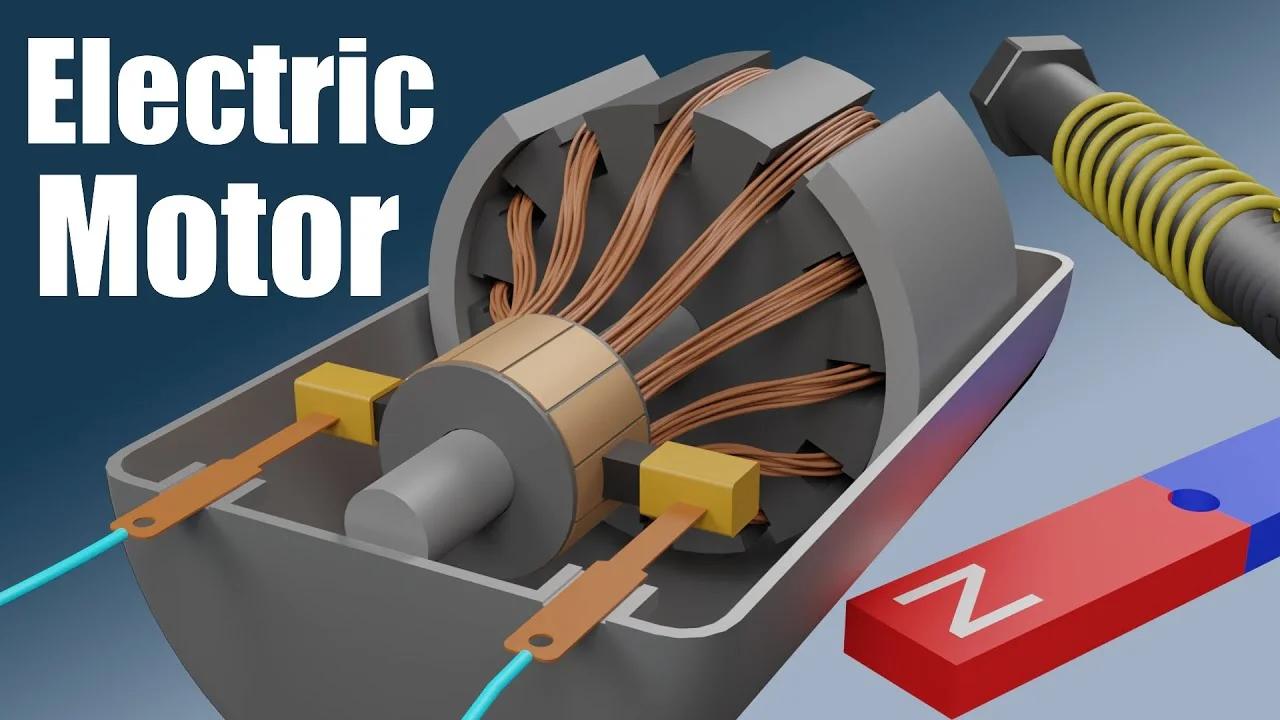
This article explains the basic principles behind a DC electric motor, starting with simple circuits and magnets, and then shows how these concepts combine to create continuous rotation.
Fundamentals of Circuits and Magnetism ⏱ 0:01
•A circuit requires a complete path for electricity to flow; a break stops the current.•Conventional current flows from the positive terminal to the negative, and reversing the battery reverses the current direction.•Permanent magnets have north and south poles; opposite poles attract, same poles repel, and they are always magnetic.•Magnetic domains in a permanent magnet are aligned in the same direction.Electromagnets and the Spinning Principle ⏱ 2:06
•Wrapping a wire around a metal bolt and passing current through it aligns magnetic domains, creating an electromagnet.•Electromagnets can be turned on and off, unlike permanent magnets.•Reversing the current direction (by flipping the battery or switching wires) reverses the electromagnet's poles.•A spinning magnet can be kept spinning by repeatedly switching the polarity of an electromagnet.Building a Practical DC Motor ⏱ 4:07
•Replace the side magnets with curved permanent magnets and the bolt with a metal loop (armature).•A commutator—a split ring with gaps—and brushes automatically switch the current direction as the armature spins.•The commutator reverses the electromagnet's polarity at the right moment to maintain rotation.•Multiple loops and commutator segments ensure smoother, continuous torque.•Torque can be increased by using more wires in the electromagnet or by increasing the current.•The stationary part is the stator (permanent magnets); the rotating part is the rotor (armature).Key Takeaways
•A DC motor uses an electromagnet that switches polarity to keep spinning.•The commutator and brushes automatically reverse the current direction in the armature.•More wire turns or higher current increase the motor's torque.•The stator (permanent magnets) and rotor (armature) are key components of a DC motor.Conclusion
A DC motor converts electrical energy into rotational motion through the interaction of electromagnets and permanent magnets, with the commutator ensuring continuous spinning.