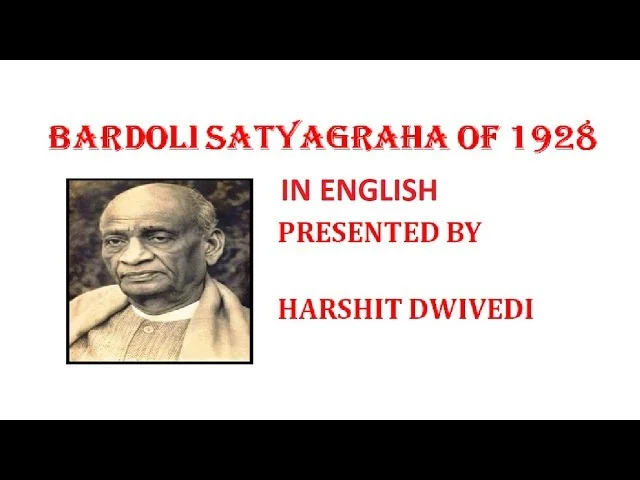
The Bardoli Satyagraha of 1928 was a non-violent protest led by Sardar Vallabhbhai Patel against a tax hike imposed by the Bombay Presidency government on farmers already suffering from floods and famines.
Background: Causes of the Satyagraha ⏱ 1:00
•In 1925, Bardoli taluka (in modern-day Gujarat) was affected by famines and floods.•Floods destroyed crops, reducing farmers' income and causing financial hardship.•Despite this, the Bombay Presidency government increased tax rates by 22% (some sources say 30%).•Petitions and appeals from civic groups and farmers were ignored, and the government proceeded with tax imposition and collection.Leadership and Preparations by Sardar Patel ⏱ 3:30
•In January 1928, Bardoli taluka farmers invited Vallabhbhai Patel to lead the protest.•Patel consulted Gandhiji, who gave his blessings but agreed that Congress would not officially associate with the movement.•Patel met with farmers, warning them of consequences: land confiscation, cattle confiscation, arrest, and imprisonment.•Farmers pledged non-payment of taxes and readiness to face consequences.•Patel wrote a letter to the Bombay Presidency governor, urging reversal of the tax hike, but the government refused.Conduct of the Movement ⏱ 6:00
•Patel organized the taluka into camps for men and women, involving Hindus, Muslims, and Parsis.•Camps issued news bulletins, held campaigns, and gave speeches to educate masses on discipline and austerity.•Door-to-door campaigning strengthened the movement.•A large number of women participated, giving Patel the title 'Sardar'.•Peasants took an oath in God's name not to pay taxes, and those paying taxes were socially boycotted.•Non-essential goods to government offices were refused (essential goods continued).•The government hired tax inspectors and patels from northwestern India to confiscate property and suppress villagers.•Farmers locked cattle inside homes to prevent seizure.•When land was confiscated and auctioned, no one from Gujarat came forward to buy it.•People resisted eviction by emptying villages before officials arrived, leaving no owner to sign documents.•Landless laborers refused to work on confiscated or auctioned land.•Members of the Bombay Legislative Council resigned in protest against the suppression.Outcome and Resolution ⏱ 12:41
•The government set up a Maxwell Group Inquiry Commission to look into the matter.•The increased revenue (originally raised by 22-30%) was reduced to 6.03%.•Patel continued efforts to return confiscated lands to original owners.•Government refused to return auctioned lands, but wealthy Bombay merchants purchased those lands and returned them to rightful owners.•The success of Bardoli Satyagraha established Patel as a national leader with remarkable organizing skills.Key Takeaways
•The tax hike was imposed despite farmers suffering from floods and famines, with increases of 22-30%.•Sardar Patel warned farmers of consequences but secured their pledge for non-violent non-payment.•The movement used social boycott, camp organization, refusal of non-essential goods, and village evacuation.•The government eventually reduced the tax increase to 6.03%.•Wealthy Bombay merchants bought auctioned lands and returned them to original owners.Conclusion
The Bardoli Satyagraha succeeded in reducing the tax hike and established Vallabhbhai Patel as a national leader capable of organizing mass movements.