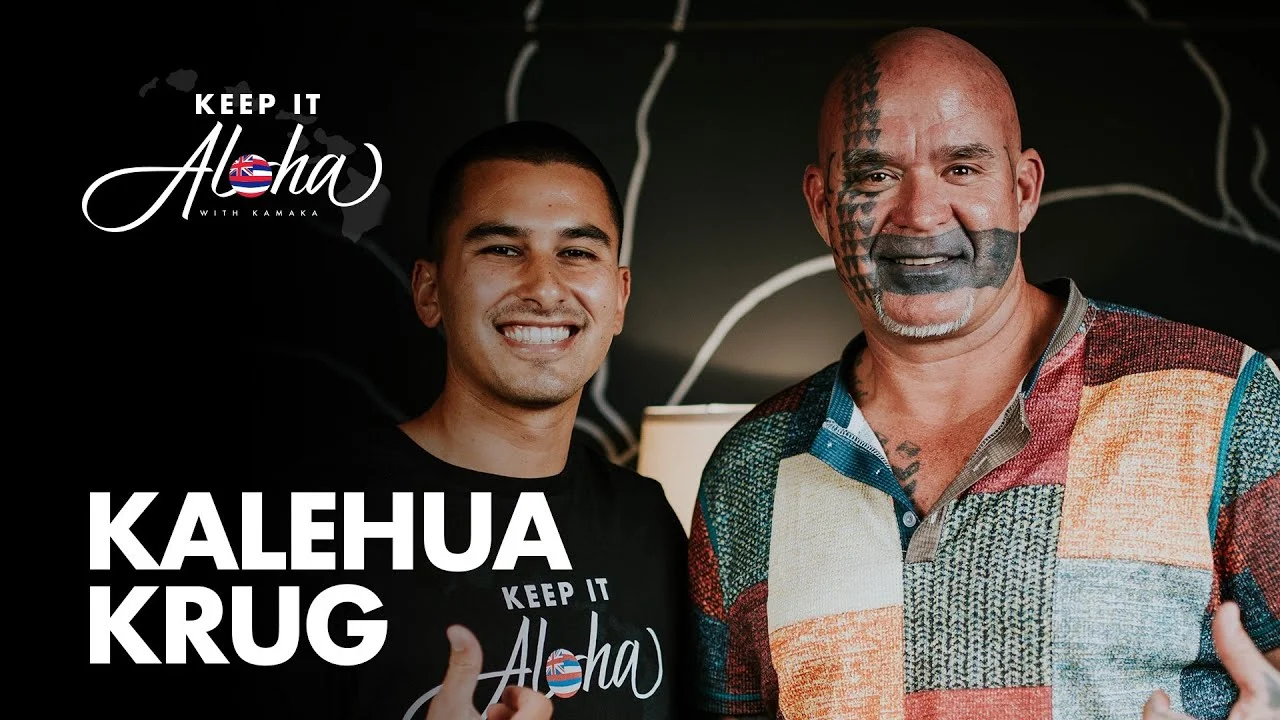
Dr. Kalehua Krug, a Hawaiian language advocate, educator, and traditional tattoo artist, discusses the importance of indigenous worldview, the Hawaiian language, and cultural practices in reshaping Hawai'i's future.
Background and Upbringing ⏱ 7:18
•Kalehua Krug's family originates from Waianae, with his mother's side from 'Ewa; they walked through their journey to Nanakuli where they settled on homestead land.•He graduated from Kamehameha Schools in 1994, after attending Punahou earlier; Kamehameha's environment of being around other Hawaiian students made him feel more comfortable in his Hawaiianess.•His father is from Montana; growing up in a diverse environment challenged his identity.•He spent a lot of time with his grandmother, who was part of a church called Ka Mauli Ola, where sermons were partly in Hawaiian and cultural practices were present; she was a key influence in his desire to enact his culture.•He played football at San Diego State University but moved back home when his father was diagnosed with lymphoma, finishing his college career in Hawai'i.Learning Hawaiian and Its Impact ⏱ 14:04
•He started learning Hawaiian after returning home from college; his father encouraged him to pursue language and culture.•He picked up the language quickly; it resonated with him, and cultural stories pulled him through.•Learning Hawaiian answered questions he didn't know he had, generating new emotions and ways of seeing the world.•He describes learning the language and ideology as part of something stolen from Hawaiians.•The language reshaped his brain and enhanced his ability to be resilient, accept diversity, and synthesize information.Education and Early Childhood Development ⏱ 25:54
•As principal of a Hawaiian charter school (Kawaihona o Kānewai), he believes the critical period from birth to eight years old is when worldview is shaped; inserting language and culture in that window is crucial.•The impact of culture includes caring for the natural world and anthropomorphism—seeing plants, animals, and fish as important as one's own family.•Concepts like 'aumākua and kinolau are important: when we value the environment as equally valuable as our family, we make better decisions as a species.•Language engagement manifests Hawaiian indigenous ideology; it doesn't matter if one is fluent—the act of learning language reshapes thought.•He wants to reshape how we think, not just preserve the language.Tradition, Balance, and Connection to Land ⏱ 31:40
•Balance requires knowing both tradition and contemporary life; one must engage deeply in tradition to truly balance it.•He encourages reconnecting with the land: going into the lo'i, mountains, seeing animals, spending significant time with elders, and listening.•Progress is not always linear; balance means knowing when a decision aligns with tradition or the future.•At his school, students grew over 1,200 pounds of kalo in the past year; they teach children to greet the hāloa (taro plant) and give it a kiss, shifting consciousness.•Reconnecting is not a one-day field trip; it requires significant time and intention.Hawaiian Identity Beyond Ethnicity ⏱ 58:49
•Kalehua does not prescribe to the idea that Hawaiian must be an ethnicity; the most important aspect is the ideology—the way kupuna thought and lived.•You don't need dark skin or Hawaiian features to enact indigenous behaviors.•Hawaiian-ness is a mindset and a way of being that touches the soul; it occupies the space of morals, ethics, and values, similar to religion.•The morals and values of a Hawaiian worldview stem from nature and natural processes, unlike monotheistic religions that focus on human experience and dominion over the natural world.•The land is seen as equal or even more than equal; being a kahu (steward) to the 'āina is a point of accountability.Research, Truth, and Language Preservation ⏱ 70:11
•Research requires multiple sources from multiple time frames; triangulation is essential to make sound decisions.•The word "haole" was not derived upon Captain Cook's arrival; native speakers recorded in chants support this.•Claims that "haole" is a new word are harmful; if we don't have significant research, we lose the truth of our people.•He criticizes commercialized, modern "programming" that enters spaces where native speaker thought no longer exists, leading to irresponsible inferences.•He emphasizes that truth doesn't have to fit what we want it to fit; we must research the whole thing and find authenticity.•Language death can happen in a decade; the Pūnana Leo and Larry Kimura are legends for saving the language.Sovereignty, Usurpation, and Historical Context ⏱ 85:32
•Lā Ho'iho'i Ea celebrates the return of sovereignty after Admiral Thomas's actions in 1843; it is not Independence Day.•The strategies used by Queen Lili'uokalani in 1893 were similar to those used successfully with Britain, but the U.S. resisted due to ideological differences.•The annexation was done via a joint resolution (McKinley) using domestic American law in an international space, which is illegal; no treaty or declaration of war was passed.•He distinguishes between "usurpationBringing Hawaiians Back and Development Issues ⏱ 117:19
•Bringing Hawaiians back home depends on changing the mindset that people are free to do whatever, including moving to Hawai'i and buying property.•Overpopulation, lack of houses, and jobs are symptoms of American ideology; the first problem is ecological, not human-centered.•The word "mainland" reinforces a mindset; he uses "outside of Hawai'i" or "the continent."•On Red Hill: the tanks are set to be drained by 2024; millions of gallons of filtered fuel water are being put into a lava stream (drinking water) without public access.•On Wai Kai wave pool: he cannot support continued development; the community's voice must be heard. He understands counterpoints about Hawaiian families supporting it and improving surf performance.•Burials: the practice of putting iwi into the land is a ho'omalu (returning); desecration is disrespectful because developers would never accept it for their own ancestors.Traditional Tattooing (Kākau Uhi) ⏱ 154:09
•His teacher is Keone Nunes, whom he met in 1999-2000; he chose him over a tattoo parlor because he wanted to reconnect to ancestry.•The first meeting with a client is to hear their intention; if the intention is congruent with a tattoo shop mindset, he says no.•Designs are animals, plants, responsibilities, ranks, islands, and winds—these are the database of patterns.•Tattooing is not merit-based; it is received to help one reach their highest potential.•For his daughters, he performs a ceremony called 'Aha Wī Maka Lehua at first menstruation: women gather, the mother presents the daughter into womanhood, then the men inside start the tattoo (small, symbolic) on both legs.•The process of kākau uhi (especially painful areas like the mouth) forces you into deep contemplation and is transformational; it takes you into a place ancestors went.•He has personal tattoos: a fish design for his family (the fish is the name of his family from his grandmother's lineage), responsibility designs, protection designs (niho niho triangles), a speaking design on his face from an oral history source, and kāwa‘a designs on his temples.Appropriateness of Traditional Tattoos for Non-Polynesians ⏱ 223:53
•He will tattoo non-Hawaiians, but only after a significant process of knowing the person and assessing their intentions.•He will not give family markings to them; designs are attached to families and places, so if you are not from that place, it's common sense not to use them.•Designs that are growth patterns (not linked to specific genealogies) can be used; the person must engage in a significant process to be part of a Hawaiian's life.•It is not about ethnicity; it's about not being born to that place with that family.How to Visit Hawai'i Responsibly and Final Thoughts ⏱ 219:18
•When in Rome, do as the Romans do: research what Hawaiians do to take care of Hawai'i and do that.•Be thoughtful, smart, deep, and caring; if you are a responsible, compassionate, respectful guest in other aspects of life, you will be the same in Hawai'i.•How you do anything is how you do everything.•His life hack: constantly keep learning Hawaiian; bilingual existence enhances biculturalism, resilience, and the ability to accept diversity.•Keeping it Aloha means living an empathetic lifestyle and understanding the concept of 'āpiko: when you sit in a circle, the group has a piko; you speak to the piko of the group, not just to each other as individuals. This generates positive relations, movement, action, and change.•He wants to be remembered as compassionate, thoughtful, and courageous—another iteration of who we are as a people.Key Takeaways
•Hawaiian identity is defined by ideology and behaviors, not ethnicity; indigenous wisdom and stewardship of the land are central.•Learning Hawaiian language reshapes thought and worldview; it is more important for shifting consciousness than achieving fluency.•Traditional tattooing (kākau uhi) is not merit-based but a tool for reaching one's highest potential; designs are tied to family and place.•The U.S. annexation of Hawai'i was illegal via a joint resolution without a treaty; the overthrow is considered usurpation, not occupation.•Language death can occur in just one decade; the Pūnana Leo and Larry Kimura are credited with saving the Hawaiian language.•Balance in modern life requires deep engagement with tradition, not superficial understanding; reconnecting with land is essential.•Critical period for embedding culture is birth to age eight; education can proactively reshape reality.•Hawai'i's ecological health must be prioritized over human-centric development; overpopulation and resource depletion are symptoms of American ideology.Conclusion
Kalehua Krug's message is clear: to keep Hawai'i Hawaiian, we must embrace indigenous worldview, language, and practices, and act with empathy and collective responsibility.