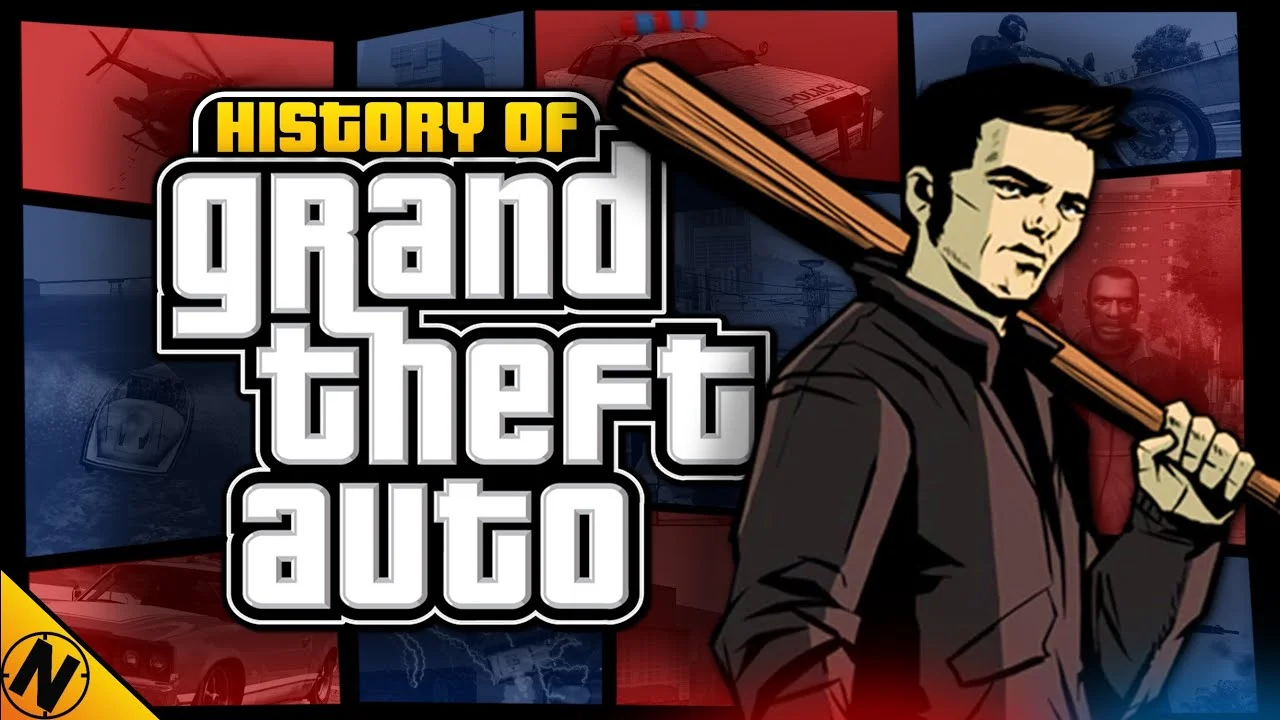
This documentary traces the history of the Grand Theft Auto series, from DMA Design's founding in Dundee, Scotland, in 1984 through the release and evolution of GTA Online. It covers the development of each main entry, key acquisitions such as Take 2's 1998 deal and Rockstar's acquisition of DMA Design, and controversies including Hot Coffee.
Origins of DMA Design and the Birth of Grand Theft Auto ⏱ 0:00
•In 1984, Dave Jones and fellow enthusiasts at the Kingsway Amateur Computer Club in Dundee, Scotland, founded DMA Design after the success of Menace. DMA later created Lemmings, which sold over 55,000 copies on its first day.•After Sony acquired Psygnosis in 1993, DMA lost the Lemmings IP but pivoted to mature 3D action games. Their N64 project Body Harvest was rejected by Nintendo for its adult themes and published by Midway instead.•In 1995, Dave Jones pitched Race and Chase to the Hower brothers at BMG Interactive. The game was renamed Grand Theft Auto and published in fall 1997 for DOS and Windows, with ports for PlayStation and Game Boy Color.•GTA introduced the wanted level system, inspired by a glitch where police vehicles aggressively rammed the player. The Hower brothers hired publicist Max Clifford to generate controversy, which boosted sales to over 1 million copies by 2000.Acquisitions and the Formation of Rockstar Games ⏱ 0:00
•In 1998, Take 2 Interactive acquired BMG's video game division to secure the GTA property. The Hower brothers relocated to New York, and within a year, Take 2 formed Rockstar Games.•DMA Design changed hands multiple times: sold to Gremlin Graphics in 1997, then to Infogrames, which was forced to sell DMA to Take 2. Many original developers left, but Mike Daily oversaw GTA 2's darker atmosphere and 3D graphics renderer before departing.GTA 2, the London Expansions, and the Shift to 3D (1999–2001) ⏱ 20:00
•GTA 2 (fall 1999, PC/PlayStation then Dreamcast and Game Boy Color): set in the futuristic dystopian Anywhere City; silent protagonist Cloud Speed; headline feature is a colored-bar gang reputation system where completing missions unlocks lucrative jobs and failing or aiding rivals turns streets hostile; adds weapons (shotgun, throwables, electro gun), vehicle upgrades like front-mounted machine guns, and collectible GTA tokens; critics said it barely innovated and looked the same, and sales passed 1 million at launch but slowed to a crawl.•Rockstar Canada (renamed from Alternate Reality Technologies after the GameTek purchase) built GTA London 1969 in under a year with mostly cosmetic changes to unstable DMA source code: 1960s London setting, red telephone booth missions, opposite-side traffic, British weapons like the Sten SMG and double/triple-decker buses; criticized for outdated visuals and lower sales; follow-up GTA London 1961 added armor plating and drive-bys but released as a free PC download on Rockstar's website.•Dave Jones resigned in 1999 (founded Realtime Worlds in 2002); Leslie Benzies took over as lead project director after Space Station Silicon Valley; Rockstar secured an extended RenderWare license (proven in the 2000 game Burnout) for a PS2 3D GTA; Leslie, programmer Adam Fowler and lead artist Aaron Garbett devised an environment-streaming solution off the CD around a rendered car to beat memory limits, influencing every later GTA.•GTA 3 used a mocap studio for fully voiced cutscenes (actors Robert Loggia, Frank Vincent, Keith "Guru" Elam), with Dan Houser co-writing; art shifted from bright and cartoon-like to a darker tone with rain and trail blur; the E3 June 2001 showing was ignored in favor of Metal Gear Solid 2 and State of Emergency; after 9/11 Rockstar's New York HQ was vacated for over a month and DMA made last-minute changes (emergency vehicles, airport prop-plane collisions, skyline) and a new comic-book collage cover; released October 2001 on PS2, with PC and Xbox ports later.Grand Theft Auto 3: Story and Revolutionary Open-World Design ⏱ 31:12
•Liberty City story is unrelated to the 2D era: silent protagonist Cloud is double-crossed by girlfriend Catalina during a bank robbery, sentenced to 10 years, freed when the Colombian cartel ambushes his convoy, and seeks revenge; structure mirrors the original but animated cutscenes give bosses like 8-Ball, Don Leone and Maria, Ray Machowski and Donald Love actual personality; satire targets early-2000s American society, with Chatterbox FM co-written by Dan Houser and radio host Lazlow Jones; story still relies on stereotypes but that was deliberate.•First dominant third-person camera (top-down still optional), a living world with day/night cycle and randomized weather, and three districts: Portland (industrial, Brooklyn-style), Staunton Island (Manhattan-style business district), and Shoreside Vale (elite mansions); a radar HUD shows position, streets and map markers.•Overhauled mechanics: improved driving with tipping/rolling and exploding vehicles, area-specific vehicle spawns, safe-house garages for saving cars, first boats and planes (the clipped-wing Dodo), modern on-foot controls, a sprint key, lock-on aiming on console and free aim on PC, weapons from pistol and Uzi to M16, sniper rifle and rocket launcher bought at gun stores or picked up, and a six-level wanted system.GTA III: Wanted System, Missions, and Controversy ⏱ 40:00
•Wanted level system escalates: at 4 stars SWAT teams with automatic weapons and roadblocks; at 5 stars FBI; at 6 stars army with military transports and tanks.•Over 50 mainline story missions plus side jobs: pay phone missions, off-road checkpoint races, RC missions, and vehicle-specific missions (taxi, firetruck, vigilante). 100 hidden packages unlock weapons and armor at safe house.•Critical and commercial success with high review scores, but sparked controversy over violence; critics misrepresented content, claiming points for headshots (false, as GTA 3 removed point system) and ignoring satirical nature.•Controversy increased awareness, solidifying GTA 3 as one of the most influential games.GTA Vice City and GTA San Andreas Development ⏱ 45:06
•After GTA 3, Rockstar acquired DMA Design, renamed it Rockstar North, and moved team to Edinburgh. Canceled GTA 3 expansion assets were repurposed for a 1980s-themed sequel.•Vice City developed in only 9 months; set in fictional Miami with Tommy Vercetti (voiced by Ray Liotta). Licensed over 100 era-appropriate songs. Story inspired by Scarface, Carlito's Way, and Miami Vice.•Gameplay improvements: tighter gunplay, new weapons (Python revolver, Spas 12, Ruger carbine, PSG1 sniper, M60, minigun, chainsaw), nearly double the vehicles of GTA 3, return of motorcycles, first pilotable helicopters and plane. Players can purchase safehouses and businesses.•Vice City praised for story and atmosphere but criticized for technical issues and sparked controversy over portrayal of Haitian immigrants, leading to dialogue changes and removal of mentions in later ports.•San Andreas set in early 1990s hood life across three cities; DJ Pooh consulted; team conducted field research in Los Angeles. New render pipeline allowed massive scope with lower-poly distant objects and improved lighting/shadows from Manhunt. Extended 2-year development.San Andreas Gameplay and World Design ⏱ 62:23
•Core gameplay similar to previous games but adds swimming, vaulting short walls, improved gunplay with autolock and colored crosshair, crouching for stability, stealth takedowns, and new weapons like Winchester rifle, heat-seeking rocket launcher, remote explosives, parachutes, and night vision goggles.•Vehicles improved with better handling, superior damage models, and many more options including hovercraft, go-karts, and jetpack.•The game is an entire state, not just one city, with areas: Los Santos (urban war zone), Red County (rural countryside), San Fierro (second major city with verticality and naval action), Bone County (desert with Area 69 military base), and Las Venturas Strip (casinos and heist).•Main missions feature scripted set-piece moments and unique gameplay; optional activities include gang wars, graffiti spraying, territory conquest, recruiting gang members, RPG mechanics (customization, eating, exercise, skills, dating), and minigames like basketball, pool, and gambling.Hot Coffee Controversy and Rockstar's Expansion; Portable GTA Titles ⏱ 62:23
•The Hot Coffee mod, a fan-made modification for the PC version of San Andreas released a year after launch, unlocked a hidden minigame with explicit content. When news broke in 2005, US politicians including Senator Hillary Clinton condemned Rockstar and the ESRB, pushing for legislation to restrict adult content in games. Rockstar argued the mod violated terms of agreement, but the ESRB confirmed the code was in early copies, leading to a patch, re-release, class action lawsuits, and losses of tens of millions of dollars.•Rockstar North expanded staff and moved to a larger space near Colton Hill; Take-Two acquired Mobius Entertainment (renamed Rockstar Leeds) and assigned them a PSP title after seeing potential in the PSP. They also outsourced GTA Advance to Digital Eclipse, which released in 2004 for Game Boy Advance. GTA Advance, set in 2000, stars Mike, features no voice acting, uses a top-down perspective, and received poor reviews for visuals, soundtrack, and controls.•Rockstar Leeds developed GTA Liberty City Stories for PSP (2005), set in 1998 and starring Tony Cipriani. It featured full 3D gameplay, online multiplayer for up to 6 players via ad hoc mode, and later a PS2 re-release in 2006. It was highly regarded and dominated PSP sales.•GTA Vice City Stories (2006 for PSP, 2007 for PS2) is a prequel set in 1984 starring Vic Vance. It reintroduced swimming, flying, and bicycles, and added a criminal racket takeover system, lifeguard side missions, and weapon repurchase. It was more successful than its predecessor, earning higher review scores and more sales.Transition to the RAGE Engine and Grand Theft Auto IV ⏱ 82:23
•After the 3D era ended with Vice City Stories and The Warriors port, Rockstar needed a new engine because EA acquired Criterion and Renderware in 2004; Rockstar San Diego developed the Rockstar Advanced Game Engine (RAGE), first shown in a table tennis game, which Rockstar North used for GTA IV.•GTA IV returned to Liberty City with unprecedented detail: field research in New York, individual artist teams per area, architectural sculpting of facades, Image Metrics body language technology, a more responsive autotargeting system, and a snap-to-cover mechanic inspired by Gears of War.•Lead writer Dan Hooser aimed for a meaningful, thought-provoking story benchmarked against film rather than rival games, abandoned major Hollywood talent for unknown actors, and delivered a gritty immigrant tale starring Niko Bellic, whose cousin Roman's lies draw them into conflict with the Russian mafia; the game released in spring 2008 for PS3 and Xbox 360 with a PC follow-up.•The game overhauled combat (body-part-specific aiming, dynamic procedural cover), driving (soft-body damage, suspension physics, window braking and hot-wiring animations), and introduced a cell phone menu, an in-game internet browser, TV programming, and a friendship system with 10 characters; multiplayer included races, deathmatches, co-op missions, cops and robbers, and free mode.Reception, Criticism, and the Episodic Expansions ⏱ 100:19
•GTA IV received overwhelmingly positive reviews averaging at or above 98%, remains the highest-rated entry in the franchise, sold well over 6 million copies in its first week, and became the fastest-selling video game of all time; praise focused on its narrative, lifelike feel, attention to detail, and Niko Bellic's voice acting and writing.•Criticism targeted the relentlessly annoying phone calls that interrupt the action and the depiction of drunk driving.•Rockstar North immediately began large expansion packs partly funded by a new timed exclusivity deal with Microsoft for Xbox 360; the first, The Lost and the Damned, released a year after the base game and follows Johnny and his biker gang, The Lost, exploring narrative forks built into the main story.GTA 4 Expansions, Chinatown Wars, and GTA 5 ⏱ 102:24
•The Lost and Damned (2009): Johnny Klebitz leads the Lost MC after president Billy Grey's incarceration; Billy's return sparks civil war. Story emphasizes friendship and loyalty over power, and its events are integrated into GTA 4's main plot. New features include ride formation for conversations, calling gang members for assistance, gang wars to boost combat stats, new bikes, shotguns, grenade launchers, mission checkpoints, a clubhouse with minigames, and a memorial for fallen members. Received highly positive reception for its tone, storytelling, and mechanics.•The Ballad of Gay Tony (2009): Players control Luis Lopez, bodyguard to nightclub owner Tony Prince. Story is more light-hearted with insane missions like base jumping, flying golden helicopters, and driving an APC. New features include vehicles, weapons, dancing, drinking, an underground fight club, a mission rating screen, and base jumping missions. Praised for its realistic LGBT character and enjoyable systems; it closed the loop on GTA 4's narrative themes.•Grand Theft Auto: Chinatown Wars (2009, Nintendo DS): Developed by Rockstar Leeds using a new engine based on RAGE, returning to top-down roots in GTA 4's Liberty City. Follows Huang Lee seeking revenge and a stolen sword. Features a comic book art style, hot-wire minigame, simplified driving, lock-on aiming, and a drug-dealing system. Despite critical praise, sales fell below expectations; a PSP port followed a year later, but it became the last portable and top-down entry.•GTA 5 (2013, PS3/Xbox 360): Takes place in present-day San Andreas with three protagonists: Michael De Santa (ex-bank robber in witness protection), Franklin Clinton (ambitious repo man), and Trevor Phillips (psychopath). Story revolves around heists, which can be approached quietly or loudly, and features scripted action set pieces. The open world is the largest in the series, divided into Los Santos (based on Los Angeles) and Blaine County, with activities like golf, tennis, yoga, scuba diving, and bounty hunting. Combat and driving improved using lessons from Max Payne 3 and Midnight Club; player customization returns for weapons, cars, and haircuts; stat progression focuses on shooting, driving, and flying, with no visible weight gain and no eating at restaurants.GTA V: Special Abilities, Police Changes, and Record-Breaking Success ⏱ 122:24
•GTA V introduces special abilities for each protagonist: Michael has slow-motion bullet time, Franklin can slow time while driving, and Trevor enters a rage mode.•The police system is revised: max wanted level is reduced to five stars, and officers gain cones of vision on the radar, allowing players to hide and lose their wanted level.•GTA V became the fastest-selling video game in history within its first day and has sold over 140 million copies since its 2013 release, making it the second highest-selling game of all time.•Critical reception was near flawless, with some outlets like IGN calling it the best video game ever made.GTA Online: Evolution from Simple Multiplayer to Expansive Criminal World ⏱ 124:27
•Launched less than a month after GTA V, GTA Online lets players create a mute custom character and rise through the criminal underworld, with a narrative set prior to GTA V but later moving past the 2013 story.•Early GTA Online was criticized for being too simple, offering only deathmatches, races, and repetitive missions; promised heists were delayed due to development difficulties.•Shark Cards were introduced to convert real money into in-game cash, becoming a crucial revenue source but negatively influencing game design.•Major updates expanded the game: the Heist update (March 2015) added five cooperative heist sets; subsequent updates introduced free mode events, Low Riders, organizations, cunning stunts, biker clubs, import/export, militarized content (gun running, smugglers run, Doomsday Heist), nightclubs, a casino, and the Kaio Heist.•By 2019-2020, content releases slowed as Rockstar focused on Red Dead Redemption 2 and the next GTA; the online mode now features nearly 700 vehicles and thousands of customization options.The Future of Grand Theft Auto and Closing Thoughts ⏱ 134:33
•The series' future is uncertain: a reimagined Vice City is speculated, but with GTA V still dominating sales, Rockstar may have re-evaluated the property.•Key departures include longtime producer Leslie Benzies and lead writer Dan Houser, with veterans Aaron Garbett, Rob Nelson, and Andrew Semple taking over.•Rockstar has stated they want to work on smaller scale, more focused and polished titles moving forward.•For over 20 years, GTA has been a staple of the industry, balancing incredible gameplay with controversy, driving its unrivaled reputation.Key Takeaways
•In 1984, Dave Jones and fellow enthusiasts at the Kingsway Amateur Computer Club in Dundee, Scotland, founded DMA Design, the studio behind the original Grand Theft Auto.•In 1998, Take 2 Interactive acquired BMG's video game division to secure the GTA property, and Rockstar Games was formed; Rockstar later acquired DMA Design, renamed it Rockstar North, and moved the team to Edinburgh.•GTA 2, released in fall 1999, was set in the futuristic dystopian Anywhere City, and the London expansions preceded the series' shift to 3D.•Grand Theft Auto 3 featured a wanted level system that escalated from SWAT teams at 4 stars to the FBI at 5 stars and the army with tanks at 6 stars.•After the 3D era ended, Rockstar needed a new engine because EA acquired Criterion and RenderWare in 2004, leading to the RAGE engine and GTA IV, which received reviews averaging at or above 98% and remains the highest-rated entry in the franchise.•The Hot Coffee mod, a fan-made PC modification for San Andreas released a year after launch, unlocked a hidden minigame with explicit content, sparking controversy.Conclusion
The documentary follows Grand Theft Auto from DMA Design's early days through the 2D and 3D eras, GTA IV and its expansions, GTA V's record-breaking success, and the ongoing evolution of GTA Online, noting that the series' future remains uncertain.