

Epic Games’ Multiplayer World Model▶ 0:32
Epic Games has released a playable neural world model capable of generating real-time video. This release includes the research paper and the code, which became public four days prior to this discussion. Unlike previous iterations of generative world models, this version supports multiplayer functionality, allowing multiple users to exist within the same generated instance simultaneously.
The demonstration shows a user taking control of the model, pressing forward and backward to navigate the environment. The user remains stationary in their physical space while the model responds to the input commands. While a slight delay is present, the movement tracking follows the controls smoothly, offering a more fluid experience than previously tested alternatives. When a second player joins the session, both users can interact within the shared virtual space. The speaker notes that the smoothness and interactivity of this release mark a significant leap in real-time generative environments.
Auto Remesher 1.0.0▶ 1:45
Auto Remesher has reached version 1.0.0, marking a major update after four years of development. The software is released under an MIT license, allowing for free local use. The update features significant improvements in speed and topology quality, capable of retopologizing a mesh in just a few seconds.
In demonstrations, the tool successfully extracts detailed features such as eyes, noses, and mouths from scanned geometry. For users working in Blender, a dedicated bridge add-on is available. This add-on provides controls for target quad size, adaptivity, and edge scaling, allowing for customized topology generation directly within the software. The local execution and open license make it an accessible option for high-speed mesh optimization.
TriFlow: Artist-Like Topology▶ 2:47
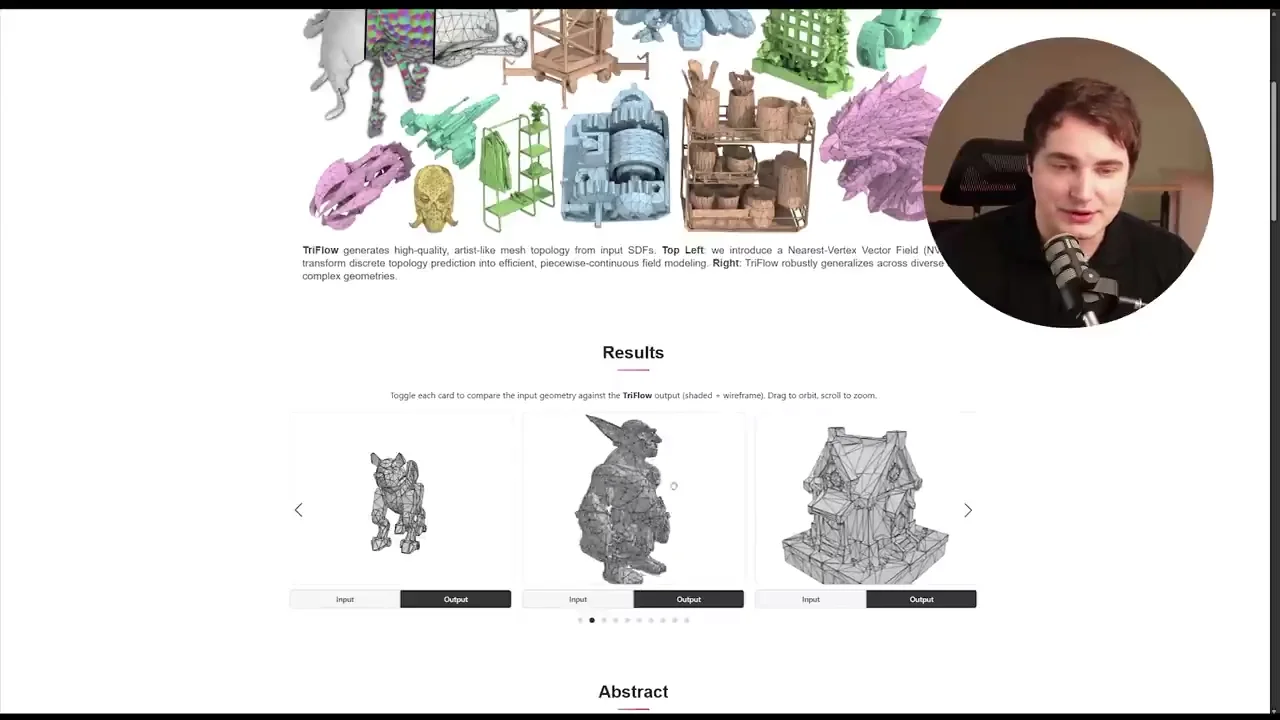
TriFlow is a new method focused on reconstructing meshes with artist-like topology. The research paper and a demo are available, showcasing the tool's ability to generate optimized geometry from input Signed Distance Functions (SDFs). The results display complex geometries, including organic characters and hard-surface structures, with topology that mimics manual modeling techniques.
While the output is generally impressive and optimized, minor imperfections are visible in some areas. The performance is comparable to paid generators such as P1, particularly regarding low-poly generation. TriFlow also includes settings for Level of Detail (LODs), though the specific implementation—whether it involves precise polygon count control or preset resolutions similar to Houdini’s approach—remains unclear. The code release status and VRAM requirements are pending, with further testing planned upon public availability.
Dual Contouring of Signed Distance Data▶ 3:55
A new paper presented at SIGGRAPH 2026 introduces an approach to dual contouring of signed distance data. This method addresses the limitations of standard marching cubes algorithms, which often produce stepped or inaccurate surface details in AI-generated 3D assets. The new technique generates sharp, clean, and smooth shapes, eliminating the stair-step artifacts common in previous conversion methods.
Chris Lord has developed a Windows version of this implementation, which can be integrated into workflows such as ComfyUI. The process allows for the rapid creation of models, primarily utilizing the CPU rather than the GPU. The resulting meshes are cleaner and often more straightforward than those produced by other architectures like Trellis, offering a viable alternative for high-fidelity geometry conversion.
NVIDIA Neural Materials▶ 4:41
NVIDIA has introduced a system for neural materials, diverging from standard Physically Based Rendering (PBR) workflows used in games. This AI-driven approach reads and understands material properties, extracting them as a latent texture alongside the albedo texture. The system then renders the object by interpreting these latent properties, allowing the AI to "understand" the surface characteristics without traditional parameter maps.
This method is designed for complex use cases that are difficult to handle with standard pipelines, such as clear coats, dust layers, and fuzz effects. The demonstration shows successful rendering of these mixed properties, producing visually accurate results. However, the latent nature of the data means the materials are not directly editable by humans in the traditional sense. Questions remain regarding the ease of use and the computational resources required to run this system effectively.

PixWorld: 3D Gaussian Splatting▶ 5:59
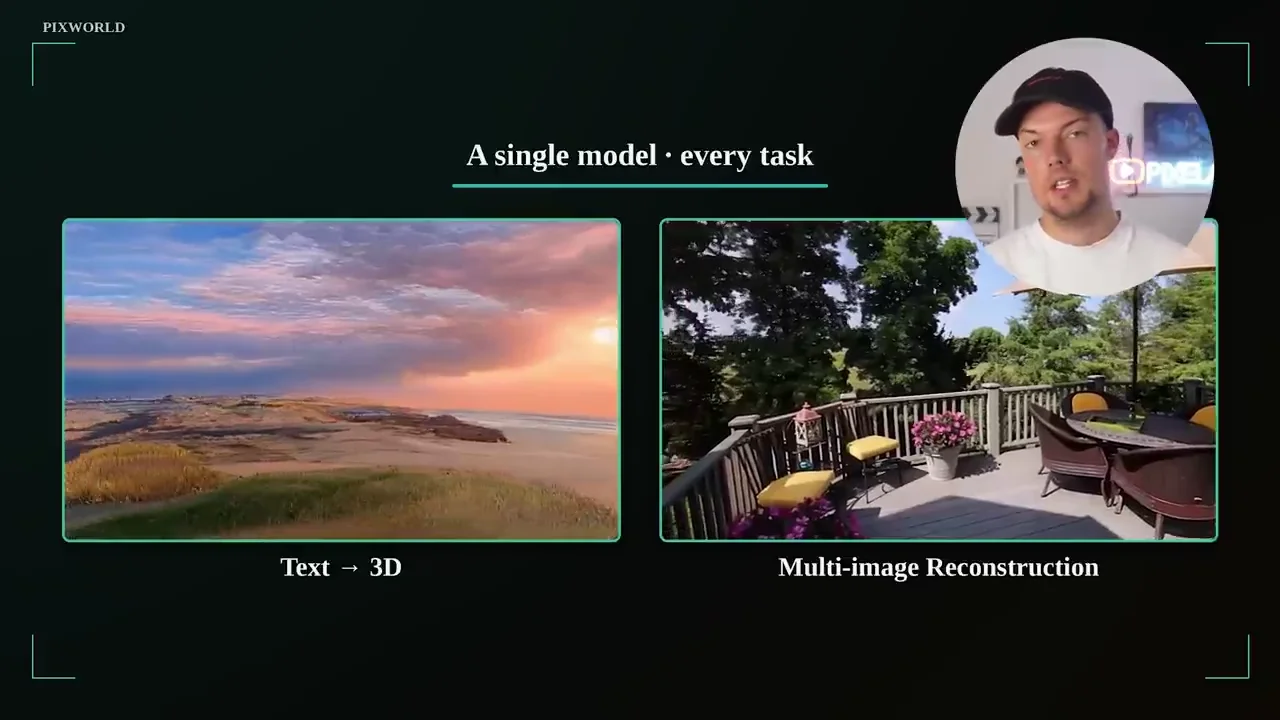
PixWorld is a new tool for 3D scene generation that focuses on creating pixel-aligned 3D Gaussian splats. The tool delivers high-quality, sharp results that surpass many existing Gaussian splatting models. It supports multiple input methods, including text-to-3D generation and multi-image reconstruction, where users can feed multiple photographs into the system to generate a cohesive 3D scene.
The demonstrations highlight the clarity and detail of the output, particularly in complex environments. Comparisons between text-generated and image-reconstructed scenes show consistent quality across different input types. This tool represents a significant step forward in the application of Gaussian splatting for rapid scene creation.
Warped 3D 2.0▶ 6:45
Warped 3D, developed by NC AI (part of NCSoft), has released version 2.0. The update includes a redesigned, more intuitive website interface. Key feature additions include multi-view support, user-selectable polygon counts, and texture resolution options up to 4K.
Testing indicates improved output quality compared to previous versions, though some artifacts persist. The tool specializes in stylized outputs, producing results with a hand-drawn, cartoonish, or anime aesthetic. This stylistic leaning is more pronounced than in competitors like Hunyuan, making it a specific choice for non-photorealistic character and asset generation.
AI Motion Capture in Blender▶ 7:33
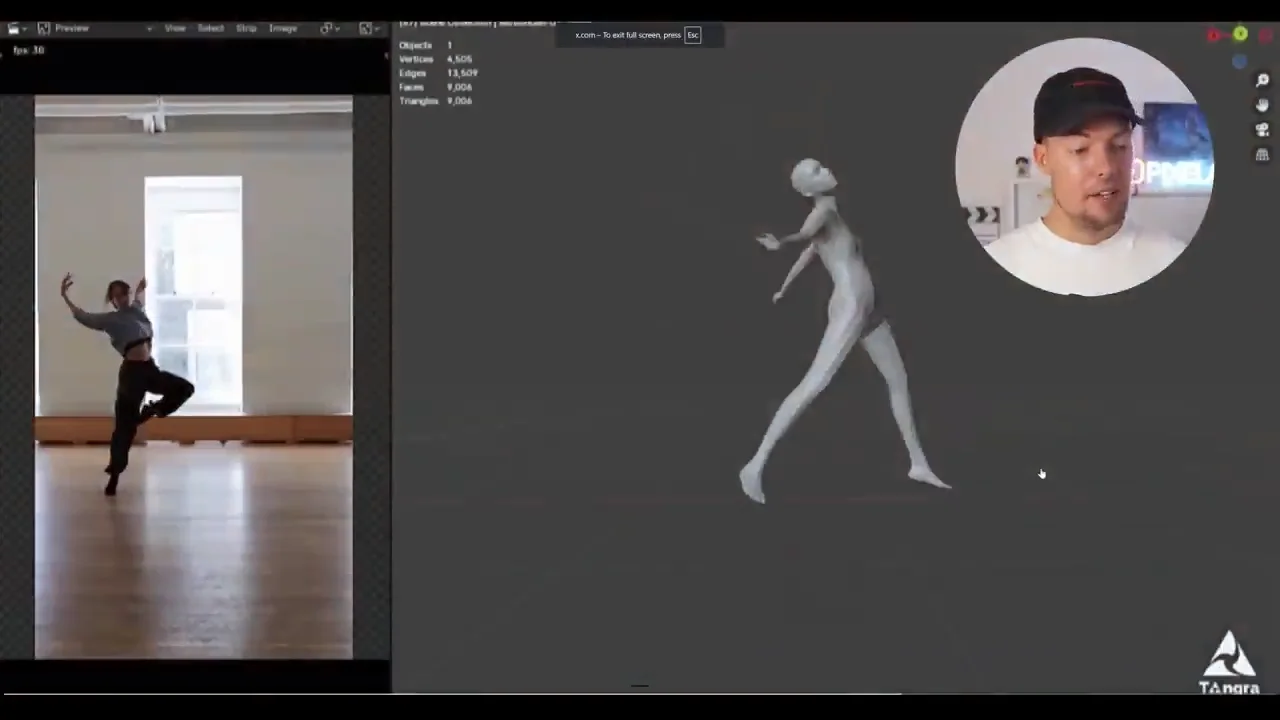
New open-source motion capture tools combined with AI are now available for local use in Blender. An add-on facilitates the integration, allowing users to generate animation data from video inputs. The demonstration shows a character mirroring the movements of a dancer from a source video.
A notable advancement in this tool is its handling of camera movement. Unlike many previous AI mocap solutions that require a static camera, this system accurately tracks motion even when the camera in the source video is moving. The tracking remains clean and does not suffer from the "hugging" or drifting artifacts common in less robust systems.
NVIDIA TRON for 3D Gaussian Relighting▶ 8:32
NVIDIA’s TRON (Tracing Rays to Orchestrate a Neural render) addresses a major limitation of 3D Gaussian Splats (3D GS): the lack of natural interaction with light and PBR settings. TRON enables the relighting of 3D GS scenes, allowing them to interact dynamically with environmental lighting.
The demonstration shows a 3D scanned courtyard scene where lighting conditions change realistically, casting shadows and adjusting reflections on surfaces. This capability bridges the gap between static splats and interactive game assets. The code is not yet released, but the development suggests that 3D Gaussian Splats will become more viable for game development and filmmaking by the end of the year.
Roden AI Rigging Tool▶ 9:15
Roden has announced a new AI-powered rigging tool that expands beyond standard humanoid characters. While most AI animation tools focus on bipedal figures, this solution supports the rigging of props, robotic structures, and mechanical items.
The demonstration includes a tank model with functional spinning wheels, showcasing the tool's ability to handle complex mechanical articulations. This development allows for the animation of non-character assets, broadening the scope of AI-assisted animation pipelines.
Tanya AI tentang video ini