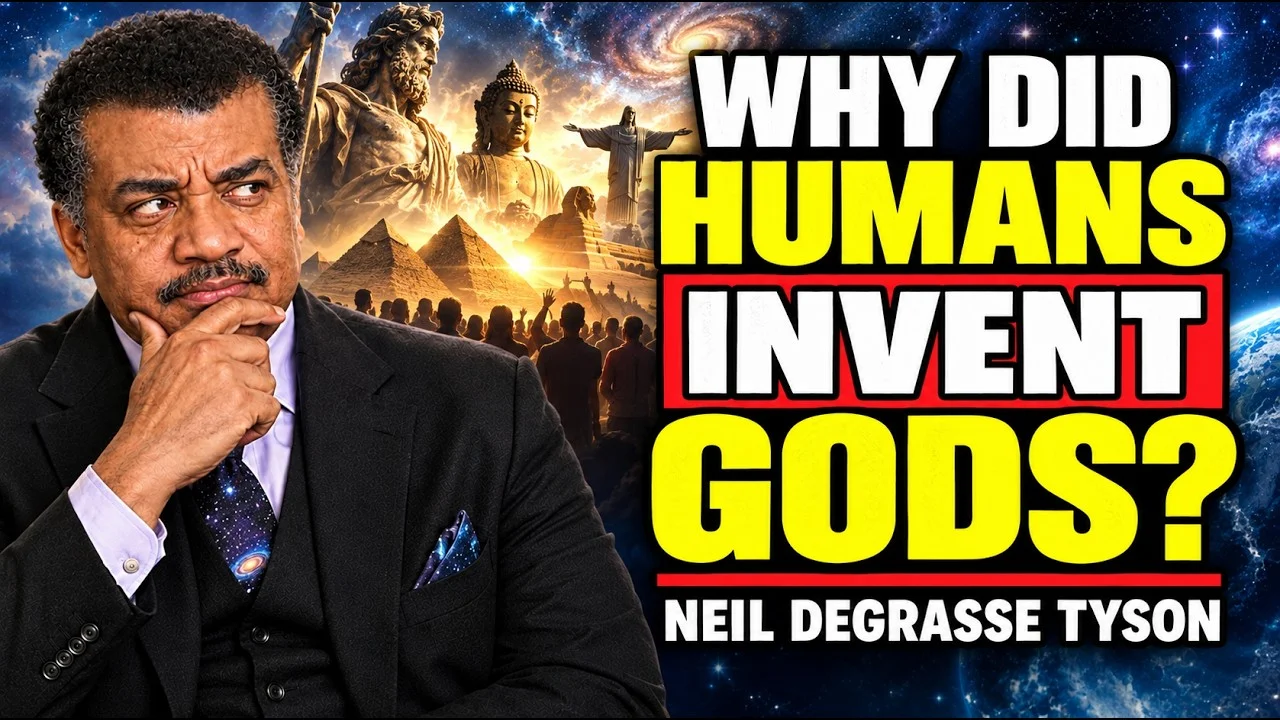
Neil deGrasse Tyson explores why every human culture has independently invented gods, tracing the answer from our brain's agency detection to our fear of death and the need for social cohesion.
The Universal Invention of Gods ⏱ 0:00
•Every human culture on every continent and in every climate has invented gods.•The ancient Egyptians worshiped a crowded sky of gods; the Norse told stories of brave, doomed gods; Amazonian tribes spoke of spirits in rivers and trees.•These cultures did not compare notes; they independently did the same thing.•Two possibilities: either every culture discovered the same hidden truth, or every culture built the same kind of story from the same raw material inside the human skull.•Tyson argues humans invented gods the way the eye invented vision—it was what a certain kind of brain does when it wakes up in a universe it does not understand.The Scale and Variety of Belief ⏱ 2:04
•Scholars have documented the spiritual lives of hundreds of human societies, from Arctic hunters to desert nomads to island fishing villages to modern mega cities.•No society has ever been found entirely without some form of belief in supernatural beings, spirits, or forces.•Defining religion is tricky, and absence of evidence is not evidence of absence, but the pattern is overwhelming.•Variety is breathtaking: cultures worshiped one supreme god or thousands. The ancient Egyptians had gods of the sun, river, afterlife, and household. The Greeks imagined gods as a powerful, petty family on a mountaintop—humans with superpowers and worse impulse control. Hinduism embraces a vast multitude of deities as faces of one ultimate reality. Japan's tradition sees kami in waterfalls, mountains, and ancient trees. Aboriginal Australians describe ancestral beings who sang the world into existence during the Dreaming. Amazonian peoples spoke of spirits in rivers and jaguars.•The oldest layer looks like animism: the sense that the world is alive with intention—rivers are beings, thunderstorms express anger, mountains are presences.•The shaman emerged as a specialist—part healer, part storyteller, part traveler—who journeyed into the spirit world. These traditions appear on every inhabited continent and may be the oldest profession of the human imagination.Archaeological Evidence: Göbekli Tepe and Burial Practices ⏱ 4:39
•Göbekli Tepe in Turkey, built 11,000 to 12,000 years ago, is a vast complex of stone circles carved with foxes, lions, scorpions, and vultures.•It predates agriculture, the wheel, writing, and the pyramids by more than 6,000 years. Hunter-gatherers with stone tools quarried and carved pillars weighing many tons.•The excavating archaeologist suggested the temple came first and the city followed—the need to gather and worship may have pulled scattered bands into the first settled communities. Religion may not have been a product of civilization; civilization may have been a product of religion.•Tens of thousands of years ago, humans buried their dead with red ochre, tools, ornaments, and flowers. You do not decorate a corpse for hygiene; you do it because you believe or hope or fear the person is going somewhere.•Even Neanderthal cousins may have buried their dead with care, though archaeologists still debate the evidence. The question of what happens after death may predate our species.•Religion was not invented once like the light bulb; it was invented independently thousands of times, the way language was. Every human culture develops language because the brain is built to do it; religion appears for what looks like the same reason.•Cave paintings in France and Spain from some 36,000 years ago show ancestors making art by torchlight and pressing hand stencils to stone. The religious impulse is older than history itself.The Brain's Agency Detection and Pattern-Seeking ⏱ 7:44
•The brain is not a camera; it is a prediction machine constantly guessing what happens next, because for ancestors, guessing wrong could be fatal.•Scientist Justin Barrett called the tendency to assume things happen because someone made them happen the hyperactive agency detection device. In the savannah, assuming a rustle is a lion when it is just wind costs only a moment of panic, but assuming it is wind when it is a lion makes you lunch. Natural selection rewards the survivors who assume the lion.•This detector never turned off; it just got promoted. Winds move branches, so something must move the wind; rivers flood, so someone must be angry; thunder cracks, so someone up there must be shouting.•Theory of mind—imagining what others think and feel—is essential for group living, but it has no off switch. We yell at computers, name cars, see faces in the moon, and hear intention in thunderstorms.•Developmental psychologist Deborah Keleman found young children are "promiscuously teleological," insisting everything exists for a purpose. Under time pressure, many adults agree with the children, suggesting the purposeful view is suppressed, not outgrown.•Our hunger for patterns spots faces in burnt toast and voices in static—pareidolia. It is the agency detector running as designed.•To a human 10,000 years ago with no science, the gods were the most reasonable conclusion. These rituals persist today: lucky socks, exam shirts, knocking on wood. Conspiracy theories run on the same fuel—a hidden hand over random chaos.Memory, Death, and the Afterlife ⏱ 12:54
•Anthropologist Pascal Boyer noted that religious ideas follow a recipe: take an ordinary concept and violate just one or two expectations—a person who never dies, a person you cannot see but who sees you, a tree that listens, a statue that hears. These "minimally counterintuitive concepts" are mostly normal (easy to understand) and slightly impossible (impossible to forget).•Gods are built to be remembered, and they spread from mind to mind the way a good melody spreads.•Humans are the only animal known to know it will die. Terror management theory holds that awareness of death generates background anxiety, and cultures are machines for turning down the volume.•Some cultures promise literal immortality (a soul surviving the body); others promise symbolic immortality (living on through children, great works, or tribal memory).•Ancestor worship is one of the most widespread practices: when a grandmother dies, the theory of mind machinery keeps running. You dream about her and catch yourself thinking what she would say, and without neuroscience the natural interpretation is that she is still there.•Dreams give a nightly preview of the afterlife—the dead walk and talk—and without concepts like REM sleep, the dream world would seem like another world.•Near-death experiences with tunnels of light, feelings of peace, and reunions with loved ones provide firsthand testimony that consciousness continues. Modern medicine explains these as the brain under extreme stress, but the experiences feel real to those who have them.Gods as Explanation and the Shrinking Gaps ⏱ 18:00
•For most of human history, gods had an enormous job description: running weather, deciding life and death in childbirth, sending or withholding rain, shaking the ground, darkening the sun. Crop failure meant someone had angered them; plague meant someone had to pay.•These were not stupid explanations but the best available to brilliant minds with almost no data. Without atmospheric electricity, lightning as a weapon is reasonable. Without germ theory, disease as punishment or possession is pattern matching with the only patterns available.•Over centuries, lightning became electricity, disease became microbes, earthquakes became the grinding of tectonic slabs, the diversity of life became evolution by natural selection, Earth became 4.12 billion years old, and the universe became 13.8 billion years old with two trillion galaxies.•Theologians reply that their god was never just a gap filler. Thomas Aquinas argued for a god as the fundamental ground of existence, the reason there is something rather than nothing. Science tells us how the heavens go, religion tells us how to go to heaven.•But Tyson notes this concedes that gods of thunder, plague, and harvest are gone. The God concept has retreated from weather manager to ultimate mystery. The history of science is the history of the supernatural becoming the natural.•Comets were omens, eclipses were dragons, stars were fixed to a crystalline sphere, planets were wandering gods—each fell to natural explanation. The divine explanation migrates from the thunderstorm to the origin of life, then the universe, then consciousness. The "god of the gaps" occupies a risky address as gaps keep getting smaller.•Yet if gods were only bad science, they would have vanished with bad science. They did not, so there must be something deeper.Social Cohesion and the Big Gods Hypothesis ⏱ 23:37
•Humans cooperate with strangers on a scale no other animal approaches. In small tribes, reputation keeps everyone honest, but as societies grow into chiefdoms, kingdoms, and empires, most interactions are with strangers.•The big gods hypothesis (Ara Norenzayan and colleagues) holds that when societies grew, big moralizing gods arose—gods who care how you treat others, who see and remember everything, and who punish cheaters even when no human is watching. A watchful god is a policeman who never sleeps, and a society policed by an all-seeing god can grow far larger than one policed only by neighbors.•Fear of divine punishment may have been one of the technologies that made civilization possible. Oaths were sworn on the gods; contracts held because a higher power was believed to witness the deal.•Groups whose beliefs encouraged honesty and cooperation outcompeted those whose beliefs did not. The gods that survived were the gods that built successful societies.•Costly signaling: anyone can claim loyalty, but who would fast for a month, walk hundreds of miles, give away a tenth of earnings, or undergo painful initiation just to fake it? Costly rituals are hard to counterfeit and serve as honest advertisements of devotion.•Émile Durkheim argued that when people gather for rituals—singing, moving, feeling together—what they really worship is the community itself. The god is the tribe seen through sacred eyes.•Synchrony—marching, dancing, chanting, rowing—releases bonding chemistry; experiments show people become more generous and cooperative afterward. Armies drill, and worship involves standing, kneeling, singing, and swaying together. Ritual manufactures unity in real time.•The shadow side: the same beliefs that united the in-group often demonized the out-group. "My God versus your God" has justified conquests, persecutions, and holy wars. Religion built hospitals and universities but also inquisitions; it comforted the grieving and burned the heretic.Theological Objections and the Limits of Explanation ⏱ 29:15
•Explaining why people believe in gods is not a proof that gods do not exist. Confusing the two is the genetic fallacy—thinking that explaining where a belief came from tells you whether it is true. Just as explaining the evolution of the eye does not prove there is nothing to see, explaining the god-detecting machinery does not disprove God.•Philosopher Alvin Plantinga suggests that if God exists, we would expect a natural sense of the divine—what John Calvin called the sensus divinitatis—and evolution with its agency detectors and theory of mind could be precisely the mechanism God used.•The problem of evil: if God is all-powerful and all-good, why is there suffering? The free will defense argues that genuine freedom must allow the possibility of wrong choice, or it is puppetry. John Hick's soul-making idea suggests this world is a classroom for the growth of souls, not a paradise for comfort.•Natural evil (earthquakes, disease) is addressed by some theologians arguing that a lawful, predictable universe must operate by regular laws, and regular laws have byproducts. Skeptical theism holds that finite minds cannot judge the reasons of an infinite one.•Divine hiddenness: an overwhelming divine presence would coerce belief and destroy the freedom that makes love meaningful.•Fine-tuning: the fundamental constants appear balanced for life. Tyson's reply is careful about selection effects—we could only observe a universe that allows observers. A vast multiverse (a hypothesis, not established fact) with different constants could explain why we find ourselves in a rare life-permitting one.•Tyson's honest position: a complete explanation of why we believe is not a verdict on what is true. Anyone claiming evolution disproves God is making a philosophical claim, not a scientific one; anyone claiming universality proves God is doing the same in reverse.Key Takeaways
•Every human culture has independently invented gods or spirits, which suggests the cause is not local but rooted in the human mind.•The brain's hyperactive agency detection device makes us assume intentions behind events—an evolutionary advantage that also makes gods seem natural.•Minimally counterintuitive concepts—mostly ordinary with one or two violated expectations—make gods memorable and spreadable.•Awareness of death creates anxiety that religions address by promising literal or symbolic immortality.•The big gods hypothesis argues that watchful, moralizing gods helped large societies cooperate and outcompete groups without them.•Explaining why we believe in gods does not prove or disprove their existence; that remains the greatest open question.Conclusion
We invented gods because our brains, memories, mortality, and societies left us almost no choice—yet whether that invention points to something real beyond the stars or only to the stars within us remains the greatest open question our species has ever asked.