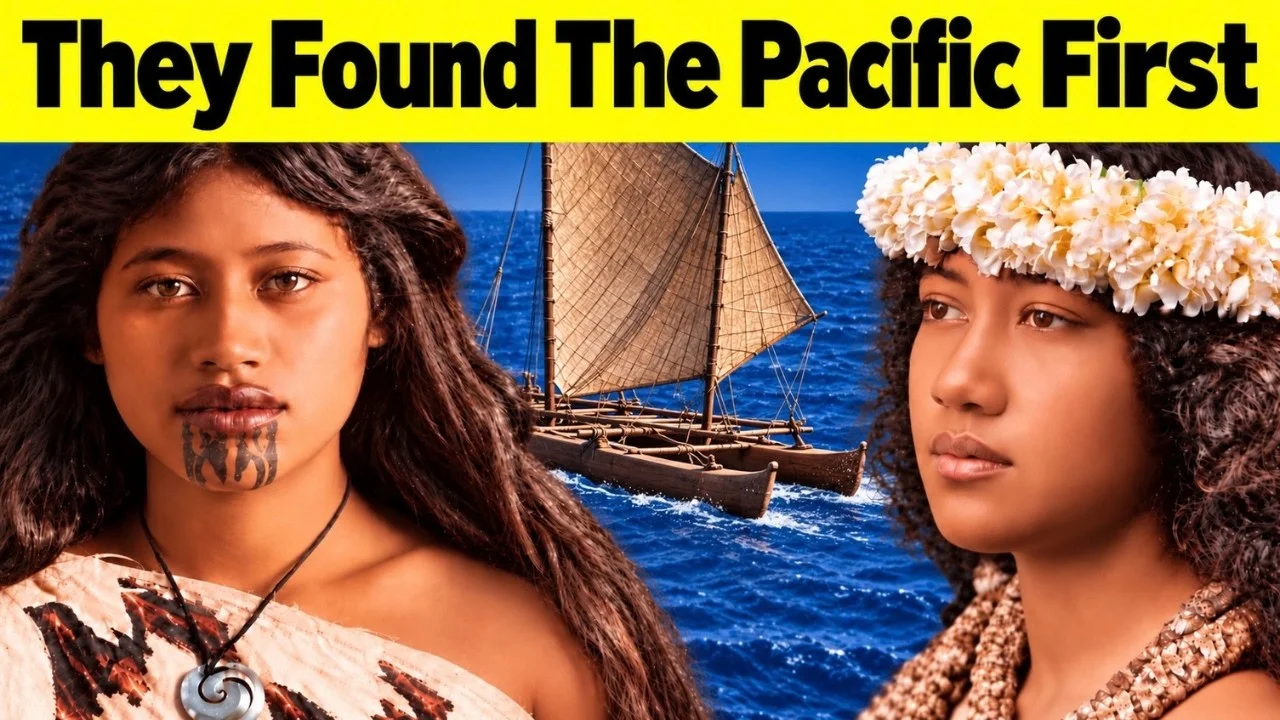
A 2026 study of ancient DNA from Fiji reveals that Polynesian ancestry is far more complex than previously thought, with maternal and paternal lines telling different stories and a rapid expansion that scientists cannot fully explain.
The Polynesian Triangle and the Origins Puzzle ⏱ 0:00
•The Polynesian Triangle covers about one-third of the planet's surface, mostly ocean, with islands from Hawaii to New Zealand to Easter Island.•Before Europeans arrived, these islands were inhabited by people speaking related languages, sharing gods, canoe styles, and tattoo traditions.•Around 40 years ago, the 'express train' model proposed that farmers from South China and Taiwan moved through the Philippines, Indonesia, along New Guinea, and out into the open ocean about 3000 years ago.•These people left behind a distinctive red-slipped pottery with dentate patterns called Lapita, found from Vanuatu to Samoa.Genetic Signatures: Mitochondrial DNA and Y Chromosome ⏱ 2:01
•Mitochondrial DNA (mtDNA) is inherited only from the mother, creating an unbroken maternal line, while the Y chromosome is passed only from father to son.•Nearly all Polynesians carry a common mtDNA signature called the Polynesian motif (B4a1a1), which was thought to originate in East Asia.•New analysis of 1,364 mitochondrial genomes from 68 islands estimates the motif arose about 6,500 years ago near the Bismarck Sea, not Taiwan.•Paternal lines: the dominant Y-chromosome haplogroup C1b2a1 (M208) originated in New Guinea around 9,000 years ago, but ancient Lapita skeletons in Vanuatu and Tonga carried haplogroup O1a (M119), which is Taiwanese.Fiji Study: Two Waves of Settlement ⏱ 6:35
•A 2026 study in Cell, led by Cosimo Posth and Michael Feldman, analyzed 72 ancient genomes from Fiji—the first ancient DNA from the archipelago.•The first wave (Lapita people) had Southeast Asian ancestry, almost no Papuan ancestry, and moved quickly from the Bismarck Archipelago through Vanuatu, Fiji, and Tonga in just a few generations.•The second wave (Papuan ancestry) arrived much later: in Vanuatu around 2,700 years ago, in Fiji about 500 years later.•The second wave replaced the paternal Taiwanese lines, so today almost all Polynesian men carry New Guinea-related Y chromosomes.The Long Pause and the Great Expansion ⏱ 8:36
•After settling Tonga and Samoa around 2,800 years ago, Polynesians stopped expanding east for 1,500–2,000 years—a period called the 'Long Pause.'•Possible reasons: easterly trade winds, lack of boat technology, or no compelling reason to go.•Around 1000 AD, canoes reached Tahiti and nearby islands, then within 200 years expanded to the Tuamotus, Marquesas, Hawaii (4,000 km north), Rapa Nui (3,500 km from any other island), and Aotearoa (New Zealand) by about 1250–1300 AD.•Genetic networks show planned voyages with small founder groups, each island having its own unique canoe lineage.Evidence of Pre-European Contact with the Americas ⏱ 10:37
•Polynesians carry a small amount of Native American ancestry that predates European contact, found in people from the southern Marquesas and dated to around 1200 AD.•In 2024, 15 ancient Rapa Nui individuals were sequenced and found to have about 10% Native American ancestry, with admixture dated between 1250 and 1430 AD—before Europeans reached the island.•Other evidence includes the Pacific rat, which was transported by Polynesians across the Pacific; its DNA shows continued inter-island voyaging after initial settlement.•Chicken bones found in Chile in 2007, dated before Columbus, matched DNA from Tongan and Samoan chickens.•The sweet potato, native to the Andes, was grown throughout Polynesia by 1000 AD, and the Polynesian word 'kumara' resembles the Quechua word 'kumar'.Key Takeaways
•The maternal Polynesian motif originated in New Guinea around 6,500 years ago, not Taiwan as previously thought.•Paternal lines show a complete replacement: early Lapita men carried Taiwanese Y chromosomes, but today nearly all Polynesian men carry New Guinea-related lines.•Settlement of Polynesia occurred in two waves: a fast Lapita expansion with little Papuan admixture, followed by a slow Papuan wave that took 500 years to reach Fiji.•After a 2,000-year pause in Tonga and Samoa, Polynesians rapidly expanded east to Hawaii, Rapa Nui, and New Zealand within 200 years around 1000–1300 AD.•Genetics and archaeology confirm pre-European contact between Polynesians and Native Americans, evidenced by DNA, chicken bones, and sweet potato.Conclusion
The DNA evidence shows that Polynesian ancestry is a complex mix of maternal and paternal lines from different origins, with a long pause followed by a rapid expansion that remains unexplained, but it confirms that Polynesians were not passive drifters but skilled, intentional voyagers.