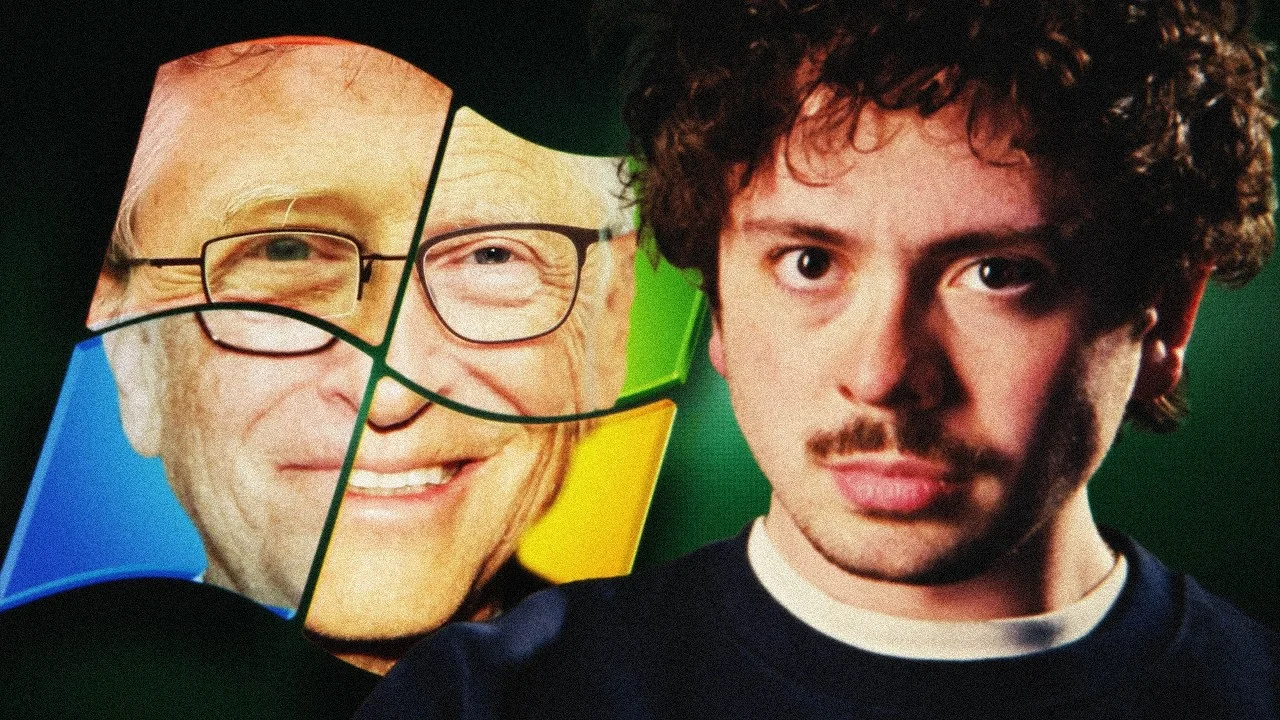
This video traces Bill Gates's career from Microsoft's aggressive rise to dominance of the PC software market, through the antitrust battles of the 1990s, to the creation of the Gates Foundation and its role in global health and the COVID-19 pandemic, and finally to questions raised by his association with Jeffrey Epstein.
Bill Gates: From Hated Businessman to Global Philanthropist and Back ⏱ 0:00
•Bill Gates is now expressing regret for his association with Jeffrey Epstein, and thinking he is outright evil has become the norm, but less than 10 years ago a global survey ranked him as the most admired man on Earth.•For 25 years before becoming the "cute cuddly billionaire" saving sick babies, Gates was the most hated businessman in America, accused of lying, cheating, stealing, sabotaging competitors, bullying employees, and building a monopoly that forced the US Department of Justice to intervene.•Gates helped save millions of lives and create the world of computers, but he also created a level of control and influence over civilization that no other person in modern history could match, becoming the perfect symbol of the billionaire age—"the age where the people who created our problems are allowed to sell us the solution."•In 1982, Microsoft was a 26-person startup in Bellevue, Washington (between a preschool, a La Quinta Inn, and a Burgermaster) run by 26-year-old Bill Gates, who drove a green Porsche 911 he crashed constantly and responded to bad ideas with "That's the stupidest [__] thing I've ever heard."Vaporware, the IBM Heist, and the Rise of a Monopoly ⏱ 0:00
•Microsoft's flagship product was MS-DOS, a 16-bit single-user, single-tasking command-line operating system, and Gates's mantra was "a computer on every desk and in every home," a vision no one else shared—Ken Olsen of DEC famously said, "There's no reason for any individual to have a computer in his home."•Microsoft invented the word "vaporware" internally to describe its strategy: at the end of 1983, it announced Windows at the Plaza Hotel in New York with a promise to release it in 6 months, but Windows 1.0 shipped more than 2 years later; in the meantime, competitors like VisiCorp (whose revenue was 15 times Microsoft's) went bankrupt, and Windows 1.0 got terrible reviews and sold less than 500,000 copies in its first 2 years.•In 1985, Microsoft partnered with IBM (400,000 employees vs. Microsoft's ~1,000) to build OS/2, but Microsoft secretly hired Dave Cutler to build a new OS Microsoft owned outright; in May 1990, Microsoft launched Windows 3.0, which sold 1 million copies in 4 months and 15 million within a year, while IBM announced an $8 billion annual loss in January 1993—the largest single-year corporate loss in American history—and later laid off 100,000 employees.•By 1994, Microsoft employed more than 50,000 people, and of the almost 60 million personal computers in the US, 54 million ran Microsoft Windows; Microsoft went public, making Gates the youngest self-made billionaire in American history and soon the richest man in the world, while Word, Excel, and PowerPoint were used by every accountant, secretary, and student in America.Microsoft's Monopoly and Public Backlash in the 1990s ⏱ 20:00
•Microsoft's aggressive tactics: lost a patent trial to Stack Electronics with $120 million restitution, embedded code in Windows to crash competitors' programs, forced per-processor licenses requiring royalty on every computer sold, and threatened Compaq with license termination to restore Internet Explorer icon; Windows market share passed 96% by the mid-1990s.•By 1998, Microsoft employed 30,000 people, worth $600 billion, campus grown to 40+ buildings, 15,000 employees became millionaires; Bill Gates, 42, net worth $60+ billion, worth more than New Zealand's GDP.•Public image turned negative: called a monopolist by Time, 'Robber Baron' by Business Week, mocked on SNL and The Onion, hit with a pie, portrayed as villain in Hollywood film; his treatment of Paul Allen, including plotting to dilute Allen's shares while Allen had Hodgkin's lymphoma, and Allen's account of Gates' abusive behavior, explained his character.•Background: Gates attended elite Lakeside school with a computer, met Paul Allen, dropped out of Harvard, started Microsoft; Allen was the visionary, Gates the closer who used humiliation and lies to close deals; IBM contract came via Gates' mother's connection to IBM CEO John Opel.•Gates saved Apple with a $150 million investment in 1997 to avoid appearing as a monopoly, but the DOJ still filed an antitrust lawsuit; Microsoft crushed Netscape by making Internet Explorer free and forcing manufacturers to include it, driving Netscape from 85% to less than 10% market share in 2 years.Microsoft Antitrust and Bill Gates's Departure ⏱ 40:00
•In 1890, Congress passed the Sherman Antitrust Act; under it, Standard Oil was broken into 34 corporations after controlling 90% of US oil.•Microsoft had been investigated for most of the 1990s; in 1994 it signed a consent decree to stop forcing manufacturers to pay royalties on all PCs, but continued its practices, strangling Netscape and strong-arming Compaq.•In May 1998, 20 state attorneys general and the federal government filed United States versus Microsoft; in his deposition, Gates said "I don't know," "I don't remember," or "I don't recall" more than 200 times over three days.•The judge ruled Microsoft an illegal monopoly and ordered it broken in two, but the decision was appealed and overturned; Gates had already stepped down weeks after the ruling at age 44, still the richest man alive.The Gates Foundation: From Philanthropy to Global Influence and the Pandemic ⏱ 44:05
•In January 2000, Gates announced a $750 million donation to save children from disease; the Bill and Melinda Gates Foundation was initially funded with $5 billion and promised to eradicate polio, cure malaria, end childhood deaths from preventable disease, fix US education, and feed sub-Saharan Africa, aiming to save 122 million lives.•In 2000, malaria killed around 800,000 children yearly, tuberculosis 300,000, and there were 15 million AIDS orphans; polio paralyzed and killed children in 80 countries.•The foundation spent $10 billion on polio, hiring armies of vaccinators; India hired 2.3 million vaccinators to immunize 100 million kids in one week, and India has been polio-free for 14 years; around 100 vaccinators were murdered in Pakistan by the Taliban; they also spent over $7 billion on malaria, funded the first malaria vaccine approved by the WHO in 2021, and helped save over 12 million lives; rotavirus deaths fell to 128,000 per year from over 500,000 in the late 1990s; they put computers and high-speed internet into 11,000 libraries; in total, they vaccinated 1.2 billion children in more than 80 countries and claim to have saved 82 million lives.•By 2019, Gates was a secular saint: Time Person of the Year in 2005, honorary knighthood from Queen Elizabeth II, Presidential Medal of Freedom in 2016, and ranked most admired man for 6 years in a row; the Giving Pledge had over 200 billionaires.•In 2020, a years-old video of Gates warning that a highly infectious virus could kill over 10 million people went viral, and he was hailed as a prophet; the Gates Foundation became directly involved in the global COVID response.Gates, COVAX and the Philanthrocapitalism Backlash ⏱ 60:01
•COVAX was run by the WHO, CEPI and GAVI; CEPI was established and funded by the Gates Foundation and GAVI was set up by Gates as the vaccine logistics hub, while the Gates Foundation supplies 10% of WHO's yearly funding, making it the second largest donor behind Germany.•COVAX fell short: it delivered less than half its original 2021 target, only 0.4% of COVID tests and 0.5% of vaccines went to low-income countries, and 99.5% of vaccines went to rich countries, arriving in South Asia and Africa only after the variants were gone.•In October 2020, India and South Africa proposed a temporary patent waiver supported by 100 nations, the WHO, the African Union, the Pope, Prince Harry and Elton John; Bill Gates said no, which critics read as protecting centralized control over vaccines (the Biden administration later pushed it through), turning his image from humble philanthropist to a symbol of greed and control.•Tim Schwab calls the foundation "a structure of power" that should be among the most investigated institutions on Earth yet remains one of the most admired; its theories became programs: billions on smaller schools, new teacher evaluations and Common Core (largely repealed with no lasting legacy), and AGRA, which promised to double crop yields and halve hunger but saw undernourishment rise and small farmers pushed into dependence on commercial seeds and fertilizers.•The core complaint: one unelected billionaire holds quasi-governmental influence over education, agriculture and global health with no oversight, and by 2023 the foundation had given over $400 million in journalism grants (BBC $50 million, NPR $24 million, The Guardian $13 million, plus The Atlantic, ProPublica, The Financial Times, Al Jazeera, The New York Times) which Schwab says is meant "to defang his watchdogs and bring them to heel."•The speaker concedes the foundation did real good — vaccinated kids, fewer diseases, libraries with computers, mothers surviving childbirth — but argues Gates did charity the way he did tech, seeking control and domination.The Epstein Friendship, the Divorce and the Final Verdict ⏱ 60:01
•Weeks after Epstein died on August 10th, 2019, Gates said he had no business relationship or friendship with him, but the New York Times showed he had met Epstein regularly for years in the early 2010s after Epstein's release from prison, including visits to his Manhattan townhouse and flights on his plane.•Gates' alibi was that Epstein promised to raise billions for global health that never materialized; colleagues' emails called Epstein's lifestyle "kind of intriguing," and a Boris Nikolic, a 10-year chief science and technology adviser at the Gates Foundation, appears in the Epstein files more than 14,500 times, is the fourth most connected person in the docs, and was named successor executor in Epstein's will.•Epstein reportedly held intimate details of Gates' extramarital affairs and prepared blackmail emails; Gates apologized for a "foolish mistake" but insisted he had nothing to do with Epstein's illicit activities, and Melinda Gates said she regretted meeting Epstein, describing him as "evil personified" and saying she had nightmares and that her husband should answer for himself in public.•Bill and Melinda announced their divorce after 27 years in summer 2021, around 6 months before her March 2022 statement; Gates is scheduled to testify before Congress on his Epstein relationship later this summer, and the speaker declines to conjecture further.•Final takeaway: the problem isn't that Gates gave his money away, it's that he ever had that much money to give — the nicest, most generous billionaire is still the wrong person to save the world, and in a functioning society our future would not depend on the whims of one person.Key Takeaways
•Microsoft's flagship product was MS-DOS, a 16-bit single-user, single-tasking command-line operating system, and Gates's stated goal was a computer on every desk running Microsoft software.•Microsoft used aggressive tactics against competitors, including losing a patent trial to Stack Electronics with $120 million in restitution and embedding code in Windows intended to crash rivals' programs.•The Sherman Antitrust Act of 1890, under which Standard Oil was broken into 34 corporations after controlling 90% of US oil, formed the legal backdrop for the Microsoft antitrust case.•In January 2000 Gates announced a $750 million donation to save children from disease, and the Bill and Melinda Gates Foundation was initially funded with $5 billion.•COVAX was run by the WHO, CEPI and GAVI; CEPI was established and funded by the Gates Foundation, and GAVI was set up by Gates as the vaccine logistics hub.•Weeks after Epstein died on August 10th, 2019, Gates said he had no business relationship or friendship with him, but the New York Times showed he had met Epstein multiple times.Conclusion
The video follows Bill Gates from Microsoft's monopoly-era tactics and antitrust clashes through the Gates Foundation's global health and pandemic work, ending with his statements about Jeffrey Epstein and the scrutiny of their meetings.