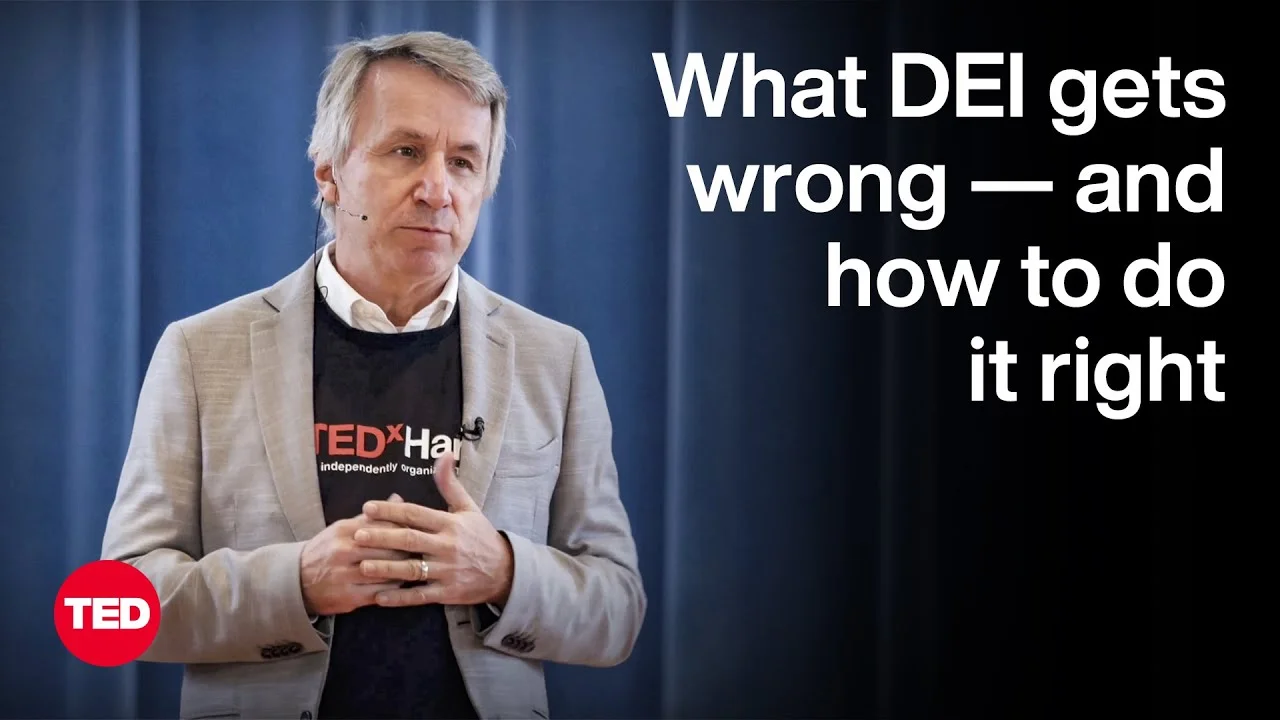
Paolo Gaudiano argues that decades of DEI efforts have been flawed by focusing solely on diversity (the D) while neglecting inclusion and equity, leading to backlash and wasted resources. He presents a data-driven case for measuring and improving inclusion as the path to genuine diversity and better business outcomes.
The Diversity Disconnect: Why Focusing Only on Representation Fails ⏱ 1:35
•No tools exist to quantify what happens when an organization becomes more diverse, unlike other asset classes.•Diversity targets can trigger backlash, perceived as reverse discrimination, and are mathematically unfair to white men.•The real problem is retention: McKinsey's data shows at entry level ~40% white men, but at executive level white men increase by >30%, while women and people of color decrease by >30%.•Pushing diversity at entry levels without fixing inclusion is like lighting a match under a thermostat when windows are open and roof is leaking.Redefining DEI: Inclusion Is What You Do, Diversity Is What You Get, Equity Is What You Want ⏱ 5:44
•Example: a perfect team loses performance when one member underperforms; if a second is added, frustration spreads and team performance plummets.•Anything that causes someone to feel excluded due to personal characteristics hurts the organization's performance.•Inequity is visible when retention, performance, or outcomes differ among groups.•Quantitative example: if a company has 1,000 women paid $100k/year average, losing 10% retention vs. men (100 women) costs $10 million annually in replacement costs.Why Inclusion Is Invisible and How to Measure It ⏱ 8:53
•Inclusion is like health: we notice it only when absent. Leaders (often white men) are least qualified to see or fix exclusion.•Gaudiano's organization measures inclusion by measuring exclusion via confidential online platform where employees share specific experiences.•Three real examples from their data: - A senior female engineer asked to speak to "a guy who works in IT" instead.
- A parent passed over for travel because it was "assumed" they couldn't go.
- A VP said Martin Luther King Day was "not a real holiday" and shouldn't be taken off.
•These experiences drive talent away, costing money.The Business Case: A 30:1 Ratio of Payroll to Advertising ⏱ 12:34
•US companies spend $250 billion annually on advertising; payroll is $7.5 trillion — 30 times more.•If a CEO has 10 people optimizing marketing, they should have 300 people working on DEI.•Failing to invest proportionally is failing shareholders.Key Takeaways
•Decades of DEI focused solely on diversity (representation), ignoring inclusion and equity, which causes backlash and fails to retain diverse talent.•McKinsey data shows white men increase by >30% from entry to executive levels, while women and people of color decrease by >30%, proving retention is the real problem.•Inclusion is invisible to those who have it; leaders (often white men) are least qualified to see or fix exclusion.•Measuring exclusion through anonymous employee stories reveals specific barriers and costs; a 10% retention gap for women can cost $10 million annually.•US companies spend 30 times more on payroll than advertising; CEOs should allocate DEI resources proportionally.Conclusion
Creating an inclusive organization leads to greater diversity, equity, and profitability — it is both a moral imperative and a smart business decision.