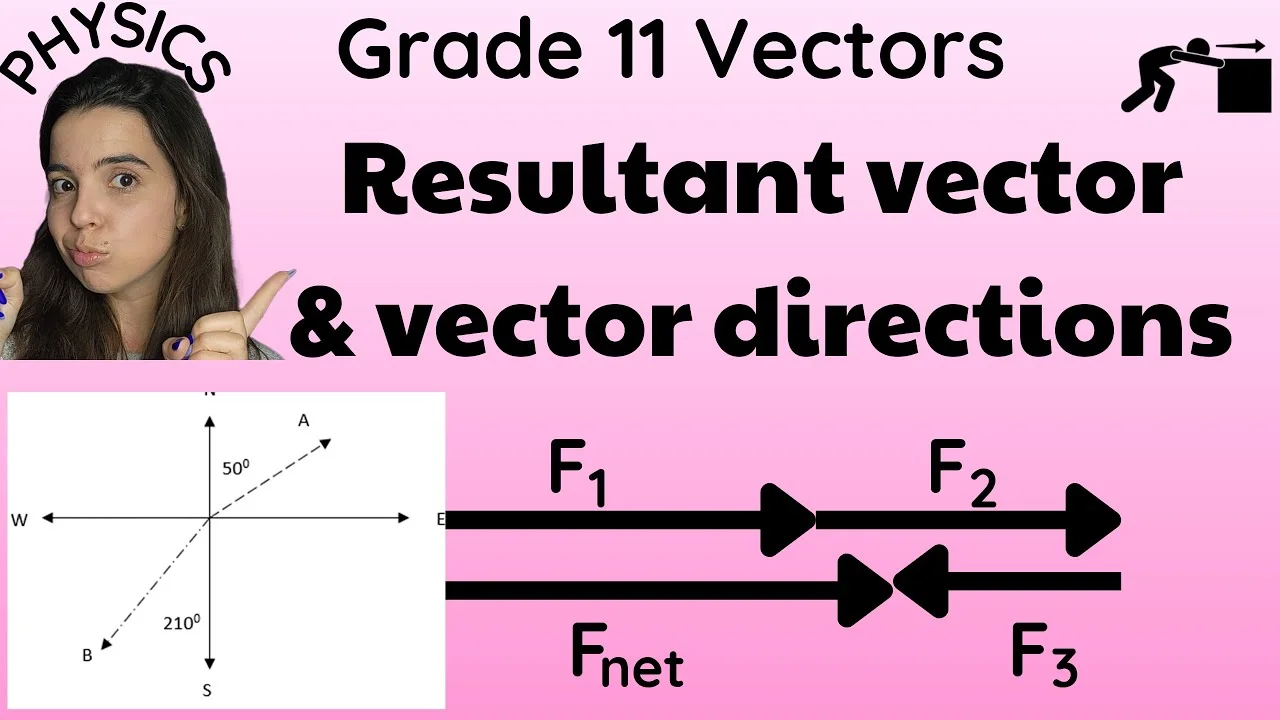
This article explains the concept of resultant vectors and the three essential methods for stating vector directions, crucial for exam success in grade 11 physics.
What is a Resultant Vector?
•A resultant vector is the vector sum of two or more vectors added together.•Alternatively, it is a single vector that has the same effect as two or more separate vectors combined.•For example, a diagonal vector can be broken down into horizontal and vertical components that together produce the same overall effect.Methods for Stating Vector Directions
•Bearing: Measured clockwise from north (e.g., 0° for north, 90° for east), useful but less common in exams.•Cartesian plane: Direction is given as an angle clockwise or anticlockwise relative to the positive x-axis (e.g., 30° clockwise).•Compass direction with angle: Uses phrases like 'north of east' or 'east of south', where the angle is wedged between the vector and the last-named compass point.Teacher Tips for Exams
•Always include a direction when answering vector questions, as marks are not awarded without it.•If a question asks for 'magnitude' only, direction is not required.•Exam questions may specify which direction method to use (e.g., 'relative to the positive x-axis'), so follow instructions carefully.Key Takeaways
•A resultant vector represents the combined effect of multiple vectors, essential for solving physics problems.•Vector directions must be stated using specific methods like bearing, Cartesian plane angles, or compass directions to earn full marks.•In exams, always check if direction is required and use the method specified in the question to avoid losing points.Conclusion
Mastering resultant vectors and direction methods is key to excelling in grade 11 physics exams.