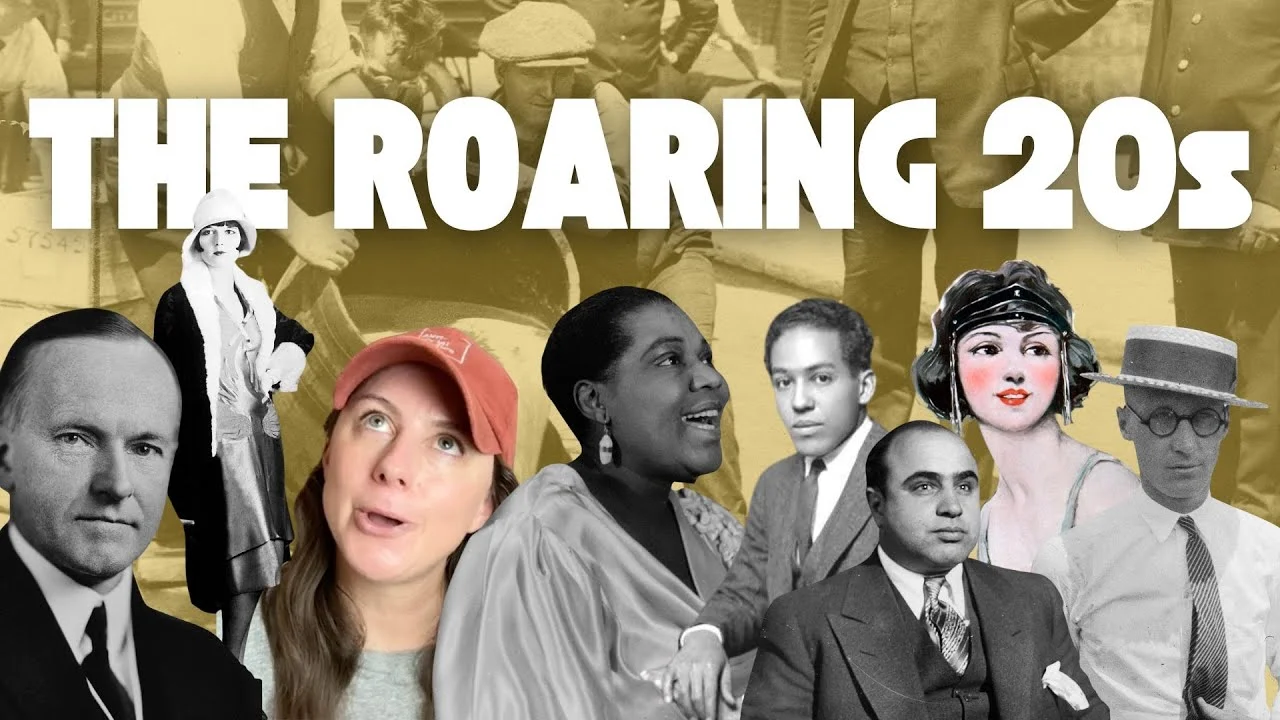
The 1920s in America were a decade of economic boom, cultural change, and social conflict, marked by a return to isolationism, Republican leadership, and a vibrant black cultural renaissance.
Political and Economic Context ⏱ 0:00
•After WWI, Americans sought a return to normalcy, electing Republican presidents.•Harding's slogan was "America first."•The US became isolationist, focusing on the economy and avoiding global affairs.•The economy boomed: the US entered WWI as a debtor nation but ended with Allies owing $10 billion.•By the 1920s, the US was the dominant economic power in the Western world.•The Kellogg-Briand Pact (1928) had 15 nations agree to abandon war.•The US funded Germany's war reparations to stabilize Western economies.•Treasury Secretary Andrew Mellon's policy: balance budget, reduce debt, cut taxes (supply-side economics).•By 1928, income tax for most Americans was 1-5%; for the richest, it dropped from 73% to 25%.•Per capita earnings grew 22% over the decade, work hours decreased.•Henry Ford's Model T became affordable: 80% of car-owning families lacked bathtubs with running water.•Postal service carried mail via planes; Congress invested in airports.•In 1927, Charles Lindbergh completed first transatlantic solo flight.•Radio grew: in 1920, one of first public broadcasts announced Harding's victory; by 1929, over 12 million radios in use; NBC and CBS broadcasting nationwide.Political Scandals and Coolidge ⏱ 4:28
•Harding's cabinet, the "Ohio Gang," was embroiled in scandals.•The first VA head stole medical supplies meant for vet hospitals.•Teapot Dome scandal (1922): Secretary of Interior Albert Fall leased federal oil reserves for bribes; he became first cabinet secretary to go to prison in 1929.•Harding died near end of first term; Coolidge succeeded him.•Coolidge's Wikipedia page says he gave "unremarkable speeches" and hid from his staff.•Coolidge won 1924 election; said "the business of America is business."•He epitomized laissez-faire governance and left before the Great Depression.Social and Cultural Changes ⏱ 6:40
•The 1920s were about a feeling: young people moved to cities, had cars, fought in WWI, and faced Prohibition.•Flappers: women with short dresses, bob haircuts, bright lipstick; emerged from workplace participation, suffrage, and birth control.•Designers like Coco Chanel popularized sportswear (tennis dresses).•Prohibition (18th Amendment) led to bootlegging, an illegal alcohol industry run by gangs.•Al Capone led the Chicago Mafia; St. Valentine's Day Massacre (1929): seven rivals machine-gunned by Capone's men.•Discrimination forced many immigrants into the black market.•Harlem Renaissance: black cultural golden age.•The Great Migration moved over 300,000 African-Americans from the South to cities.•Harlem became a global mecca for black artists.•W.E.B. Du Bois and the NAACP's magazine "The Crisis" promoted black creativity.•Notable figures: novelist Jessie Redmon Fauset ("There is Confusion," 1924), poet Langston Hughes, actor Paul Robeson, composer Duke Ellington, singer Bessie Smith.•Shuffle Along (1921) debuted on Broadway.•Artist Aaron Douglas adapted African art styles; known as father of black American art.•Jazz and blues mixed African instruments (banjo, drums) with European big band sounds.•Bessie Smith died after a car accident: the first ambulance was from a white hospital and refused to take her.•Divisions within Harlem Renaissance: generational divides, taboo topics (homosexuality), debates over selling out (e.g., Cotton Club had all-white audience but black talent).Cultural Divide and Scopes Trial ⏱ 14:14
•1920 was first year more Americans lived in cities than rural areas.•Rural areas were still in the 19th century, leading to cultural clashes.•Evangelical Christians felt left behind.•Scopes Trial (1925): high school teacher John Scopes taught evolution, violating Tennessee law.•Clarence Darrow (progressive) vs. William Jennings Bryan (evangelical).•Scopes was found guilty and fined, but punishment was thrown out.•The trial embarrassed evangelicals, who stayed out of politics for about 50 years.•Darrow eviscerated Bryan's views on literal interpretation of Christianity.Key Takeaways
•The 1920s saw Republican presidents Harding, Coolidge, and Hoover promoting isolationism and supply-side economics.•The economy boomed: income tax fell to 1-5% for most, and car ownership soared.•Prohibition fueled organized crime, with gangs like Al Capone's profiting from bootlegging.•The Harlem Renaissance was a golden age for black culture, producing figures like Langston Hughes and Duke Ellington.•Cultural conflict erupted in events like the Scopes Trial, pitting modernism against traditional evangelical Christianity.Conclusion
The 1920s were a decade of contradictions: economic prosperity and cultural liberation existed alongside deep social divisions and the seeds of future crises.