Legendary programmers are deeply divided over AI's role in software development. From Linus Torvalds to George Hotz, the industry's most influential figures have staked out opposing positions on whether AI coding tools are a revolution or a costly mistake.
The Skeptical Holdouts ⏱ 0:30
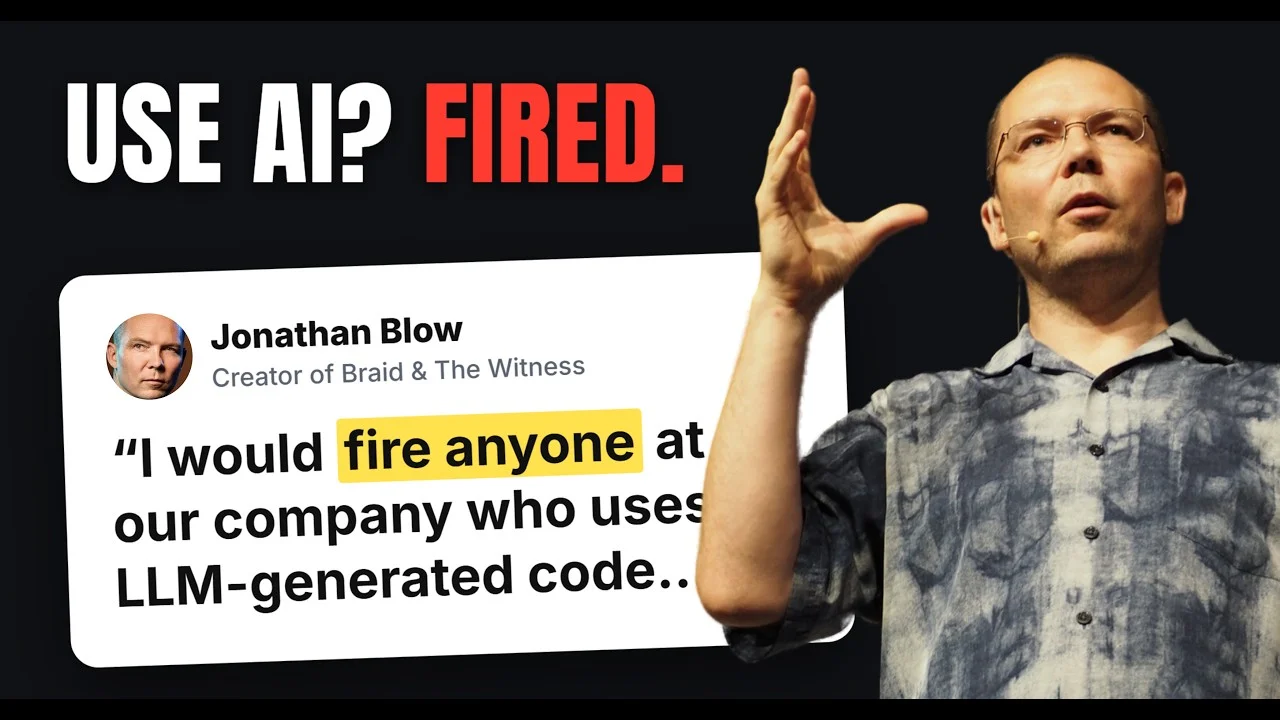
•George Hotz, who jailbroke the first iPhone at 17, predicted in 2023 that AI would turn 10x engineers into 100x engineers and wipe out entry-level programmers. After six months testing AI coding agents on real codebases, including custom deep learning GPU kernels for tinygrad and reverse engineering firmware, he reversed his stance in May 2026 with a post titled "The Eternal Sloptember."•Hotz wrote: "I'm calling it now: the adoption of AI agents into software development will be one of the most costly mistakes in the field's history. Agents cannot program, and it's taking longer and longer to realize that they can't." He described AI models as highly sophisticated statistical models that mimic programming output, producing broken code in ways that are getting harder to detect.•Jonathan Blow, creator of Braid and The Witness and developer of the Jai language, said: "It's context that doesn't matter because LLMs do not reason well enough to program for real. They can only pretend to program right now." He added that additional scaffolding won't "change a donkey into a horse." He also stated he would fire anyone at his company who uses LLM-generated code in a game.•Bjarne Stroustrup, creator of C++, said LLM-based code is not good at safety-critical, performance-critical code. He estimated that 70 or 80% of the world's code doesn't fit that pattern, but the 10 to 20% that does is where he is interested, and "it's not there, and I don't see it coming with the LLM model." He said LLM-based code is "imitating old code and getting old performance and old bugs." He also invoked Dijkstra, who claimed the idea of natural languages as programming languages was idiotic.The Converts ⏱ 4:17
•Andrej Karpathy, who built Tesla's Autopilot vision pipeline and co-founded OpenAI, coined the term "vibe coding" in early 2025 for casual weekend hacking. By early 2026, the amount of code he wrote by hand dropped drastically. He sees engineering splitting into those who fell in love with typing code and those who just want to build things.•David Heinemeier Hansson, creator of Ruby on Rails, initially feared that not typing code meant he wasn't learning. He dismissed vibe coding as empty calories and kept AI in a separate window for explanations. Months later, after the underlying models improved, he admitted his core reason for holding out was gone.•Steve Yegge argued back in 2024 that the profession had fundamentally flipped and that anyone clinging to the old way was in denial. Over the following year, he claimed he pushed nearly a million lines of code, an output rivaling his entire four-decade career. Letting go of skills he spent 40 years mastering took an emotional toll, but the leverage was too big to ignore.•During that run, an agent accidentally wiped Yegge's production database passwords. He kept going anyway, viewing occasional disasters as a cost of doing business when shipping at 10 times normal speed.Linus Torvalds: The Pragmatic Adopter ⏱ 8:02
•In late 2024, Linus Torvalds called AI "90% marketing and 10% reality" and said he would basically ignore it.•By mid-2026, Google engineers deployed an automated AI review system across the Linux kernel mailing list. When anti-AI developers pushed back, Torvalds shut the debate down: "I realize that some people really dislike AI, but this is an area where I'm willing to absolutely put my foot down as the top-level maintainer. Linux is not one of those anti-AI projects. And if somebody has issues with that, they can do the open-source thing and fork it, or just walk away. AI is a tool, just like other tools we use, and it's clearly a useful one."•Torvalds compared AI to compilers decades ago: a tool that handles low-level mechanics without making programmers obsolete. But adopting it created an operational headache. By late summer 2026, the Linux 7.2 release was hit with a massive wave of AI-assisted code, and release candidates ballooned to historic sizes. Torvalds said: "I can't say that I'm exactly thrilled about the size of this all, but it is what it is. The new normal with a lot of fixes, many of them due to review by various AI tools."•He noted the tools are digging up real, embarrassing bugs that humans have missed for years, and you don't ignore something that works just because the cleanup is a headache.The Test-Driven Camp ⏱ 9:36
•Kent Beck, creator of test-driven development and extreme programming, said after testing advanced large language models: "This means that the value of 90% of my skills has dropped to $0, and leverage the remaining 10% in a new way." Two years later he added: "This idea that I can go, 'I wonder what a B+ tree looks like in Go.' I've got 40 years' worth of ideas that suddenly are back in play, and I'm having so much fun making things that are real."•Beck compares working with coding agents to dealing with unpredictable genies: you ask for something but rarely get exactly what you intended. His solution is not to micromanage agents but to make test-driven development the steering wheel.•Robert C. Martin, known as Uncle Bob, author of Clean Code, revealed: "I started coding in the late '60s. My current strategy is not to read any of the code written by my agents. That's the only way I can take advantage of their productivity." Instead, he surrounds agents with extreme constraints: unit tests, Gherkin tests, QA procedures, quality metrics, mutation testing, test coverage, and more.•Uncle Bob said he has very high confidence in the code because agents have had to run the gauntlet of all constraints and tests. To him, engineering in the AI era is about designing prison walls so tight that bad code can't escape.Key Takeaways
•George Hotz reversed his pro-AI stance after six months of testing, calling AI agent adoption 'one of the most costly mistakes in the field's history.'•Jonathan Blow and Bjarne Stroustrup argue LLMs cannot reason well enough for real programming, especially safety-critical and performance-critical code.•Linus Torvalds initially dismissed AI as 90% marketing but later insisted Linux is not an anti-AI project, accepting AI tools despite ballooning release sizes.•Kent Beck said 90% of his skills dropped to $0 in value, while Uncle Bob stopped reading agent-written code entirely, relying instead on automated constraints and tests.•Steve Yegge pushed nearly a million lines of code in a year using agents, even after an agent wiped his production database passwords.Conclusion
No camp has cleanly won the war: using agents brings speed but bloated repos and subtle bugs, while refusing them protects the codebase but risks being outshipped. The real divide is psychological—how much risk you tolerate versus how much control you demand.