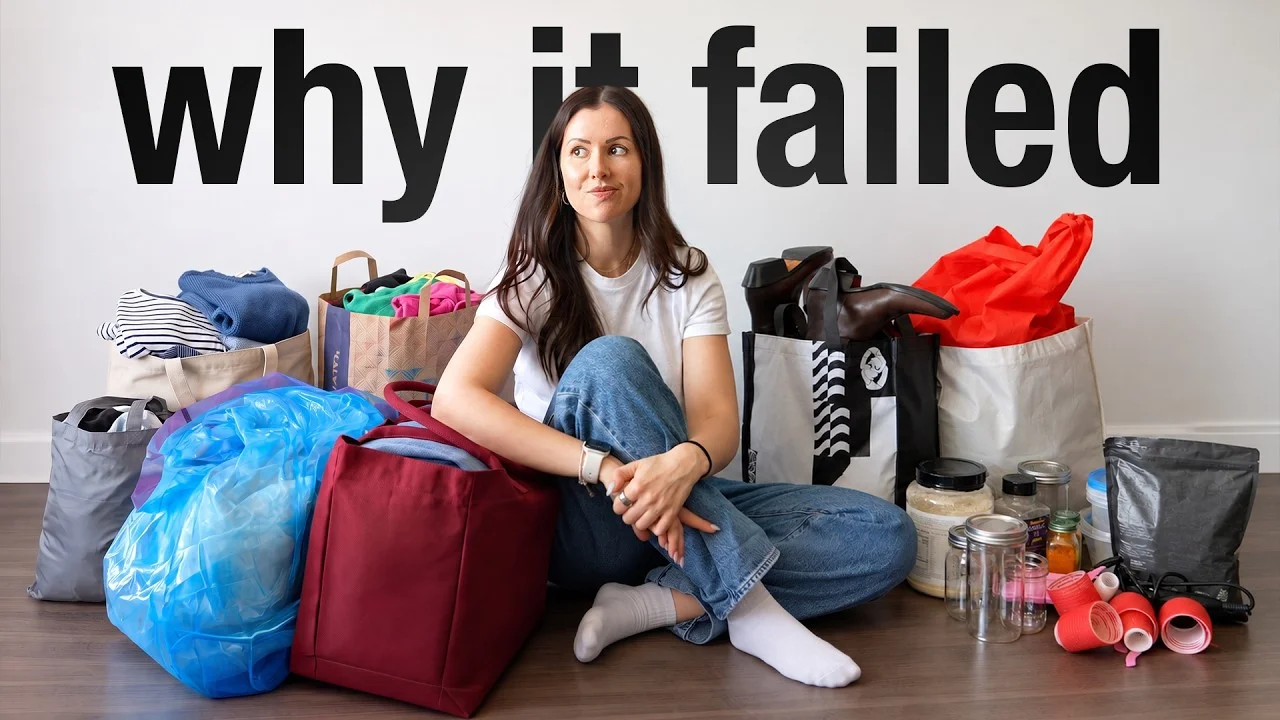
A look back at the minimalist rules of the 2010s that no longer hold up, and what works better a decade later.
Minimalism as an Aesthetic, Not a Practice ⏱ 1:01
•The all-white apartment with gray furniture became the iconic minimalist look, spreading to coffee shops, boutiques, and logo design.•People decluttered but then bought the aesthetic to replace what they removed, creating an expectation of what minimalism should look like.•If items didn't look minimalist enough, people painted walls gray, bought matching Tupperware sets, and decanted everything into glass containers or amber vials.•Chasing the ultra-minimalist aesthetic meant buying things just to look like you didn't buy things.•The focus on how you consume was lost; the core of minimalism is your relationship to consumption, not its appearance.The Capsule Wardrobe Numbers Game ⏱ 3:02
•The capsule wardrobe is a small, curated collection of versatile, high-quality clothing that can be mixed and matched.•The internet turned it into a numbers game: owning more than 10, 20, or 30 pieces made you an over-consumer.•Example: Person A has a perfect 30-item capsule but constantly shops, returns, and declutters; Person B has 90 items curated over decades, loves her clothes, and shops less.•The better question is: can I build a wardrobe that makes me want to stop shopping and that I'm content with?•Fewer clothes became synonymous with being better, which dismissed people who love fashion and don't mind a larger wardrobe.The 6-Month and 20/20 Decluttering Rules ⏱ 5:37
•The rule "if you haven't worn it in 6 months, get rid of it" can be useful for people who struggle with decisions, but it led to getting rid of things that were later bought back.•Many items are more expensive and worse quality today, so decluttering something perfectly good risks spending double for a worse product.•The 20/20 rule (replace something for less than $20 in less than 20 minutes, then get rid of it) assumes $20 isn't a lot of money to many people, and $20 in 2026 buys much less than in 2016.•Even with $20 to spare, replacing an item costs time researching, reading reviews, dealing with packaging, and may not be equivalent.•The 2026 version of minimalism focuses less on decluttering as much as possible and more on utility, value, and intentionality.The Spark Joy Rule and the Accumulation Problem ⏱ 8:37
•Marie Kondo is not a minimalist, but she got swept up in the decluttering side of the movement.•People interpreted spark joy as getting rid of anything they didn't love; junk removal requests and donations went up by 200% in 2020.•At the same time, online shopping in the US went up 43%, so people were decluttering and buying at unprecedented rates.•Minimalism taught people to declutter well, but many forgot the part about accumulation and using shopping as a coping mechanism.•Decluttering isn't the same as consuming less; you can be a pro at decluttering while continuously acquiring.Underconsumption Core and the Future of Minimalism ⏱ 10:37
•Around 2022-2023, Gen Z rebranded minimalism on TikTok as "underconsumption core," which means using what you have until it's finished.•It focuses on use rather than how much you own or what it looks like, making intentional spending and using more accessible.•Underconsumption impresses through how much you use an item, which is the true core of minimalism.•Minimalism isn't dead; it has a PR problem and isn't searched on Google as often, but the fundamental idea is alive.•What needs to be decluttered is the pursuit of aesthetic minimalism over functional minimalism.Key Takeaways
•Minimalism in the 2010s became about buying an aesthetic rather than changing consumption habits.•The capsule wardrobe was distorted into a numbers game that caused more stress and shopping.•Rules like the 6-month and 20/20 decluttering rules ignore replacement costs and quality issues.•During the pandemic, donations and junk removal rose 200% while online shopping rose 43%, showing decluttering isn't the same as consuming less.•Underconsumption core (using what you have until it's finished) better captures the original intent of minimalism.Conclusion
Minimalism's fundamental idea remains relevant, but it works better when focused on utility, value, and intentionality rather than chasing a perfect aesthetic or arbitrary numbers.