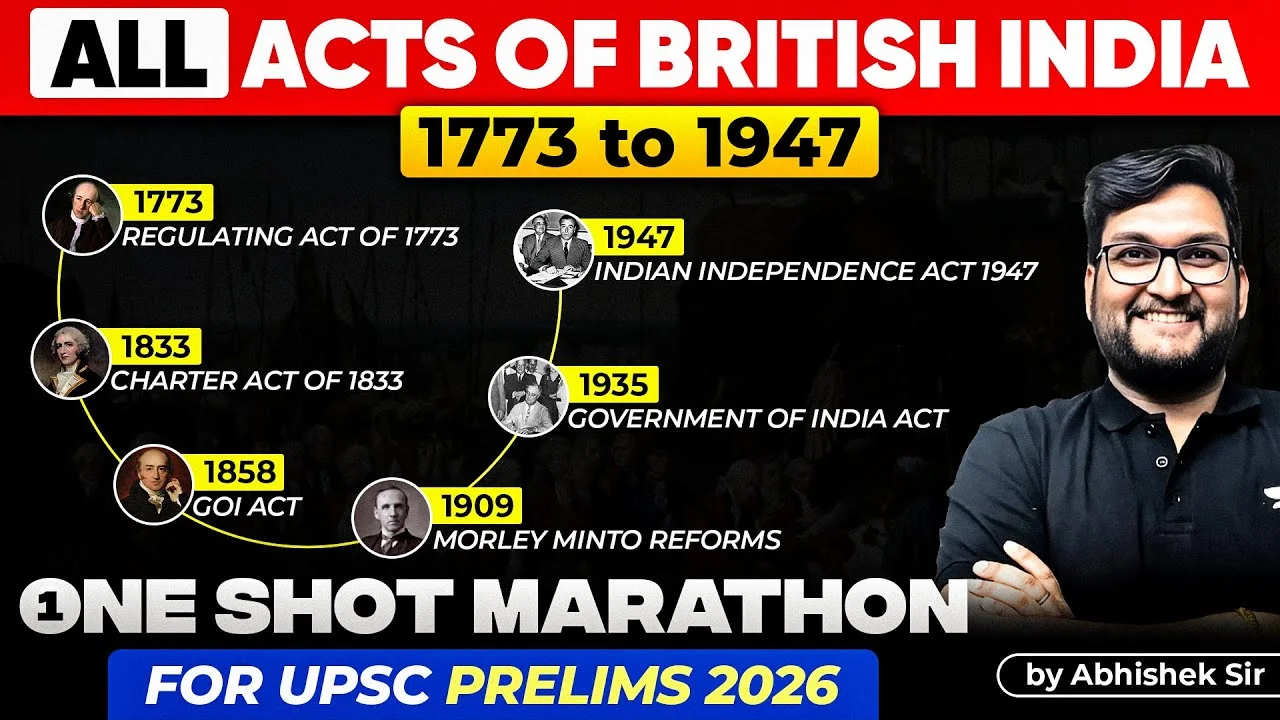
This session covers all acts of British India from 1773 to 1947 as a one-stop solution, with emphasis on their importance for UPSC Prelims 2026 based on past 10 years of PYQs. Each act is discussed through its context, provisions, and a code or trick to help students avoid mixing up the acts.
Introduction and Structure of the Session on British India Acts (1773–1947) ⏱ 0:06
•Session covers all acts of British India (1773–1947) as a one-stop solution; topic is critical for UPSC Prelims 2026 based on past 10 years of PYQs where a question appeared every year or alternate year — be it 1935, 1919, 1909, or indirect questions; there was a controversy over the 1935 Act.•The 14 acts to be covered in this 2.5–3 hour session: 1773, 1781 Amending Act, 1784, Charter Acts of 1793, 1813, 1833, 1853, then transition Act of 1858, followed by 1861, 1892, 1909, 1919, 1935, and the Indian Independence Act 1947.•Speaker will teach, make students learn, and revise in the same session using flow charts and PPT, and will give tricks/codes to remember major provisions; the acts are grouped as Regulating, Amending, Pitt's India, Charter Acts, Government of India Acts, Indian Council Acts, and the Indian Independence Act.•The Constitution is based on the Government of India Act 1935; this topic helps in both Polity and History; questions have appeared on 1833 (Governor General of India aspect), 1935, 1919 (three times), 1909 (separate electorates), and the Regulating Act.Context and Provisions of the Regulating Act 1773 and Amending Act 1781 ⏱ 0:06
•Discussion of each act is divided into context, provisions, and a code/trick; problem is students mix up acts like Regulating Act with Pitt's India Act, or 1813 with 1848.•Context of 1773: Battle of Plassey 1757 gave the British a foot in the door, but the real battle was Buxar 1764–65, through which the Treaty of Allahabad gave Diwani rights (revenue administration); Clive's policies (European supervisors over Amin and Amil) led to the famines of 1769–70 and the Clivian fiscal bubble where revenue was estimated five times higher than actual, causing stock price rise then collapse; the Company sought bankruptcy in the British Parliament while extracting crores of dam from Bihar, Bengal and Orissa.•Four major issues — too much corruption (bribes, gifts), too much private trading (Clive himself traded as an individual), privileges taken by Clive in the first and second loot of Bengal, and the rotten system — led to the British Parliament regulating the Company.•Pre-1773 structure: Court of Directors (COD) nominated by shareholders, with three equal governors — Bengal (Clive was first Governor of Bengal), Madras, and Bombay — each dealing with the COD separately. After the Regulating Act 1773: Governor of Bengal became Governor General of Bengal (Warren Hastings first), with a four-member Executive Council (Governor General of Bengal in Council); Madras and Bombay were subordinated to him — this is legislative centralization; a Supreme Court was established in Calcutta in 1774 with 1 Chief Justice + 3 judges; Company servants were barred from private trading; and the COD had to report Indian revenue to the British Parliament for the first time.•Code to remember: ``73 GGB + 4 LCSC`` — 1773, Governor General of Bengal, plus four-member council, Legislative Centralization, Supreme Court (1 + 3); no micro provisions should be added to the code. By the 1781 Amending Act, two power centers had emerged — Governor General in Council and the Supreme Court with Chief Justice — and by 1773 in the next five to six years, two-three major issues emerged: whether the Governor General and his council were answerable to the judiciary in the form of the Chief Justice, and whether Company officers were answerable to the Chief Justice.From the Amending Act (1781–86) to Pitt's India Act (1784) ⏱ 20:37
•The Amending Act fixed the 1773 gap: company officers became answerable only to the Governor-General in Council, not the Chief Justice — removing judicial control over executive officers; the Supreme Court of Calcutta (Chief Justice + three judges) was confined to Calcutta inhabitants and to Hindu law, Muslim law, or English jurisprudence.•Revenue matters were removed from the Supreme Court and given to the Governor-General in Council, making the District Collector a judicial officer in Mal Adalats; appeals from provincial courts went to the Governor-General of Bengal, not the Supreme Court, and company servants gained immunity — concentrating power in the Governor-General while distorting separation of powers.•A small 1786 amendment gave Cornwallis, on coming to India, the role of Commander-in-Chief as his condition to serve.•Pitt's India Act (1784) created the Board of Control holding all functions except commercial, which stayed with the Court of Directors; Council reduced from GGB plus four to GGB plus three so the Governor-General could not be outvoted. The Board's composition (Chancellor of Exchequer, one Secretary of State, four Privy Council members) gave the British Parliament indirect control over the East India Company for the first time, and company territories were now called British possessions in India.Context of the Charter Acts (1793 onwards) and the 1773–1858 Arc ⏱ 34:37
•The East India Company was a private joint stock company (1599/1600), not a government entity; its royal charter (initially given by Elizabeth for nine years, made indefinite in 1609) made it the sole British Crown representative east of the Cape of Good Hope, with exclusive trade rights and no amendment made from 1609 till 1793.•The Charter Acts — 93, 13, 33, 53, every 20 years — represent the greed of the British Parliament as trade in India became lucrative; the story from 1773 till 1858 is the progressive control of the British Crown.•War in Europe (France fighting Austria and Prussia, Britain involved) required funding that came from provisions introduced in the 1793 Act; while the 1793 Act does not touch the structure (Court of Directors, Board of Control, Governor-General of Bengal, Madras, Bombay), it adds new concepts that tweak it.Charter Act of 1793 and the Road to the Charter Act of 1813 ⏱ 40:07
•The 1793 Act required royal approval for appointed administration members leaving or being appointed in India, revealing the East India Company was no longer an independent commercial entity due to increased British parliamentary and Crown control between 1773 and 93.•1793 Charter Act: £5 lakh (pounds, not rupees) transferred annually from the Company to the British Parliament after all expenses, dividends, salaries, and pensions; Mal Adalats abolished; country trading licenses granted to individuals; Board of Control changed to president plus two members (could or could not be privy council); GGB given formal executive control over Governors of Bombay and Madras and overriding power over his council; salaries of Court of Directors and Board of Control paid from Indian revenue (home charges).•Context for 1813: Napoleon's Continental Blockade (1799–1815) blocked British trade with Continental Europe; Adam Smith's Wealth of Nations promoted free trade (laissez-faire) against monopolies; Christian missionaries and evangelical push argued for opening India to preaching; socio-religious issues (sati, child marriage, widow remarriage) were cited.•Charter Act of 1813 provisions: Indian monopoly gone (any British trader from Cape of Good Hope to Straits of Malacca), but Chinese monopoly retained (only EIC from Straits of Malacca to China); dividend increased to 10.5% (provision already in 93); 20-year life retained; Christian missionaries allowed to enter and preach in India, increasing conversion activities.Charter Acts 1813 & 1833: Education, Parliamentary Control and Legislative Centralisation ⏱ 60:08
•1813 Charter: ₹1 lakh allocated for native education, but unused for 10 years until Macaulay's Minute (1835) tilted British policy from Orientalist to Anglican; Christian missionaries permitted to preach; Company's India monopoly ended but China monopoly retained; shareholders given 10.5% dividend; Company retained positions for 20 years; Board of Control and Court of Directors accounts separated (administrative vs commercial); laws made by Governors of Madras, Bombay, and Governor General of Bengal required British Parliamentary Approval (BPA). Code: 13, India, BPA, CM, ₹1 lakh for education.•1833 Charter Act (asked in UPSC Prelims 2024): Governor General of Bengal renamed Governor General of India (Bentinck first, Canning most powerful); China/tea monopoly gone; legislative centralisation reached its highest point — Governors of Madras, Bombay and Bengal could only propose laws to the Governor General and his Council; European immigration allowed and land ownership permitted, boosting tea and coffee plantations; Company territories held in the name of His Majesty (Crown control); Company became purely administrative; law member added (LM) leading to Law Commission; slavery provision present but abolished only in 1843; no open competition introduced in 1833 despite illusion of it, ICS still through nomination. Code: 33, China, LC highest point, GGI, LM, S (slavery), EI.•Context: mounting pressure from the free trade lobby, which was growing stronger against the China monopoly; complexity of law-making drove these changes.•Next: the charter of 1853, which has no 20-year provision unlike 1833.Charter Act of 1853 and Consolidation of Acts (1773–1853) ⏱ 80:08
•Charter Act 1853: Board of Directors reduced from 24 to 18 (6 nominated); Governor-General of India plus Governors of Bombay, Bengal, and Madras; created separate Executive and Legislative Councils; introduced open competition for ICS (in principle open to Indians, but dominated by British); 'local representation' meant Bombay, Madras, and Bengal could send members to the Legislative Council; concept of Lieutenant Governor also created.•Consolidated code till 1853: 1773 – Governor-General of Bengal + 4 members, legislative centralization, Supreme Court (1+3); 1784 – GGB + 3, Board of Control and Board of Directors, Pitt's India Act, Privy Council members part of Board of Control; 1793 – 5 lakh pounds transferred, royal approval, Mal Adalats abolished, country trading, salary from Indian revenue; 1813 – India monopoly gone, 1 lakh rupees for education, Christian missionaries allowed, British Parliamentary approval for acts; 1833 – Governor-General of India, Bombay/Madras/Bengal could propose laws for European immigration, everything in name of Crown, China monopoly gone, law member added; 1853 – Executive Council, Legislative Council, open competition, local representation.•Additional points: slavery abolished (1833); widow remarriage not part of any act; the speaker announced a 10-minute break, asking students to consolidate till this point.From Company Rule to Crown Rule: The 1858 Act and Indian Council Acts ⏱ 105:06
•Revolt of 1857 (reaction to political frustration, economic exploitation, social changes, conversion anxiety, annexation of Awadh, military changes, doctrine of lapse, subsidiary alliance) began at Barrackpore, spread to Meerut, Delhi, Kanpur, Lucknow, Jagdishpur; a restorative revolt, not nationalist, killing 10 to 15,000 Britishers and white men, was the last nail in the coffin for the East India Company.•The 1858 Act, with Victoria's Proclamation (Queen's Proclamation), ended company rule and began crown rule: Board of Control and Court of Directors abolished; Secretary of State (a cabinet minister answerable to the Prime Minister and British Parliament) with 15 members paid from Indian revenue formed India House; Governor-General became Governor-General and Viceroy of India (representative of the Crown, one person, Canning); ICS placed under Secretary of State.•The Indian Council Acts of 1861, 1892, and 1909 introduced legislative decentralization to simplify lawmaking and create an illusion of democratic values (white man's burden); the 1861 Act expanded provinces (Punjab and North-Western Province), introduced the portfolio system in the Executive Council, nominated three Indians (Raja of Banaras, Maharaja of Patiala, Sir Dinkar Rao) to the Viceroy's Legislative Council, restored provincial legislative councils, and gave the Governor-General ordinance-making powers with emergency clauses (six-month life).•New structure: Secretary of State plus 15 members, Governor-General and Viceroy, Executive Council, Legislative Council, Governors of Bengal, Bombay, and Madras; bills on debt, military, public revenue, and foreign affairs required the Governor-General's assent.Indian Councils Acts 1861–1909: Legislative Decentralization, Nomination, and Separate Electorates ⏱ 125:08
•Indian Councils Act 1861: Introduced legislative decentralization — reduced the Governor-General/Viceroy's law-making power by adding 3 Indian members to the legislative council and creating provincial legislative councils (Bengal, Bombay, Madras, Punjab, NWFP); also included the portfolio system and ordinance-making (emergency) powers.•Indian Councils Act 1892: Made after the 1885 formation of the Indian National Congress and the rise of economic nationalism (Dadabhai Naoroji's drain of wealth theory); expanded central and provincial councils and added Oudh/Awadh as a new province. It kept the structure intact, maintained official majority centrally, introduced only nomination through municipal boards, district boards, universities, zamindars, trade groups and Chambers of Commerce — indirect election in effect, never using the word "election." Councils could discuss and question the executive with 6 days' notice.•Indian Councils Act 1909 (Morley-Minto Reforms): Context was the Swadeshi movement, split of Moderates and Extremists, revolutionary activities (Anushilan, Yugantar, Mitra Mela, Abhinav Bharat), partition of Bengal, and assassinations (T. Jackson, Kingsford attempt, Chapekar brothers). Secretary of State Morley and Viceroy Minto introduced separate electorates after the 1906 Shimla Deputation of 35 Muslim League members. Minto is called the father of communal electorate. Reserved seats joint electorate lets all voters in a constituency vote; separate electorate lets only the reserved community vote, disenfranchising others — India today follows reserved seats joint electorates for SC, ST and OBC.•Takeaway: 1861 is known for the portfolio system, 3 legislative council members, provincial councils, legislative decentralization and ordinance powers; 1892 for the nomination principle and expansion of councils; 1909 for separate electorates and communal representation.Government of India Act 1909 (Morley-Minto Reforms) ⏱ 145:09
•Separate electorates introduced in all Provincial Legislative Councils and the Central Legislative Assembly; for reserved seats only women voted, for joint electorates both men and women voted but the candidate remained a woman.•Governor-General/Viceroy's Executive Council: two Indian members added, and Satyendra Prasad Sinha became the first Indian associated with the Viceroy's Executive Council; voting separate budget items was permitted but the budget as a whole could not be voted; officials retained an official majority in the Central Legislative Assembly (60 members, 27 elected non-official), with non-official majority in Provincial Legislative Councils.•Communal representation introduced for Muslims with seats in excess of their population; Minto called the father of communal electorate; two Indians added to the India Council office in London.•Overall characterized as an eyewash based on divide and rule, with no real change.Government of India Act 1919 (Montagu-Chelmsford Reforms) ⏱ 152:26
•Montagu (Secretary of State) and Chelmsford (Viceroy) introduced the act, framed as a pacification after Rowlatt, Jallianwala Bagh, and Gandhi's movements (Champaran, Kheda, Ahmedabad).•Structural changes: a new High Commission of India created in London (India House with Secretary of State plus 15 members); bicameralism at the centre with Council of States (60 members) and Central Legislative Assembly (145 members); three of six members Indian; an executive council added to every governor's office.•Provinces reorganized: Bombay, Madras, Bengal, Awadh renamed United Provinces (UP), new Central Provinces (CP, modern Madhya Pradesh), Bihar separated from Bengal, and Punjab and Northwestern Frontier Province.•Legislative jurisdiction: imperial list (union) and provincial list (state) created; provincial list divided into reserved subjects (governor plus executive council — revenue, finance, police, land, irrigation) and transferred subjects (governor plus provincial legislative council — education, women, agriculture, sanitation) = dyarchy; separate electorates extended to Sikhs, Anglo-Indians, Europeans; a Public Service Commission to be established in 1926 (precursor of UPSC); 25% of the budget could be voted and 75% could not; women got the right to vote based on income provision.Consolidation of Constitutional Acts (1861–1919) ⏱ 166:39
•1861: Portfolio system, provincial legislative councils, three members added to legislative council, ordinance power.•1892: Nomination and indirect election.•1909: Separate electorates, plus two members in London and one in executive council, expansion of legislative councils.•1919: Provincial and central lists, High Commissioner's office, three out of six members Indian, bicameralism (Council of State + Central Legislative Assembly), executive council at provincial level, dyarchy (reserved and transferred subjects), public service commission, women's vote, separate electorates for Sikhs, Anglo-Indians, Indian Christians, Europeans. Legislators could ask questions, move adjournment motions, vote on 25% of budget.Government of India Act 1935 and Indian Independence Act 1947 ⏱ 170:16
•Context (1919–1935): Khilafat, Swarajists, No Changers, Chauri Chaura, Simon Commission, First World War, Great Depression, Irwin Declaration, Delhi Manifesto, CDM phases, Round Table Conferences, Poona Pact. 1935 Act product of three RTCs + Simon Commission report = White Papers.•1935 Provisions: Secretary of State's 15-member council and High Commissioner's office abolished (now 3-member council). Provinces increased to 11; three new provinces — North-Western Frontier Province, Orissa (from Bihar, capital Cuttack), Sindh (from Bombay, capital Karachi). Burma separated. Six bicameral provinces (Bombay, Bengal, Madras, Bihar, Assam, UP). Provincial dyarchy abolished; central dyarchy proposed but never implemented. Concurrent list created; residual powers with Viceroy. Federal Court established 1937 (precursor to Supreme Court). RBI established 1935 as federal bank. Separate electorates for women, depressed classes, labour. Franchise extended to 35 million (3.5 crore). All India Federation (11 provinces + chief commissioners areas + princely states) proposed but never implemented. Federal Railway Authority created.•1947 Indian Independence Act: Enacted July 18, 1947; implemented August 15, 1947. Two independent dominions — India and Pakistan. Each dominion had a Governor General; Mountbatten chosen for India, Jinnah became first Governor General of Pakistan. Constituent Assembly formed to write constitutions; Government of India Act enforced till then. Radcliffe Line divided India and Pakistan haphazardly, leading to communal holocaust.Key Takeaways
•The Amending Act of 1781 fixed the 1773 gap by making company officers answerable only to the Governor-General in Council, not the Chief Justice, thereby removing judicial overreach.•The East India Company was a private joint stock company (1599/1600), not a government entity, and its royal charter was initially given by Elizabeth for nine years.•The 1813 Charter allocated ₹1 lakh for native education, but it remained unused for 10 years until Macaulay's Minute in 1835 tilted British policy from Orientalist to Anglicist.•The 1858 Act marked the transition from Company rule to Crown rule following the Revolt of 1857, which was a reaction to political frustration, economic exploitation, social changes, conversion anxiety, annexation of Awadh, and military changes.•The Indian Councils Act 1861 introduced legislative decentralization by adding 3 Indian members to the Governor-General/Viceroy's law-making power and also introduced the portfolio system.•The Government of India Act 1919, framed as a pacification after Rowlatt, Jallianwala Bagh, and Gandhi's movements, was introduced by Montagu (Secretary of State) and Chelmsford (Viceroy).Conclusion
The video covered all acts of British India from 1773 to 1947, explaining their context, provisions, and tricks, with a focus on UPSC Prelims 2026. It emphasized avoiding mix-ups between key acts such as the Regulating Act and Pitt's India Act.