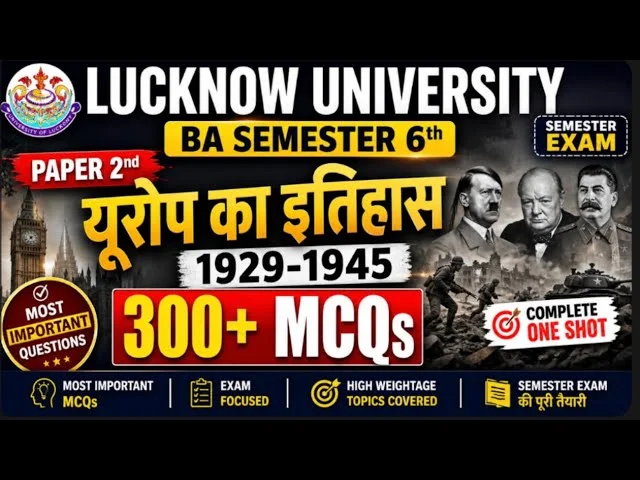
This video provides a comprehensive revision of over 300 multiple-choice questions covering the history of Europe from 1929 to 1945, tailored for BA Semester 6 students at Lucknow University. The content is presented bilingually to assist both Hindi and English medium students.
Great Depression and Rise of Dictatorships ⏱ 0:00
•The most significant impact of the Great Depression of 1929 on Europe was the rise of dictatorship.•Hitler came to power in 1933.•The Night of Long Knives was related to Nazi purges.•The Nazi concept of Lebensraum was related to expansionist policy.•The Rome-Berlin Axis was formed in 1936.•The Anti-Comintern Pact was signed between Germany and Japan.Key Events and Agreements (1938-1939) ⏱ 3:00
•Anschluss means annexation of Austria.•The Molotov-Ribbentrop Pact was signed in 1939 between Germany and the USSR.•World War II started in 1939.•The 'Phoney War' refers to the period of inactivity from 1939 to 1940.•The main aim of Britain's appeasement policy was to avoid war.•The USSR was not a part of the Munich Agreement.Major Battles and Operations (1940-1945) ⏱ 6:00
•Operation Barbarossa was the German invasion of the USSR.•The significance of the Battle of Britain was that it was Germany's first defeat.•The Holocaust was the genocide of Jews.•The main aim of the Yalta Conference was post-war planning.•Hitler committed suicide in 1945.•The main aim of the United Nations was to maintain peace.•The Nuremberg Trials were related to war crimes.•The main feature of a totalitarian state was total control.•The main reason for Germany's defeat was war on two fronts.•The Atlantic Charter was signed between the USA and the UK.•The USA entered World War II in 1941.•The main weakness of the Weimar Republic was political instability.•The Enabling Act of 1933 gave Hitler dictatorial powers.•The Reichstag Fire was used by Nazis to suppress opposition parties.•Mussolini's economic policy was called the Corporate State.•The Four Year Plan was introduced by Hitler.Spanish Civil War and Other Conflicts ⏱ 11:00
•Germany and Italy supported Franco in the Spanish Civil War.•The policy of non-intervention was related to the Spanish Civil War.•The Sudetenland was under the control of Czechoslovakia.•France built the Maginot Line.•Italy invaded Ethiopia in 1935.•The concept of collective security was associated with the League of Nations.•Germany first violated the Treaty of Versailles by increasing its army.•The Rhineland was remilitarized in 1936.•Allied powers included the UK, USA, and USSR.•The Battle of Stalingrad was a turning point against Germany.•Operation Sea Lion was the plan to invade Britain.•The Blitz referred to the bombing of London.•The Tehran Conference was held in 1943.•The Cold War began after World War II.•The UN headquarters is in New York.•The Final Solution was the extermination of Jews.•Germany attacked the USSR in 1941.•The atomic bomb was dropped on Japan in 1945.•VJ Day relates to Japan.•Hitler led the Axis powers.•The USSR suffered the most in World War II.•The League of Nations failed due to the absence of the USA.•Democratic countries opposed Nazi ideology.•The UNO was formed after World War II.Assertion-Reason and Chronology Questions ⏱ 17:00
•Assertion: The Great Depression weakened democracy in Europe. Reason: Economic crisis promoted extremist ideology. Both are correct and the reason explains the assertion.•Correct chronological order: Nazi rise to power, then others (3124).•Hitler's foreign policy main aim was expansion and revenge.•The biggest result of appeasement policy was that Hitler became more aggressive.•The biggest example of failure of collective security was Italy's invasion of Ethiopia.•Individual freedom is not a feature of a totalitarian state.•The main reason for the success of the Blitz was surprise and speed.•The propaganda minister in Nazi Germany was Joseph Goebbels (option B).•The Spanish Civil War is called a rehearsal for World War II because it was an early test of Axis vs. Allies.•The turning point of Germany's defeat was the Battle of Stalingrad.•The real purpose of the Molotov-Ribbentrop Pact was the partition of Poland.•Germany failed in the Battle of Britain due to the strength of the RAF.•Correct matching: Himmler associated with SS.•The main reason for the failure of Operation Barbarossa was the Russian winter.•The significance of the Atlantic Charter was post-war peace planning.•The Final Solution was implemented in 1942.•Hitler was not present at the Yalta Conference.•The UNO Charter was signed in 1945.•The USA and UK opened the second front.•The main cause of the Cold War was capitalism vs. communism.•The first event among the list was Hitler becoming Chancellor.•The main difference between Nazism and Fascism was that Nazism emphasized racism.USSR, USA, and Post-War Developments ⏱ 23:00
•After Pearl Harbor, the USA entered the war.•The final stage of World War II is associated with the atomic bomb on Hiroshima and Nagasaki.•The most powerful organ of the UNO is the Security Council.•Assertion: The Russian Revolution transformed European politics. Reason: It promoted socialist ideology. Both are correct and the reason explains the assertion.•The main aim of Lenin's NEP was economic recovery and stability.•Stalin's collectivization policy was related to agriculture.•The main aim of the Five Year Plan was industrialization.•The main aim of Stalin's Great Purge was elimination of opposition.•USA's isolationism meant staying away from European affairs.•The New Deal was associated with Roosevelt.•The USSR and International Brigades supported the Republicans in the Spanish Civil War.•General Franco was associated with Fascism.•The result of the Spanish Civil War was Franco's dictatorship.•The main reason for USSR's economic success was the planned economy.•The main difference between NEP and Five Year Plan was that NEP allowed private sector.•The USA passed Neutrality Acts to avoid war.•Guernica is famous as a symbol of bombing.•Command economy in the USSR meant government control.•Stalin succeeded Lenin.•Trotsky's theory was Permanent Revolution.•Stalin's theory was Socialism in One Country.•The main aim of USA's Lend-Lease policy was aid to Allied nations.•Franco won the Spanish Civil War.•The major drawback of industrialization in the USSR was violation of human rights.•International Brigades were related to the Spanish Civil War.•USA isolationism ended in 1941.•Kulaks were rich farmers.•The international significance of the Spanish Civil War was that it was a prelude to World War II.•The main aim of disarmament was to reduce armaments.•The main aim of the Washington Naval Conference (1921-22) was to limit naval arms.•The Geneva Disarmament Conference failed due to Germany's disagreement.•The main reason for the failure of disarmament was the arms race.•Assertion: The Treaty of Versailles was a major cause of World War II because it humiliated and weakened Germany. Both are correct.•The immediate cause of World War II was Germany's invasion of Poland.•The result of appeasement policy was that Germany became more aggressive.•The main reason for France's defeat in 1940 was Germany's strategy.•The Battle of Britain was mainly an aerial battle.•Germany attacked the USSR in 1941.•The significance of the Battle of Stalingrad was that it was a decisive turning point.•D-Day relates to the Normandy landings.•The USA joined World War II in 1941.•The major political consequence of World War II was the Cold War.•The UNO was established to maintain peace.•After World War II, Germany was divided.•The Cold War was between the USA and the USSR.•Colonialism began to end after World War II.•Total war means using all institutions.•The atomic bomb was dropped on Hiroshima and Nagasaki in Japan.•V-E Day refers to Germany's defeat.•The United Nations was established in 1945.•The UNO main objective is to maintain peace.•The UNO headquarters is in New York.•There are six principal organs in the UNO.•There are five permanent members of the Security Council.•Veto power is held by permanent members.•The first Secretary-General of the UNO was Trygve Lie (option A).•After World War II, world politics moved towards bipolarity.•The main cause of the Cold War was ideological conflict.•NATO was formed in 1949.•The Warsaw Pact was led by the USSR.•India gained independence in 1947.•The Marshall Plan was related to the reconstruction of Europe.•Germany was divided into four parts.•The economic organ of the UNO is ECOSOC.•The UNO Charter was signed in San Francisco.•The UNO has 193 member states.•The Cold War ended in 1991.•The judicial organ of the UNO is the ICJ.•WHO deals with health.•UNESCO is related to education and culture.•The biggest weakness of the UNO is the veto power.•The main aim of the Treaty of Versailles was to punish Germany.•Restrictions on Germany included a limited army.•The Treaty of Versailles created feelings of resentment and revenge in Germany.•The League of Nations was established in 1919.•Fascism arose in Italy.•Mussolini's ideology was Fascism.•Hitler was the leader of Germany.•The main basis of Nazi ideology was Aryan supremacy.•Hitler's autobiography was Mein Kampf.•The slogan of Fascism was 'State Above All'.•The formation of NATO was not a part of the Treaty of Versailles.•The Corporate State is associated with Mussolini.•The Great Purge took place in the USSR.•The New Deal aimed to solve the Great Depression.•The USSR was not a part of the Axis powers.•Appeasement policy is associated with Britain.•The main aim of Operation Barbarossa was the USSR.•The Neutrality Acts were passed by the USA.•Franco led the Nationalists in the Spanish Civil War.•The main effect of collectivization was peasant resistance.•The Holocaust refers to the genocide of Jews.•The formation of the UNO was decided at the Yalta Conference.•The nature of the Cold War was an indirect conflict.•Incorrect pair: Stalin-France.•The final stage of World War II is linked to the atomic bomb.•The main reason for the formation of the UNO was to maintain peace.•Japan attacked Pearl Harbor.•Post-World War II world order became bipolar.•The Marshall Plan was started by the USA.•The Berlin Blockade is related to the Cold War.•Germany left the League of Nations in 1933.•The main aim of the Rome-Berlin-Tokyo Axis was military cooperation.•Hitler remilitarized the Rhineland.•An example of appeasement policy is the Munich Agreement.•The Enabling Act resulted in Hitler gaining full power.•The main function of the Gestapo was secret surveillance and suppression.•The result of the Non-Aggression Pact (1939) was the partition of Poland.•The turning point in the European theater of World War II was Stalingrad.•The Maginot Line failed because Germany bypassed it.•The Battle of Midway relates to the Pacific War.•The main decision of the Yalta Conference was post-war order.•The General Assembly maintains peace? (Incorrect: Security Council maintains peace)•V-E Day relates to Germany.•The Berlin Wall is related to the Cold War.•The Containment Policy is related to the USSR.•The significance of the African campaign in World War II was strategic control.•The War Guilt Clause was part of the Treaty of Versailles.•Mussolini came to power in 1922.•Hitler wrote Mein Kampf.•The League of Nations headquarters was in Geneva.•Five Year Plans were implemented in the USSR.•The Spanish Civil War began in 1936.•Appeasement policy is associated with Prime Minister Neville Chamberlain.•The attack on Pearl Harbor occurred in 1941.•The ideologies that clashed in the Cold War were capitalism and communism.•The main aim of the Marshall Plan was the reconstruction of Europe.•There were 51 original members of the UNO.•The Battle of the Bulge took place in America (probably meant Belgium).•Germany was not a part of the Yalta Conference.•The second front was opened in France.•The Berlin Blockade occurred in 1948.•The aim of the Containment Policy was to stop communism.•The main cause of decolonization was World War II.•Japan was the Axis power outside Europe.•The UNO Charter came into effect in 1945.•The Cold War is linked to the USSR.•The biggest military result of World War II was the use of atomic weapons.Key Takeaways
•The Great Depression (1929) led to the rise of dictatorships in Europe.•Key events include Hitler's rise in 1933, the Rome-Berlin Axis (1936), and the Molotov-Ribbentrop Pact (1939).•Major turning points: Battle of Britain (first German defeat), Battle of Stalingrad (turning point against Germany), and D-Day landings.•The Holocaust was the genocide of Jews; the Final Solution (1942) aimed at their extermination.•Post-war outcomes: formation of the UNO (1945), beginning of the Cold War, and division of Germany.•The Spanish Civil War (1936-1939) served as a rehearsal for World War II, with Franco's victory establishing a fascist dictatorship.Conclusion
This MCQ session provides a thorough revision of Europe's history from 1929 to 1945, covering all four exam units. Students are encouraged to watch the video for complete preparation.