This video lesson explains the eight practice dimensions of substance abuse counselling as outlined in Module 1, covering clinical evaluation, treatment planning, referral, service coordination, counselling, crisis intervention, client and family education, and documentation and ethics.
Overview of the Eight Practice Dimensions and Clinical Evaluation ⏱ 0:06
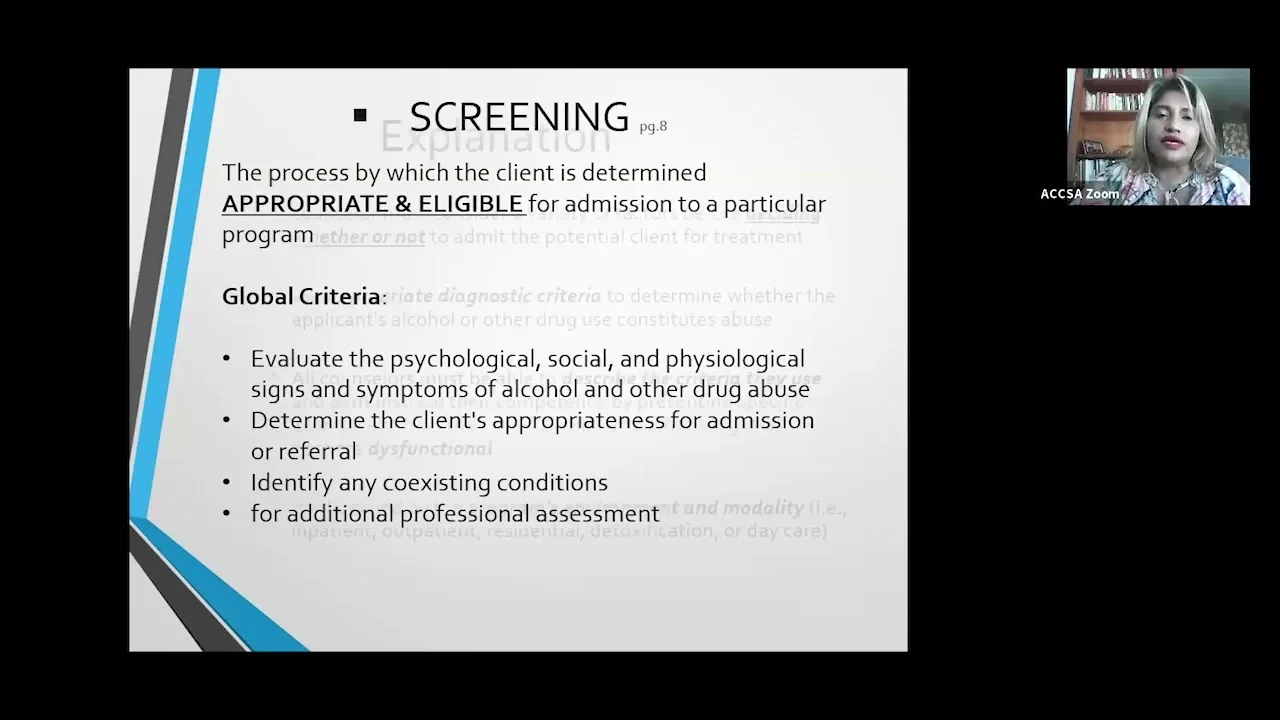
•Module 1 covers the eight practice dimensions of substance abuse counseling: clinical evaluation (screening and assessment), treatment planning, referral, service coordination, counseling (overview only; module 2 goes in depth), client/family/community education, documentation, and professional/ethical responsibilities (covered fully in module 4).•For exam preparation, focus on three factors per dimension: the definition, global criteria, and explanation; additional documentation samples, screening tools, and templates are from page 135 onward.•Clinical evaluation combines screening and assessment, gathering bio-psycho-social-spiritual information and using substance use disorder screening tools to identify indications and make appropriate referrals and treatment.•Screening (page 8) determines if a client is appropriate and eligible for admission to a particular program; the counselor must evaluate psychological, social, and physiological signs and symptoms of Alcohol and Other Drug abuse, determine appropriateness for admission or referral, identify coexisting conditions, and decide if additional professional assessment is needed (e.g., medical conditions, HIV).•All counselors must describe the criteria they use and demonstrate competence by presenting specific examples of how Alcohol and Other Drug use has become dysfunctional; this is influenced by the program's environment and modality (inpatient, outpatient, residential, detoxification, or daycare).•Eligibility criteria include biography (age, sex, residence, legal status, income level, referral, physical condition, psychological functioning) and available outside support for continuing counseling, meetings, and an exit plan; addiction is a lifelong disease, so clients must be equipped and empowered.•Diagnostic criteria (page 17): the counselor must use subjective criteria and diagnostic tools (DSM) to determine whether the issue is substance abuse, dependence, or addiction; also consider the client's level of dysfunction (physical, mental, cognitive functioning) and key problem areas (work, relationships, family, legal).•Screening forms typically ask for patient data (age, sex, residence), referral source (for collateral information while respecting confidentiality), and insurance/medical aid availability to determine acceptance or referral to an outpatient program.•Screening tasks for the counselor: assemble screening forms, collect and analyze information from the referral source, and conduct a face-to-face interview covering general client admission data and presenting problems.Assessment and Treatment Planning in Addiction Counseling ⏱ 20:06
•Obtain a holistic picture of the client: previous treatment efforts (relapse is common), outside support (family, employer), and commitment to change (stages of change model). Screening tools include the quadrants of care, CAGE, K A1, DAST, and ADS; in South Africa, workplaces may screen with breathalyzers before admitting employees to work.•The quadrants of care (level of care) use Y and X axes: Y = addiction severity (high to low), X = mental illness severity. Category 1 (low mental disorder, low addiction) → primary healthcare or outpatient; Category 3 (low mental disorder, high addiction) → addiction treatment system; Category 4 (high mental disorder, high addiction) → psychiatric hospitals or lock-up facilities (e.g., Tara, various Cape Town facilities, jails, St. Fontaine).•Assessment is the procedure to identify and evaluate client strengths, weaknesses, problems, and needs for a treatment plan. Gather relevant history, obtain corroborative information from significant secondary sources (family, work) because addiction symptoms include lies, manipulation, and deceit, and identify appropriate assessment techniques. Build rapport from first contact, exhibit empathy, nonjudgmentalism, unconditional positive regard, and explain the rationale for assessment.•Assessment is a continuing process: evaluate major life areas (physical, vocational, social, legal, psychological functioning), use a multidisciplinary approach (e.g., MDT meetings with psychiatrist, social worker, psychologist, occupational therapist), and determine whether the client has an addiction. Identify addiction-related problems in psychological, physiological, behavioral, family, economic, environmental, and spiritual areas, and screen for behavioral/process addictions (gambling, porn, internet, social media).•Dimension 2: Treatment planning is a collaborative process where counselor and client identify and rank problems based on individual needs, formulate agreed-upon immediate and long-term goals in behavioral terms, and identify treatment methods and resources for appropriate referral. The plan is based on assessment and is a product of negotiation tailored to the individual's needs, depending on context and available resources. Goals must be expressed in behavioral terms to monitor progress, link problems with goals, and contracts must be regularly reviewed and modified.•Joint Commission requirements: treatment plan based on intake information and presenting problems (physical, behavioral, emotional status), developed within 72 hours of intake (to allow the person to sober up), individualized based on particular problems and needs, and involve family where appropriate (but not in cases of abuse or domestic violence where a partner could hinder treatment).Treatment Planning, Referral, and Service Coordination ⏱ 40:07
•Treatment planning prioritizes problems but is flexible; 72 hours is a guideline for initial paperwork and consent, not a fixed deadline. Goals must be SMART (specific, measurable, attainable, realistic, time-bound); plans reviewed every 7 to 10 days.•Referral involves identifying unmet needs, explaining rationale, and adhering to confidentiality laws (e.g., POPIA). Resources include free primary health care clinics, SADAG, shelters, family services, and self-help meetings like AA/NA.•Counselors must work within their scope of practice and competence; referral is necessary when needs exceed competency, and burnout is addressed in later modules.•Service coordination implements the treatment plan through consultation and ongoing assessment.Service Coordination, Consultation, Counseling, and Crisis Intervention in Addiction Counseling ⏱ 60:08
•Service Coordination: administrative, clinical, and evaluative activities linking client, treatment services, community agencies, and resources to address treatment plan needs; includes case management and client advocacy; e.g., collaborating with a social worker for a client with deferred legal charges.•Consultation: in-house staff meetings (case management) or outside professionals (e.g., psychiatrist, medical doctor) assure comprehensive quality care; recognize issues beyond one's scope, consult appropriate resources, obtain informed consent, document, and adhere to laws and policies; goals include providing a firmer foundation for treatment and empowering clients.•Counseling: collaborative process toward mutually determined goals; methods sensitive to individual characteristics, cultural and social context (e.g., South Africa's 12 official languages including sign language); global criteria include selecting theories, applying techniques (individual, group, family), individualizing for cultural, gender, and lifestyle differences, interacting therapeutically, and implementing the treatment plan; common approaches: reality therapy, motivational interviewing, strategic family therapy, client-centered therapy.•Crisis Intervention: recognize elements of client crisis and implement immediate action; crisis may be directly related (overdose, relapse) or indirectly related (death of significant other, separation/divorce, arrest, suicidal gestures, psychotic episode, outside pressure to terminate treatment); use negative events to enhance treatment and as opportunities for growth.Crisis in Addiction Counselling: Types and Reactions ⏱ 80:09
•A crisis (e.g., client becoming psychotic or suicidal) can be a fork in the road where the client recognizes the seriousness of their substance abuse and chooses treatment — turning a negative into a positive.•Four types of trauma/crisis: situational (death of a loved one, breakup, serious illness such as a diabetic coma or alcohol poisoning, financial problems, family violence); developmental (life-stage crises — adolescent peer pressure, the "emptiness syndrome" when children leave home, retirement); intra-psychic (internal thoughts and feelings — identity confusion, interpersonal conflict, suicidal ideation); and existential (emptiness and lack of purpose, career changes).•Reactions to crisis include shock (brain releases adrenaline and cortisol for the fight-or-flight response; numbness, difficulty concentrating, helplessness, increased suggestibility, normally lasting about 48 to 72 hours), anxiety (agitation, pacing, hand wringing, rapid heartbeat, chest pains, breathing difficulty), depression (hopelessness, immobilization, low energy, possible suicidality), anger (directed outward at others or inward as self-destructive actions such as drinking more or cutting), and intellectualization (a subconscious defense mechanism that cuts off feelings, leaving the trauma unresolved).•A crisis intervention pyramid is provided at the back of the manuals as a resource for helping clients through a crisis.Dimension Six: Client, Family and Community Education ⏱ 90:02
•This dimension is the process of giving clients, families, significant others and community groups information on the risks of psychoactive substance use and available prevention techniques; in the South African context, primary healthcare clinics aim at prevention, and education matters because lack of awareness can lead to death.•Addiction is a family disease within a family system: the addict or alcoholic is the IP (identified patient), but other elements of the family system contribute to the addiction, and significant others may not understand this.•Global criteria: present relevant Alcohol and Other Drug use/abuse information through formal and informal processes, and present information about available AOD services and resources; the speaker advises keeping a referral list of community organizations and NGOs.•Education is delivered through formal didactic classes with reading materials and films (some facilities show "consequence movies"), or informally in individual outpatient sessions; it may include descriptions of self-help groups (AA) and family support groups (Nar-Anon, Al-Anon).•The US Department of Health and Human Services' alcoholism counselling education curriculum guide suggests topics such as current statistics on prevalence and incidence of alcohol and drug abuse; counsellors should keep abreast of trends and new research.•Nicotine and caffeine are addictive substances (the DSM covers these criteria; the brain has nicotinic receptors), and alcohol is one of the most dangerous substances because it affects all organs — kidneys, heart and liver.Psychoeducation, Documentation, and Ethical Responsibilities in Addiction Counselling ⏱ 100:12
•Dimension 6 (client education) covers the physical, psychological, and social effects of alcohol and drugs, including liver cirrhosis and "Wet Brain" (Korsakoff's), plus stages of alcoholism, addiction dynamics, and multiple/cross-addictions; facilities often deliver this through lectures, psychoeducation, or outpatient programs.•Dimension 7 (documentation): charting assessment and treatment-plan results, reports, progress notes, discharge summaries, and client data. Records create a paper trail for accountability to bodies like the HPCSA, protect the counsellor, monitor client progress across the continuum of care, enable communication among co-workers, support audits by medical aids (e.g. the 21-day mental health benefit), and enhance program accountability to licensing or funding sources. Progress notes follow individual, group, and family sessions.•Clients may journal outside sessions, but writing during a session is discouraged because it pulls attention away and can signal the client is not fully present; explore what the request says about the client.•Dimension 8 (professional and ethical responsibilities) requires adherence to accepted ethical and behavioral standards and continuing professional development — counsellors must earn 32 CPD points and 6 ethical points yearly. The code of ethics covers 12 principles: nondiscrimination, responsibility, competence, legal and moral standards, public statements, publication credit, client welfare, confidentiality, client relationships, inter-professional relationships, remuneration, and societal obligations.Key Takeaways
•The eight practice dimensions are clinical evaluation, treatment planning, referral, service coordination, consultation, counselling, crisis intervention, and client/family/community education, supplemented by documentation and ethical responsibilities.•Clinical evaluation involves screening and assessment to determine if a client has a substance use problem and requires treatment.•Treatment planning should be holistic, consider previous treatment efforts, outside support, and the client's stage of change, and set SMART goals; 72 hours is a guideline for initial paperwork and consent, not a fixed deadline.•Crisis intervention can be a turning point where clients recognize the seriousness of their substance use and become more open to help, and counsellors must manage their own reactions during crises.•Client, family, and community education covers the physical, psychological, and social effects of alcohol and drug use, including conditions such as liver cirrhosis and Korsakoff's syndrome (Wet Brain).•Documentation should be concise, objective, and factual, and counsellors must adhere to ethical responsibilities including confidentiality and professional boundaries.Conclusion
The video provided a detailed walkthrough of the eight practice dimensions and their associated tasks, emphasizing a holistic and client-centred approach to addiction counselling.