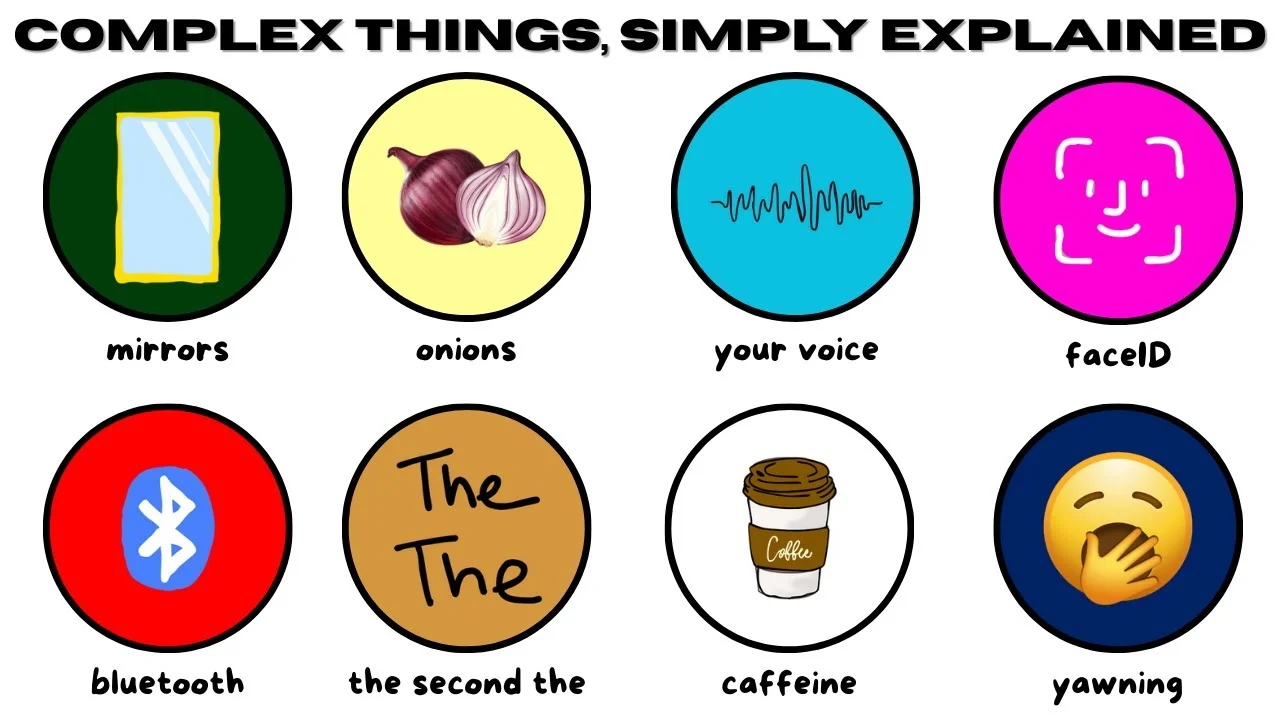
This article explores the science behind common curiosities like mirrors, hiccups, and more.
Physics of Reflection and Sound
•Mirrors work via specular reflection: light bounces off a smooth surface at the same angle it arrives.•Mirrors do not actually flip left and right; your brain interprets the reversed orientation.•Your recorded voice sounds different because you normally hear it via bone conduction, which adds bass; microphones only capture air-conducted sound.Biology of Reflexes and Reactions
•Onions make you cry when cut: mixing an enzyme and sulfur compound creates a gas that triggers tear glands.•Hiccups are a spasm of the diaphragm, causing vocal cords to close; they may be a leftover reflex from tadpole-like ancestors.•Cats have a righting reflex: using their inner ear gyroscope and flexible spine, they twist midair to land on their feet.Technology and Brain Quirks
•Bluetooth uses low-power radio waves with frequency hopping across 79 channels to avoid interference.•Your brain often skips repeated words like "the" because it predicts patterns rather than reading every letter.•Caffeine blocks adenosine receptors, hiding tiredness; it does not provide real energy, leading to a crash when it wears off.•Yawning may cool the brain; it is contagious, possibly linked to empathy and social bonding.•Face ID creates a 3D depth map of your face using 30,000 infrared dots and matches it to a stored mathematical model.Key Takeaways
•Mirrors reflect light via specular reflection; they do not flip images—your brain interprets the reversal.•Onions produce a irritating gas when cut; chilling or cutting under water can reduce tears.•Caffeine blocks sleep-inducing adenosine receptors, but does not provide energy, leading to a crash.•Face ID uses infrared dots to build a 3D face map and matches it to a secured encrypted model.Conclusion
Everyday phenomena have simple but fascinating explanations rooted in physics, biology, and technology.