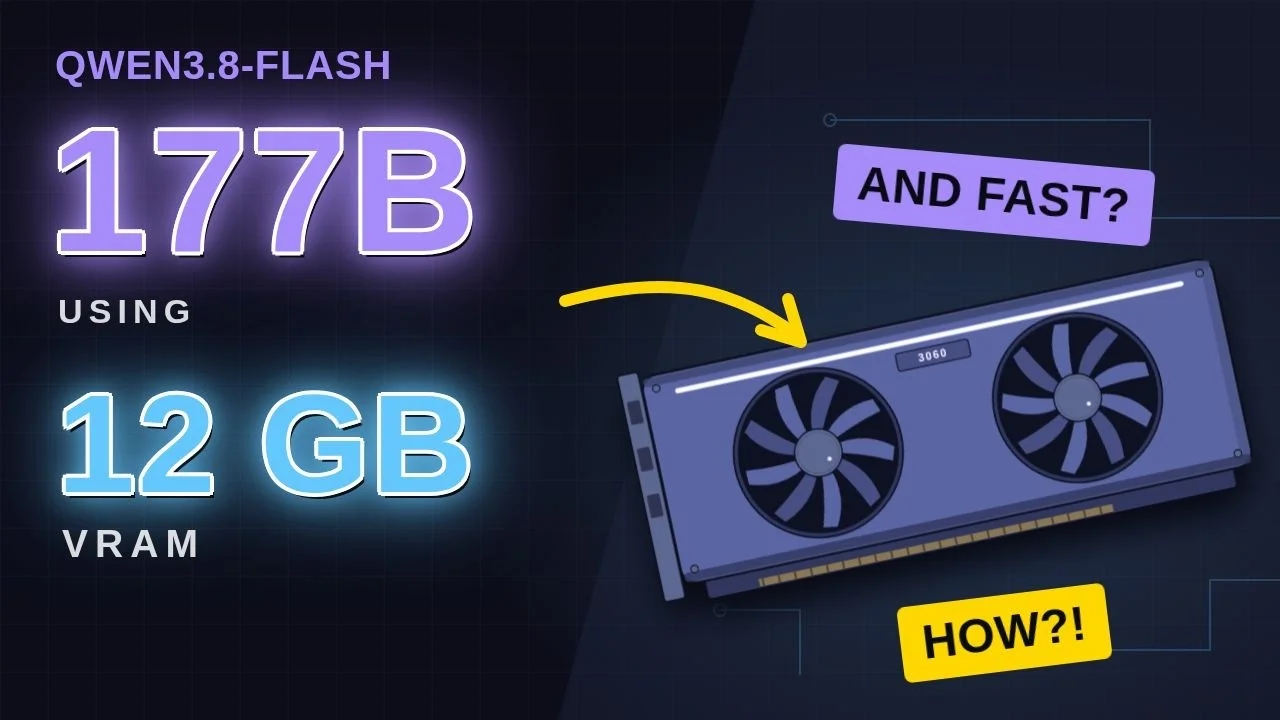
A 177-billion-parameter model runs on a 5-year-old GPU with 12GB VRAM, thanks to a phrasebook architecture that makes frontier-class AI practical on consumer hardware.
The Phrasebook Architecture ⏱ 0:31
•Model is Qwen 3.8 Flash Next, config calls it Qwen 4 EXP, early preview of Qwen 4 architecture.•Reported 125B parameters but file size 177B; extra 51B parameters are a lookup table (phrasebook), not neural network.•Phrasebook stores common phrases and their meanings, avoiding recomputation every token.•Lookup is cheap; entries fetched ahead of time, can live on SSD.•DeepSeek published N-gram paper in January; Google's Gemma 3N has similar idea; Qwen scaled it up.•Qwen kept full brain and added phrasebook, tested seven positions, found one optimal spot near start.Hardware and Performance ⏱ 4:07
•Machine: home server with RTX 3060 12GB (used ~$300), 6-core Ryzen, 61GB RAM.•Full precision model 350GB, using 3-bit quant = 82GB file.•Stock llama.cpp runs at 16.5 tokens/sec.•Llama.cpp memory maps file on SSD, reads only needed pages.•Mixture of experts: 512 experts, 10 fire per token, experts on CPU side.•Multi-token prediction draft head gave <1 token/sec improvement, so not used.•Custom expert cache and thread count optimization: 6 threads (real cores) gave 24.4 tokens/sec, ~50% over stock.•RAM sweep: at 32GB and 24GB, decode still 22 tokens/sec; at 20GB drops to 9, at 16GB to 6.5, at 12GB to 4.5.•Prompt processing: at 48GB returns to full speed (115 tokens/sec); at 32GB drops to 34; at 24GB to 15.•FreeToken project (Berkeley/MIT) pinned every expert in RAM, crashed system; llama.cpp memory map worked.Real-World Coding Tests ⏱ 11:19
•Test: Build 3D solar system in one HTML file with no libraries.•Qwen 3.6 (35B) produced static picture.•Claude Opus 5 used agent loop (Claude Code) to fix issues; result was good.•Qwen 3.8 Flash wrote 1,500 lines in one shot; added features like clickable planets, asteroid belt, better Saturn rings.•Lab: Three broken projects with specs and planted traps.•Task 1 (rate limiter): Qwen 3.8 caught wrong test (rewrote test), wrote randomized checker (18,000 decisions, zero mismatches), fixed config bug correctly, scored 7/7.•Task 2 (metric service): Qwen 3.8 deleted cache and fixed performance with index/query, argued against expected answer, scored 8/8 after grader overruled.•Task 3 (payments pipeline): Qwen 3.8 detected float precision issue, used decimal throughout, found unplanted bug, scored both checks.•Comparison: Opus 5 scored 17/17, Qwen 3.8 Flash 17/17, Qwen 3.6 14/17 (missed lazy fix and float trap).Practical Workflow and Conclusion ⏱ 22:02
•Workflow: Qwen 3.8 as planner/reviewer, Qwen 3.6 as fast worker.•Swap cost ~25 seconds per handoff.•For chat, keep 3.6 loaded.•Hardware advice: 12GB 3060 is enough; RAM needed: 24GB for full-speed answers, 40GB for full-speed prompt reading, >48GB no benefit.•Key caveat: green tests don't guarantee correctness; read code.•Local AI is becoming necessity for control and privacy.Key Takeaways
•A 177B parameter model (Qwen 3.8 Flash Next) runs on consumer hardware (RTX 3060 12GB) via phrasebook lookup table on SSD.•Stock performance 16.5 tokens/sec; with custom cache and thread tuning reaches 24.4 tokens/sec.•Qwen 3.8 Flash scored 17/17 on trap-laden coding lab, matching Claude Opus 5 and beating Qwen 3.6 (14/17).•RAM requirements: 24GB for full-speed answers, 40GB for full-speed prompt processing.•Practical workflow uses Qwen 3.8 for planning/reviewing and Qwen 3.6 for executing tasks.Conclusion
Local AI is now practical on consumer hardware, matching frontier cloud models in correctness while offering privacy and control, though still slower.