An investigation into the credentials and intellectual output of finance YouTuber Patrick Boyle, focusing on his hedge fund career, allegations of plagiarism in his videos, and a 31-page dossier alleging textual correspondences between his textbook and historical Wikipedia revisions and other textbooks.
The Hedge Fund Reality ⏱ 1:43
•Patrick Boyle's YouTube 'About' page describes him as a hedge fund manager in the present tense.•UK corporate filings for Palomar showed a generic service-provider address; the actual operation was a two-person team (Boyle and his partner) in a tiny shared office above a deli, with zero employees.•The fund structure: investor money sat in Palomar Fund (Cayman Islands), managed by Palomar Capital Management LLP (UK).•In a 2014 pitch on 'Hedge Fund Lions' Den', Boyle claimed a track record going back to 2007 with returns of over 9% a year annualized and a realized Sharpe Ratio of 2.9.•According to NilssonHedge data, Palomar produced a geometric return of just 2.4% a year with a Sharpe ratio of 0.69.•A 2017 AIMA survey of 135 small and emerging hedge-fund managers found an average break-even point of about $86 million under management.•Palomar's assets under management declined from roughly $82 million around early 2014 to $40M, $27M, $24M, $22M, and then settled around $20-something million year after year.•Boyle said he worked 12 to 15 hours a day running the fund.•Boyle stated he sold the business around 2018. CIMA records show Palomar was on the registered mutual-fund list in June 2018 but had disappeared by the September 2018 quarterly report; it later became a 'private family office that does not accept outside money.'Academic Credentials and King's College London Response ⏱ 10:22
•Boyle's website, OnFinance.org, describes him as a visiting professor of finance at King's College London and Queen Mary University of London; his LinkedIn lists 'Professor - King's College London' in the present tense.•After the speaker sent a complaint to King's College London, the Dean of King's Business School responded: '...these individuals are not faculty at King's Business School and are not employed by us – we are not their employer - they have undertaken teaching for us at some stage in the past.'•Four days after King's received the evidence dossier, Boyle's staff profile was removed from their website.Video Plagiarism Allegations ⏱ 12:02
•Pre-2024 videos showed direct copying: a 2020 video on the US banning Chinese companies tracked Bloomberg almost line for line with zero attribution.•Six minutes into that same video, Boyle presented analysis on Alibaba's corporate governance that closely matched a blog post written six years earlier by NYU professor Aswath Damodaran, following the same structure and in many places using the same words.•In December 2023, a user on the Hbomberguy subreddit publicly called Boyle out for plagiarizing; afterwards, his videos began flashing articles on screen and naming journalists more visibly.•In a November 2025 video, Boyle delivered a conclusion about algorithmic aggregation, Silicon Valley, and academia that mirrored an argument made a week earlier in The Guardian by historian David Larsson Heidenblad, in the same conceptual order, with altered vocabulary. Earlier in the same video, Boyle had explicitly quoted and named that Guardian article.Textbook Investigation: Wikipedia and Other Textbooks ⏱ 20:07
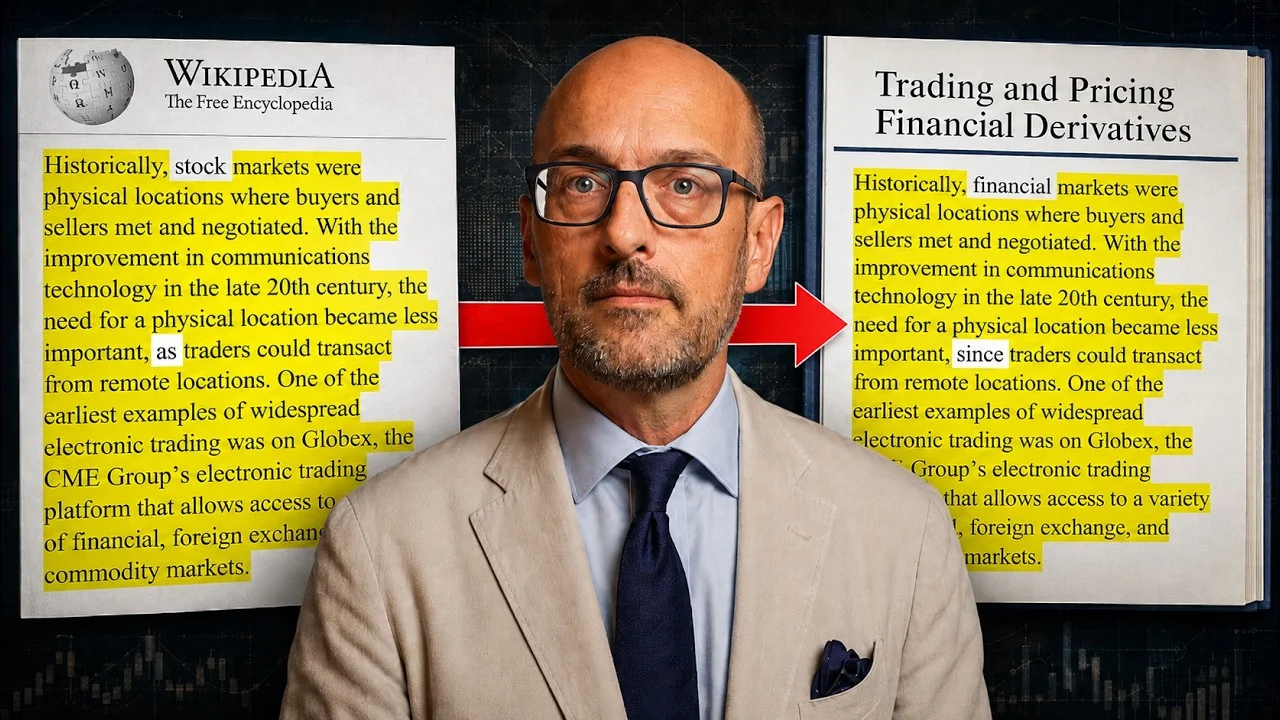
•The textbook 'Trading and Pricing Financial Derivatives' by Patrick Boyle and Jesse McDougall is used to teach students at King's College London and Queen Mary.•The speaker built a custom Wikipedia Revision Finder to compare the book's text against historical Wikipedia revisions.•The tool generated a 31-page evidence dossier documenting 40 separate textual correspondences, with historical Wikipedia revision IDs, timestamps, and side-by-side comparisons.•The first edition was published in 2011; Wikipedia edits from 2007 and 2010 contained identical wording that predated the book, with no attribution given.•Comparisons against other textbooks found shared pedagogical sequences and identical numerical structures: - From Robert Kolb and James Overdahl's textbook, a highly specific four-step process for pricing American call options appears with the same four-step sequence.
- A homework problem used the same three call options, same strike prices ($40, $30, and $35), same $90 stock price, and same core exercise.
- Chapter 6, Question 6 asks students to calculate the value of a European call option using a binomial tree with two 3-month periods, stock movements of +6% and -5%, a 5% risk-free rate, and a $51 strike price—but omits the starting stock price, making it unsolvable. The missing price appears in John Hull's 'Options, Futures, and Other Derivatives'.
•No attribution was found in the book for Wikipedia, Hull, Kolb, or Overdahl.Institutional Response and Next Steps ⏱ 25:55
•The 31-page Wikipedia dossier was submitted to King's College London and Queen Mary.•King's removed Boyle's profile, stated he is no longer employed there, and pointed the speaker toward the publisher.•The dossier is still with Queen Mary.•The textbook-to-textbook correspondences were not included in the 31-page Wikipedia report submitted to the universities; that comparison began after the report was sent.•The speaker reached out to Patrick Boyle directly with detailed questions and ample time to respond; as of recording, Boyle had not replied.Key Takeaways
•Palomar's actual performance, per NilssonHedge, was a 2.4% annual geometric return and a 0.69 Sharpe ratio, far below the 9% return and 2.9 Sharpe ratio Boyle pitched in 2014.•Palomar's assets under management fell from about $82 million around early 2014 to around $20-something million and stayed there; Boyle said he sold the business around 2018, and CIMA records show the fund disappeared from the registered mutual-fund list by September 2018.•The Dean of King's Business School stated Boyle and his partner are not faculty and not employed by King's, only having undertaken teaching in the past.•A 31-page dossier documented 40 textual correspondences between Boyle's textbook and historical Wikipedia revisions, with Wikipedia text predating the book's 2011 first edition.•Later comparisons found close parallels between the textbook and works by John Hull and by Kolb and Overdahl, including an unsolvable exercise missing its starting stock price, with no attribution found in the book.Conclusion
The investigation presents evidence that Patrick Boyle's public credentials and intellectual output rest on outdated titles and unattributed borrowing, and it raises questions for the universities and publisher to resolve.