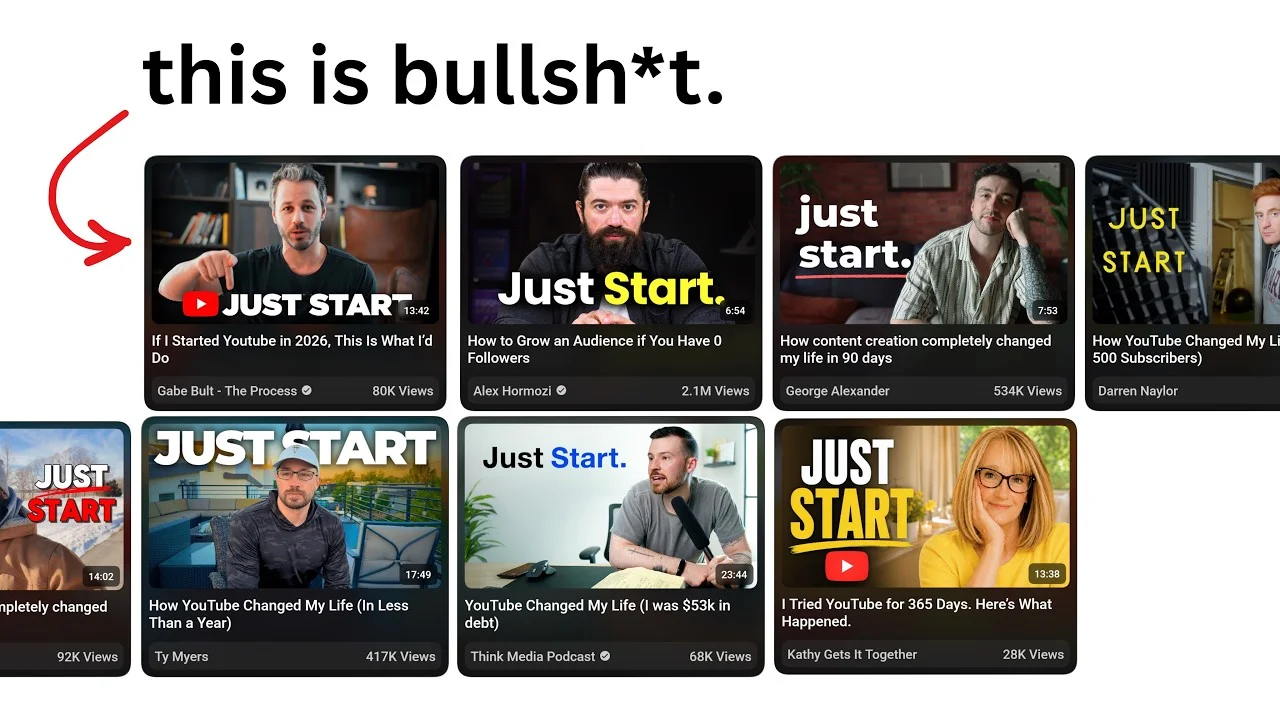
The common advice to 'just start' on YouTube works for teenagers but fails adults who can't afford to waste years. This article outlines three strategies that successful creators actually used to grow quickly, based on studying what worked rather than blindly starting.
Why 'Just Start' Fails for Adults ⏱ 1:02
•When you're 13, wasting 2 or 4 years making 200 garbage videos doesn't matter much.•As an adult, publishing a video that gets stuck at 200 or 300 views leads to doubts about spending limited time, quitting your job, or never taking off.•The advice to 'just start' is excellent for teenagers but brutal for adults over 25.•Many who give this advice started young: Paddy Galloway at 11, Marques Brownlee at 14, MrBeast at 13, Ali Abdaal at 23.•Adults can plan, strategize, and have a vision—advantages teenagers lack.Mistake 1: Studying Only Your Niche ⏱ 7:35
•Studying only top creators in your niche leads to being a cheap imitation (e.g., copying Graham Stephan).•To stand out, you must be better, different, or both—leave a new mark.•Ramit Sethi succeeded by contrasting with common advice (e.g., don't buy coffee) and saying if coffee brings joy, buy it, while helping earn more and negotiate salary.•Study people outside your niche: Ali Abdaal based his channel on Peter McKinnon (photography), who based his on Casey Neistat.•Formula: 'How to be the [favorite creator] of [your niche]' (e.g., Mr. Beast of real estate in your city).Mistake 2: Copying What Successful YouTubers Do Now ⏱ 11:40
•People watch recent videos from big creators and try to replicate them, but those videos are made with large teams and budgets.•Johnny Harris now spends over $100,000 per month and $40,000–$50,000 per field report, with 16 full-time employees and up to 15 contractors.•His early videos after leaving Vox were vlogs with static images and much smaller scope.•Dr. Joseph, a psychiatrist, gets millions of views with simple talking-head videos reacting to news clips.•Veritasium's early videos were street interviews about physics misconceptions—very achievable and potentially viral.•Copy what creators did in their first year, not their current high-budget productions.Mistake 3: Not Learning from Others' Mistakes ⏱ 17:17
•Learning only from your own mistakes yields about 20 lessons in 2 years; learning from four others multiplies that fivefold.•Chris Williamson made hundreds of videos without traction until he watched MrBeast's Rogan interview about analyzing YouTube for a summer.•The Real Estate Lawyer went from a few hundred views to 1.5 million, 1.3 million, and 400,000 views by studying thumbnails and presentation.•She made a video about HOAs that got 900 views, then remade it and got 300,000 views by focusing on not being able to park in front of a new house.•A client spent over $60,000 on a studio but had no YouTube channel 6 months later.•The speaker's videos were recorded with a $50 lavalier microphone in a home office—equipment is not what makes or breaks a channel.Key Takeaways
•The 'just start' advice is great for teenagers but harmful for adults over 25 who have limited time and need faster results.•Study creators outside your niche to differentiate yourself instead of imitating the top creator in your niche.•Copy what successful YouTubers did in their first year, not what they do now with big teams and budgets.•Learn from others' mistakes by analyzing their channels and identifying what worked and what didn't.•Early success builds confidence and momentum; planning and strategy reduce suffering and speed up growth.Conclusion
Instead of blindly starting, study what works, avoid common mistakes, and plan your channel to achieve early success and avoid years of frustration.