Matt Pocock argues that in the age of AI coding, software fundamentals are more important than ever, because bad code is the most expensive it has ever been.
The Specs-to-Code Movement and Its Pitfalls ⏱ 1:08
•The specs-to-code movement suggests writing a specification, using AI to turn it into code, and then only modifying the spec if problems arise.•Pocock tried this approach and found that each iteration produced worse code, eventually resulting in garbage.•He believes ignoring the code and letting it manage itself is just vibe coding by another name.•The underlying assumption that code is cheap is wrong: bad code is the most expensive it has ever been.•AI performs well in a good code base, so good code bases matter more than ever, which means software fundamentals matter more than ever.Failure Mode 1: AI Did Not Do What I Wanted ⏱ 4:40
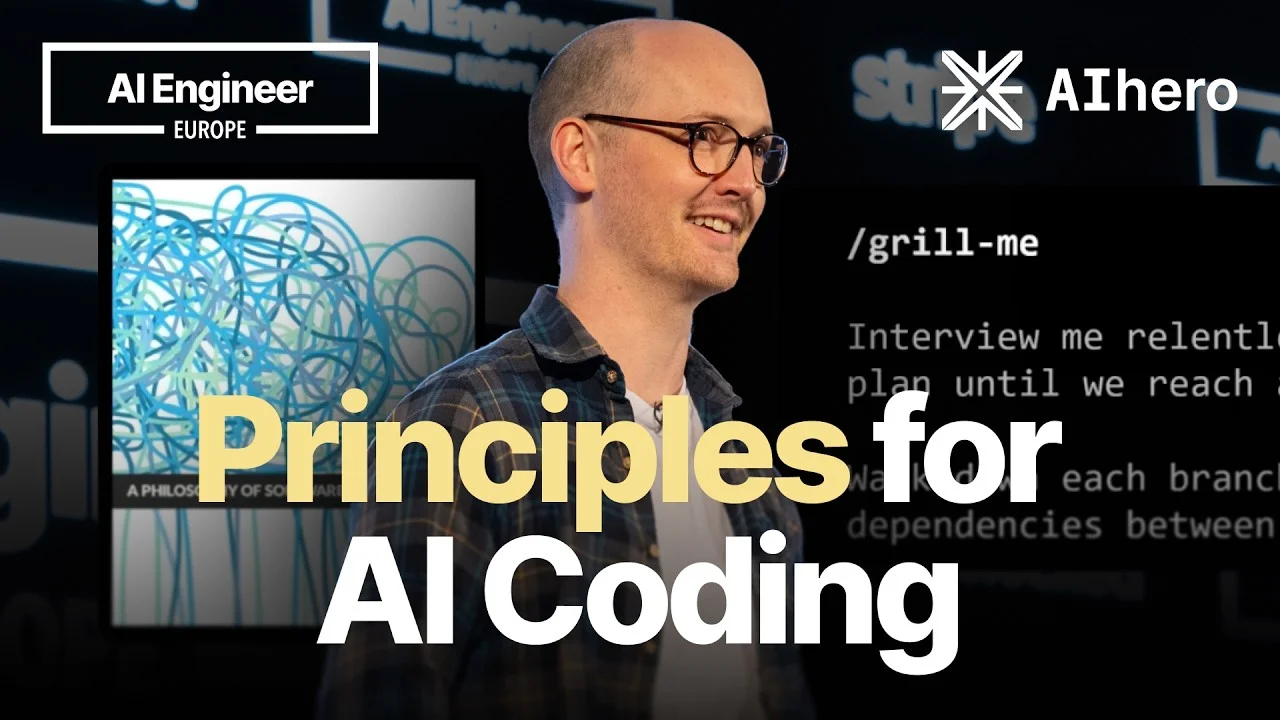
•The Pragmatic Programmer states that no one knows exactly what they want, which creates a communication barrier.•Frederick P. Brooks' The Design of Design introduces the design concept: an invisible, shared idea of what is being built.•Pocock created a skill called Grill Me that interviews the user relentlessly about every aspect of the plan until a shared understanding is reached.•The skill walks down each branch of the design tree, resolving dependencies between decisions one by one, and can ask 40, 60, or even 100 questions.•The resulting conversation can be turned into a product requirements document or directly into issues for an AFK agent.•Pocock believes this approach is better than the default plan mode in his tool (Clojure Code), which is eager to create a plan and start working.Failure Mode 2: AI Is Too Verbose ⏱ 7:15
•The AI often uses too many words and seems to talk at cross-purposes.•This mirrors the language gap between developers and domain experts, as addressed in domain-driven design (DDD).•DDD introduces the concept of a ubiquitous language: a shared set of terms derived from the same domain model.•Pocock created a ubiquitous language skill that scans the code base, looks for terminology, and creates a markdown file with tables of terms.•Reading the AI's thinking traces showed that this improves planning, reduces verbosity, and aligns implementation with the plan.Failure Mode 3 and 4: Code Doesn't Work and Cognitive Overload ⏱ 9:47
•Feedback loops are essential: static types (e.g., TypeScript), browser access for front-end apps, and automated tests.•However, LLMs often don't use feedback loops well; they produce huge amounts of code before checking, a behavior the Pragmatic Programmer calls outrunning your headlights.•The rate of feedback is your speed limit, so testing should be done in small, deliberate steps.•Pocock advocates test-driven development (TDD) to force the LLM to take small steps: write a test, make it pass, then refactor.•Testing is hard because it involves many dependent decisions: unit size, what to mock, and which behaviors to test.•Good codebases are easy to test. John Ousterhout's A Philosophy of Software Design recommends deep modules: lots of functionality hidden behind a simple interface, as opposed to shallow modules that expose many functions.•Deep modules make it easier for AI to explore and understand the codebase, and they provide testable boundaries.•Pocock created an Improve Codebase Architecture skill to refactor shallow modules into deep modules.•The sixth failure mode is cognitive overload: even when feedback loops work and more code ships, developers feel more tired than ever.•Deep modules allow developers to treat implementations as gray boxes, designing and testing from the outside, which saves mental energy.•Pocock recommends designing the interface and delegating the implementation, while being aware of the module map and including it in the ubiquitous language and PRD.•This aligns with Kent Beck's advice: invest in the design of the system every day.Conclusion: Code Is Not Cheap ⏱ 16:57
•Code is not cheap; it is important.•AI can act as a tactical programmer, a sergeant on the ground making code changes.•You need someone at the strategic level—that's you—and that requires software fundamental skills honed over 20 years or more.•Pocock's skills are available in the GitHub repo macpocockskills, and he shares free content on YouTube, Twitter, and aihero.dev.Key Takeaways
•Software fundamentals matter more than ever because bad code is the most expensive it has ever been.•Use the Grill Me skill to reach a shared design concept before coding.•Create a ubiquitous language to align terms between you and the AI.•Use TDD and feedback loops to avoid outrunning your headlights.•Design deep modules and delegate implementations to the AI to manage cognitive load.Conclusion
Code is not cheap; it is important. AI can handle tactical coding, but you must provide strategic direction using software fundamentals.