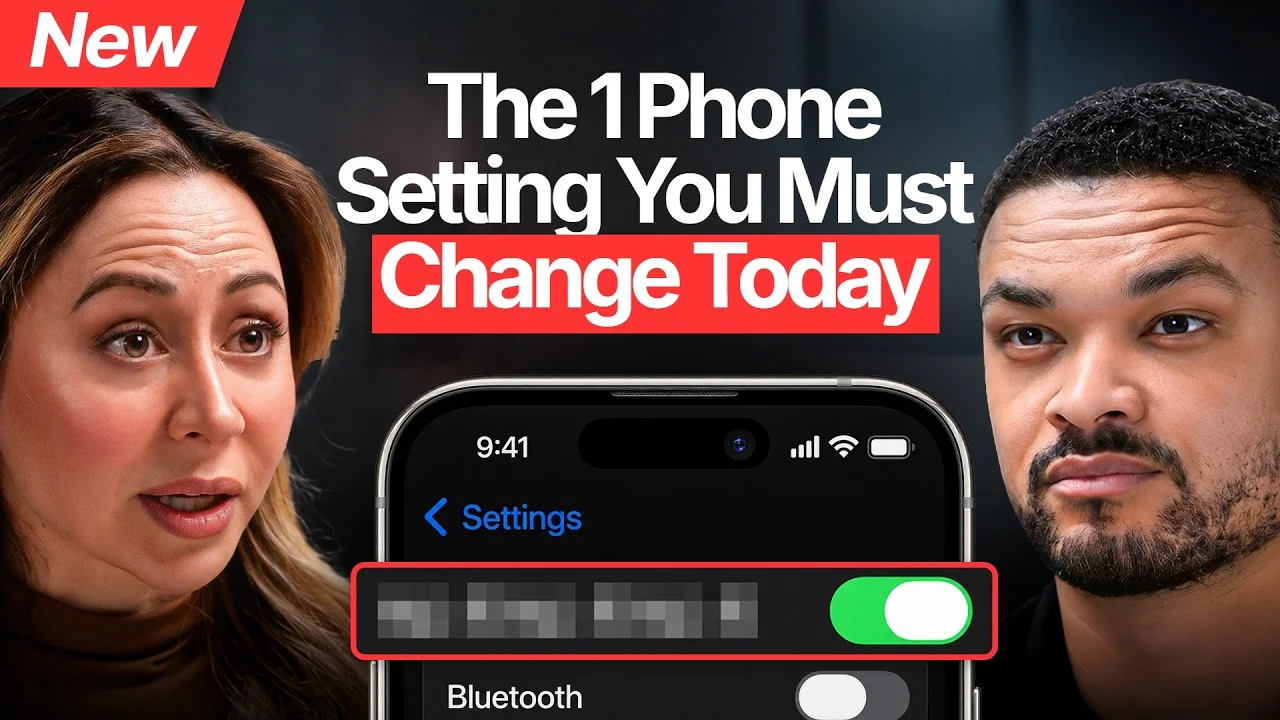
In this conversation, neuroscientist Dr. Sahar Yousef explains how the brain works and offers practical, science-based methods to improve focus, productivity, and memory. She covers the costs of distraction, the design of attention-hijacking technology, and a step-by-step focus sprint system.
The Cost of Distraction and the Case for Digital Hygiene ⏱ 0:00
•Every attention switch costs time and energy; multitasking is a myth, and on average over 2 hours a day is wasted bouncing between screens and tasks, with 60% of productivity lost when switching between two types of tasks at once.•Staying distracted leads to a life you don't like; default tech settings are designed by cognitive and behavioral neuroscientists to maximize engagement, like infinite scroll.•Countermeasures: grayscale phone reduced usage by 1 hour per day (7 hours a week); choose long-form over short-form content to protect attention span; focus sprints can double output.•Attention is the gateway to memory and learning: you cannot remember or learn anything you do not attend to; attention spans have been linearly decreasing since the advent of the phone, with the average knowledge worker staying focused on one screen for only 47 seconds.Foundations of Superhuman Performance: Sleep, Focus, and the Neuroscience of Productivity ⏱ 2:31
•Dr. Sahar Yousef's mission is to bring science education to the world so people work in line with how their brains and bodies actually work; she is founder and managing director of the Becoming Superhuman Lab, with her entire academic career at UC Berkeley and expertise in cognitive neuroplasticity.•Fundamental laws of biology are ignored, just like we wouldn't question gravity; we don't teach kids how their brains work, sleep fundamentals, or stress management; we obsess over the 'what' but not the 'how' of getting things done.•The foundation is sleep: a minimum of 7 hours a night; without it, cognitive performance and emotional regulation suffer. Next is your relationship with technology; a phone lock box helps you become a monotasking machine.•Treat only VIP notifications like a signature-required delivery knock; everything else goes to the mailbox. Demand better than default settings designed for engagement, and respect yourself enough to reclaim focus for deep thoughts.Default Settings Favor Engagement, Not Productivity — and How to Reclaim Your Focus ⏱ 20:02
•Messaging and email platforms are optimized for engagement, not user productivity; the candy industry analogy shows their profit incentive is to maximize consumption, not user well-being.•Notifications, sounds, and vibrations are tested to keep users addicted; the solution is to remove productivity drains first and adopt the mantra: "I deserve better than the default."•Set up VIP notifications (partner, boss's boss, top 15 clients) that bypass filters, and use keywords like your first name in email so you are not pinged on every CC thread.•Focus requires saying no to brilliant ideas to protect time and attention; signal vs. noise means decreasing the noise is easier than increasing the signal. Multitasking is not a skill—the brain is a monotasking machine due to survival wiring, with about a third of the cortex dedicated to looking and listening.The Tech Addiction Playbook: How Platforms Hijack the Brain Like Processed Food ⏱ 33:54
•Distractions come from external pings and internal avoidance of discomfort (overwhelm, stress, anxiety, confusion, FOMO, loneliness); the phone provides a fast, cheap exit from reality.•Studies show people would rather electrocute themselves than sit in silence, with men shocking themselves more than women and one person doing so hundreds of times.•Big Tech copied the food industry's three-part playbook: increase stimulation (sugar in bread; color saturation and short-form content), decrease friction (fast food; easy app access), and decrease satiation (remove protein and fiber; variable rewards keep engagement).•Algorithms use intermittent variable rewards, serving mediocre content first and hitting a jackpot right before you would leave; this mirrors the science of love bombing in toxic relationships.How Social Media Hijacks the Brain — and the Neuroscience-Based Reversal ⏱ 40:04
•Just as casinos and slot machines profit from unpredictable rewards, social algorithms increase stimulation, decrease friction (infinite scroll replacing pagination and finite feeds), and decrease satiation — creating an illusion of social connection while data shows the longer you spend on these apps, the lonelier you are.•Like eating a bag of Skittles when hungry, short-form content leaves you wanting more later, and Dr. Yousef argues it's illusory learning: "you end up getting off and you don't remember anything."•The reversal ("reverse UNO"): put your phone in grayscale (settings) to reduce stimulation — in her lab, healthy working professionals who stayed in gray for 3 weeks spent on average 1 hour less on their phones per day (7 hours a week), which is the difference between getting that workout in or reading that book; default settings exist to make money off your attention, not to help you.•Choose long form over short form (long-form content like a good film has been shown to increase empathy in young people); increase friction for portion control by putting your phone out of sight (a "phone parking lot") and turning off notifications; kids' undivided attention is gone and this material should be taught in schools.•Stats: 60% of active TikTok users experience negative welfare and would rather live in a world where the platform didn't exist, ranking #1 in regret due to distorted/lost time; less than half of graduating high school seniors have ever been on a date vs. something like 80 or 90% for our generation; UK nightclub engagement is down to a third; the Atlantic recently wrote about the death of dinner parties.•Advice: meet fundamental needs for connection via IRL time with real humans (touch, talk, dinner parties), which increases satiation and makes you magically like short form less; use "regrettable minutes" (Jack Dorsey's metric) as a compass; time spent online has plateaued since 2022 for young people first, per Financial Times graphs.The Focus Sprint: 5 Steps to Deep Work and 2x Output ⏱ 40:04
•Research shows a focus sprint lets people do up to 2 times as much while reducing mistakes, and it feels good because you work in line with your brain and body instead of feeling exhausted after one sprint.•Step 1: Set aside time in your calendar in advance to block off the time — anticipatory networks give a boost in cortisol and adrenaline, like butterflies before public speaking; a public calendar also deals with social guilt by showing your team you're in a focus sprint.•Step 2: Identify and define what you'll do in clear, simple terms — instead of vaguely "working on X," pick one item off your massive to-do list, break it into small manageable pieces, and time block every piece (e.g., "I'm going to work on slide 3 for about 7 minutes, then send a follow-up email to John").•This uses dopamine, the brain's primary motivation molecule: it both motivates you to do the task and rewards you for finishing more than expected.Setting Output Goals, MITs, and the Execution List ⏱ 60:05
•Goals should be outputs, not inputs — define the specific, measurable result and break it into an execution list of sub-goals, so nobody stalls mid-task deciding what the next step is.•Treat your to-do list like a refrigerator: each day ask how much uninterrupted time you have (e.g. 3 hours), then pick your MITs — the 1-2, maximum 3 tasks that would make the day a success; phrase it as "what will your future self thank you for?"•Identify 1-2-3 MITs (slow dopamine) that push long-term goals; LITs (least important tasks, fast dopamine — email, DocuSign, Amazon toilet paper) fill the nooks and crannies of the day. One MIT sprint breaks the MIT into 20-, 15-, 5-, and 3-minute chunks; an LIT sprint can cover ~15 LITs.•If you can't tell which task matters most, step back to awareness training on 5-year personal and professional goals: "What is your Everest?" The deathbed visualization (imagining yourself at 110, asking who is there and what they think of you) clarifies direction — one speaker's three priorities: family, being a good role model, net-positive impact; hospice nurse Bronnie Ware found the #1 regret of the dying was living a life less true to oneself and caring too much what others thought.•Flow and connection: consciousness never repeats the same self moment to moment; peak flow with others (and absorbed work where 3 hours vanish) involves losing the sense of self, and it mirrors deep work states.Breaking Down Goals, Removing Distractions, and the Progress Principle ⏱ 74:31
•Make MITs as easy as LITs: instead of one big hunk of cheese at the end of the maze, sprinkle it throughout — turn Everest into a series of one step to the next; "a journey of a thousand miles begins with a single step."•Kilimanjaro guides teach "pole pole" (lentement) — the only way to the top; Olympic athletes and coach Sir Dave Brailsford (marginal gains, banned the team from thinking about the podium) apply the same idea: "pedals over podiums." Christopher Hoy's times worsened when thinking about the world record or podium, and improved when he dropped into a meditative state — he couldn't even remember the cycle.•Focusing on small goals made Brailsford's riders stay until 1 a.m. instead of leaving at 5 p.m. — the progress principle: a Harvard Business Review study found people's favorite work day involved a small feeling of progress; LITs give that feeling, MITs need breakdown to deliver it.•Step three: increase signal by removing obstacles and cutting distractions — phone out of sight/out of mind, notifications off, headphones in noisy environments; people differ on music and silence. Don't wear noise-cancelling headphones more than 3-4 hours a day, as your brain resets its baseline of what the world should sound like.Managing Focus Tools, Timers, and the Economics of Time ⏱ 80:07
•Use noise cancelling for focus sprints only, as the auditory system adapts to it and removing it causes overstimulation; for music, choose no lyrics or lyrics in a language you don't understand, and build distinct playlists for different brain states (focus, email sprint, wind-down, sleep).•Humans (and most mammals) are driven by markers of progress; the cleanup-song example shows a clear beginning and end keeps children goal-oriented, and time ticking down is most effective for hustle and focus. Parkinson's law: work expands to fit the time given, so time yourself with everything—an hour-long task takes an hour, five takes five.•The center point of your influence is the allocation of your time; everything on your deathbed (relationships, achievements, health) is downstream of where you put your time. It's not about good or bad living but being intentional with time.•Distractions make people unhappy because they block progress and the "gold star" reinforcement we're trained to want, leaving to-do lists untouched and forcing evening/weekend catch-up that steals family time; timers condense work so you can use dopamine and hormones to finish, then take a break.Brain Breaks, Creativity, and Redirecting Rumination ⏱ 89:53
•A brain break is a short period of not processing information; a 2024 Nature paper found the best break is exposure to nature, followed by doing nothing at all, and the worst was TikTok-style scrolling. Scrolling isn't rest—like lifting low-grade weights between sets, your brain muscle is still working.•To avoid scrolling, do something with your hands and build systems: no grab-and-go snacks, cut cheese from a block, boil water, or prep food so both hands are occupied; ideally get natural light, fresh air, and a short walk.•For innovation, load all problem-related data so those neural networks are top of mind, then walk away (walk the dog, wash dishes, shower) to let networks loosen and cross paths for insights. To break rumination, acknowledge why it's happening then quickly redirect attention, feed a different narrative, and be careful which neural networks you strengthen and feed.•Working memory analogy: focus sprints and timers are the "when"—the clock represents chronotypes, and humans do not share one circadian rhythm.Chronotypes, Strategic Automaticity, and the Fight for Human Attention ⏱ 100:09
•Chronotypes are genetically and hormonally determined profiles of ideal sleep and wake times, with three types: AM-shifted (~25% of people, cortisol spikes very early and they naturally wake at 4–6 a.m. even after sleeping at 2 a.m.), PM-shifted (~16% globally, stay up late, energy rises later in the day, and tend to be the most artistic and creative), and biphasic (the vast majority, who wake groggy, peak in the morning, hit the biggest afternoon dip, and get a second wind). People should know their type so they can schedule focus sprints at the ideal time, since cognitive abilities vary across the day and attention span is not constant. Dr. Yousef, a PM-shifted person, never does podcasts before 11 a.m.•Strategic automaticity means getting people to do things without deliberation — like brushing teeth at night. Dr. Yousef studies addiction and habit formation, and tech companies have long tried to recruit her to make their products stickier. An email she received (companies unnamed) offered a role at four times her annual public-research salary, part of the field's push to increase engagement for billion-dollar outcomes. She sees no inherent evil in these companies, only tempting opportunities.•Digital dependence is the "Everest" for our species. Technology and AI bring game-changing advances in medicine and economics, but misuse has serious downsides, making our relationship with technology critical to whether the species thrives. She fears a future with a small "thinking class" that can focus and think critically and will run the world, while everyone else is expected to just do as they're told — it is easier to control a distracted populace. Her mission is to illuminate an intentional relationship between minds and machines so people don't lose their meaning, agency, and wake from living a distracted life they'll regret.•This is a turning point: the last century expanded the thinking class (especially through women's education), but it is shrinking again because algorithms and AI take thinking away from us — and we are letting them. She actively resists letting AI think for her, and one colleague's written work was weaker than their in-person reasoning, showing they are better than AI because they have real-world context. The brain is wired for shortcuts (per Daniel Kahneman, a UC Berkeley professor and the first psychologist to win the Nobel Prize in economics, on cognitive biases), because the world is too stimulating and full of data to process without them. As Kahneman said, thinking is to humans as swimming is to cats: they can do it but would prefer not to.Multitasking Myth and Attentional Residue ⏱ 120:41
•Thinking burns calories; no shame in scrolling or tech dependence because hundreds of experts designed tools to be addictive. Assess your situation with data (like a blood test), then apply tactics.•Multitasking is a myth. Exercise: write "I'm a great multitasker" and numbers 1–20 on two lines (31 seconds), then alternate letters and numbers on two lines or one line. Result: only reached number 8 in 30 seconds — 40% of the speed, 60% slower, potentially losing 60% of productivity daily. The task felt painful and less enjoyable.•Switch cost is the time and energy wasted switching attention. Biological law: no free lunch. Attentional residue (or baggage) means you carry over the previous task unless you get cognitive closure. Close the tab, don't carry one bag into the next. Multitasking causes poor onboarding to the next task and takes longer to finish anything.•Knowledge workers lose over 2 hours a day just bouncing between screens and tasks. Estimated average now.Priming for Luck and Final Thoughts ⏱ 126:56
•To become luckier, prime your mind to look for your luck. Define your Everest — your deathbed vision, intentions, goals. Ask daily: what is the one thing I can do today to get incrementally closer? That's the pedal vs. podium.•The mind is a focus machine; it looks for evidence to support its beliefs. If you ruminate or stay in victim mindset, you'll notice closed doors and shortcomings. Prime it with your goals and you'll see opportunities — brick walls are doors with handles.•Don't just say affirmations; use them as top-of-mind goals (e.g., "I will get Barack Obama on this podcast"). Your brain will find opportunities.•Final recommendations: gain data on your digital dependence and attention span. Treat mental check-ups like annual physicals. Free scientific assessments at mmminstitute.org. Science should be for people, not profits.Key Takeaways
•Every attention switch costs time and energy; multitasking is a myth, and on average over two hours a day is wasted bouncing between screens and tasks.•Messaging and email platforms are optimized for engagement, not productivity, and their profit incentive is to maximize consumption.•Distractions come from external pings and internal avoidance of discomfort; the phone provides fast relief from emotions like overwhelm, stress, anxiety, confusion, FOMO, and loneliness.•Focus sprints—short, intense work periods—let people do up to two times as much while reducing mistakes, and they feel good because they align with how the brain works.•Goals should be outputs, not inputs: define the specific, measurable result and break it into an execution list of sub-goals to prevent stalling.•A 2024 Nature paper found that the best brain break is exposure to nature, followed by doing nothing at all.Conclusion
Dr. Yousef outlines how to work with the brain's natural rhythms, from managing digital distractions and using focus sprints to setting output goals and taking effective breaks. She emphasizes that despite attention being under siege by addictive technologies, individuals can reclaim their focus and productivity with evidence-based strategies.