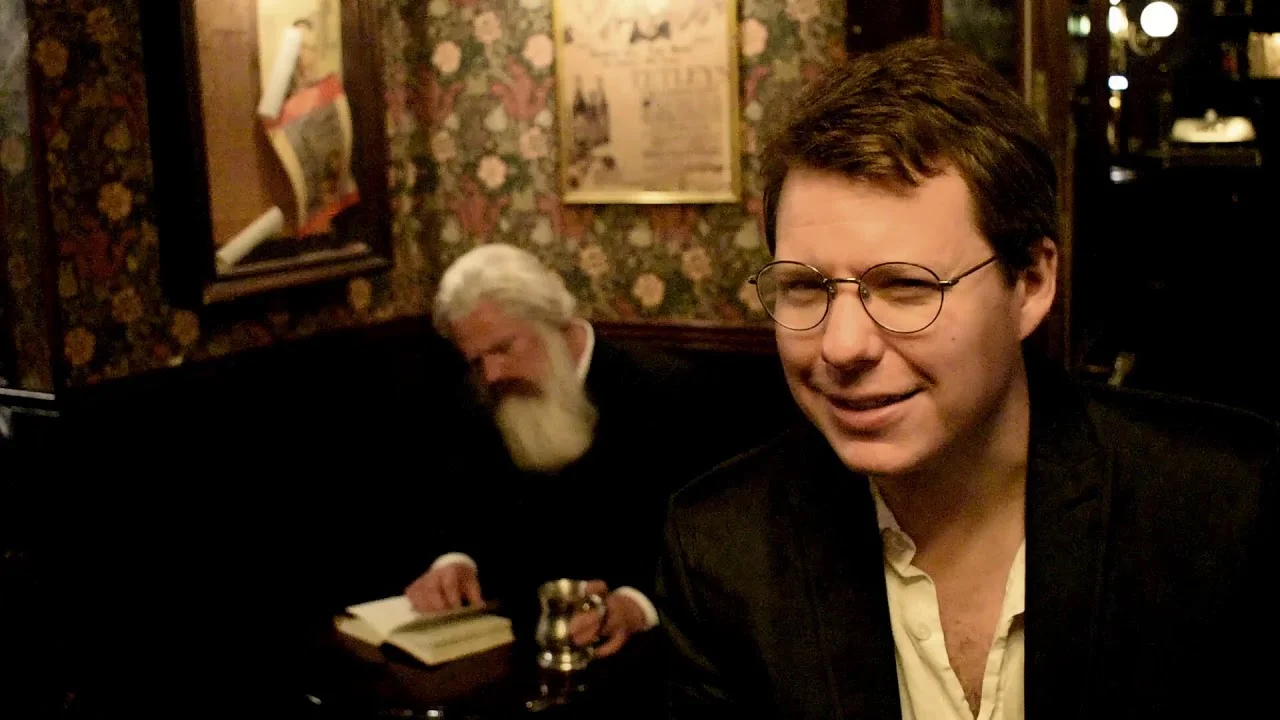
Medieval historian Richard explores how bureaucracy came to dominate the modern world, tracing its origins from an 18th-century insult to the theories of Max Weber, Karl Marx, Hannah Arendt, and Ernest Mandel, and comparing it with societies like Viking Age Denmark and medieval Iceland.
Defining Bureaucracy: From Insult to Theory ⏱ 2:13
•The word 'bureaucracy' was first used in 1764 by Friedrich Melchior, Baron von Grimm, quoting Jean-Claude Marie Vincent de Gournay, who called it 'bureau mania' and a 'fourth or fifth form of government'.•The term originated as an insult, making it hard to define from the start.•Max Weber's 1920 essay 'Bureaucratie' identified three defining features: given offices carry authority; offices exist independently of the people holding them; and offices are increasingly specialized.•In modern bureaucracy, authority comes through office, not bloodline or personal prowess, and responsibilities are specialized.Viking Age Denmark: Power Without Bureaucracy ⏱ 5:55
•The Glavendrup stone on the Danish island of Funen commemorates Atli the Pale, a Viking from the early 900s who was both a thane (military leader) and a gothi (pagan spiritual leader).•Atli likely became a military leader first and then acquired a religious role, showing that titles were accrued through power and prestige, not professional aptitude.•When Atli died, he left an 'Atli-shaped hole' in the world; his sons did not inherit his position, and he failed all three of Weber's tests.•In this world, a local big man was personally invested in whether people obeyed him, unlike a bureaucrat who is not personally invested.Alienation: Marx and the Bureaucratic Mindset ⏱ 10:24
•Weber described bureaucracy as embodying 'sine ira et studio' (without anger or frustration), meaning the complete eradication of love, hate, and purely personal sentiments from administrative tasks.•Karl Marx's concept of 'Entfremdung' (alienation) explains how bureaucrats become psychologically disinterested.•Marx argued that under capitalism, workers are alienated from their labor: 'The object that labor produces, its product, stands opposed to it as something alien, a power independent of the producer.'•Bureaucracy relies on alienation: when you interact with a bureaucrat, you are talking to their alienated self, not the real person.•Marx noted that alienated labor 'produces intelligence, yes, but it also produces idiocy and cretinism for the worker.'Capitalism and Bureaucracy: A Symbiotic Relationship ⏱ 15:16
•Criticism of bureaucracy has often come from the political right, with the idea that bureaucracy comes from the state and private companies would not encourage it.•However, Weber and Marx show that capitalism and bureaucracy get on 'like a house on fire': the principle of alienation upon which capitalism depends is the best way to manufacture a bureaucrat.•Capitalists need employees and consumers to behave predictably, and bureaucracy is a fantastic way to make people behave predictably, even at the cost of efficiency or human happiness.•Early bureaucracies existed in Mesopotamia (clay tablets from 3000 BC, including one noting beer rations for construction workers), the Christian Church, and the Islamic Caliphate, but they were child's play compared to those emerging with capitalism in the 1700s and 1800s.Hannah Arendt and the Rule by Nobody ⏱ 19:15
•Hannah Arendt, who fled Nazi Germany and then France to America, was captivated by why so many people supported totalitarian regimes.•In a 1969 article, she described the ideal bureaucracy as 'the rule by nobody,' an intricate system in which no man, neither one nor the best, neither the few nor the many, can be held responsible.•She argued that rule by nobody is 'clearly the most tyrannical of all, since there is no one left who could even be asked to answer for what is being done.'•Arendt warned that in a fully developed bureaucracy, 'there is nobody left with whom one could argue, to whom one could present grievances, on whom the pressures of power could be exerted.'•She feared such hardcore bureaucracy in the late 1960s in the Soviet bloc or the West; today, many unaccountable bureaucracies come from the private sphere, such as banks, internet providers, and tech companies.Ernest Mandel and the Icelandic Experiment ⏱ 22:38
•Ernest Mandel, a Belgian Trotskyite theorist at the Freie Universität Brüssel, argued in his 1983 book 'Power and Money' that Soviet bureaucrats had no incentive to dissolve their jobs.•Mandel proposed that a bureaucracy-free society requires a sharp reduction in the working week, suggesting a formula of four hours of non-administrative work plus four hours of administration a day, so that people have time to participate in self-administration.•Medieval Iceland (from the early Middle Ages until 1262) is an example of a society with almost no state: no king, no civil service, no tax collectors, no foreign office, no army, and courts without enforcement officials.•Despite this, the Icelandic sagas depict absurd, pedantic, and occasionally corrupt legal practices, such as exhuming dead men so they could stand trial, suggesting that in a society with no full-time bureaucrats, everyone ends up being a bit of a bureaucrat some of the time.•The speaker notes a paradox: attempts to destroy bureaucracy deliberately may end up giving it new life, and to kill bureaucracy we'd have to kill all forms of alienated decision-making, which would take more time, energy, and emotional labor. As anthropologist David Graeber points out, bureaucracy offers the possibility of dealing with others without demanding complex interpretive labor.Key Takeaways
•The word 'bureaucracy' was first used in 1764 as an insult by Jean-Claude Marie Vincent de Gournay, who called it 'bureau mania'.•Max Weber defined bureaucracy by three features: offices carry authority, offices exist independently of their holders, and offices are specialized.•Viking leaders like Atli the Pale gained power through prestige, not professional aptitude, and failed all three of Weber's tests.•Marx's concept of alienation explains how bureaucrats become emotionally detached from their work, and capitalism relies on this alienation.•Hannah Arendt warned of 'rule by nobody' in bureaucracy, where no one can be held responsible, leading to tyranny without a tyrant.•Ernest Mandel proposed a four-hour workday plus four hours of administration to enable a bureaucracy-free society, but it has never been implemented on a large scale.Conclusion
Richard concludes that bureaucracy is a uniquely human problem caused by a magic that makes us forget the complex bonds of human relationships, and that understanding it through history and theory may be the first step toward a happier world, echoing the medieval saying 'Omnia transibunt, more fluentis aquae' — like the flow of water, everything passes away.