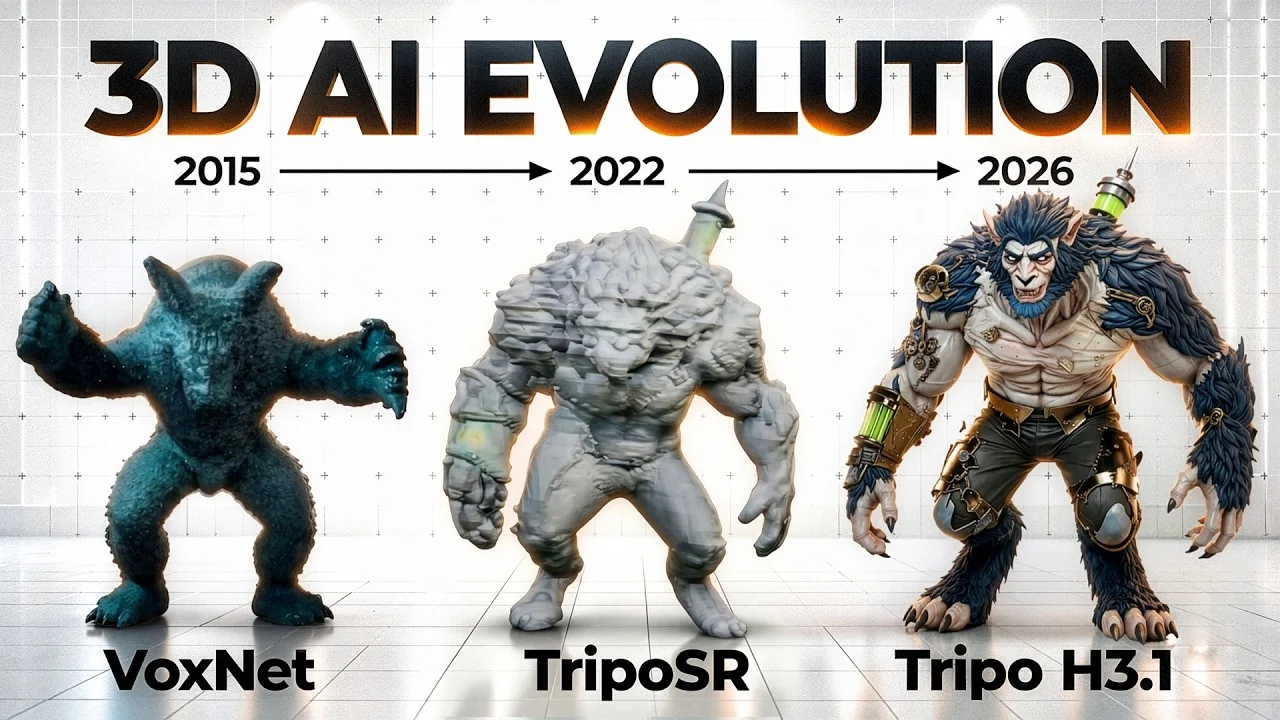
3D AI generation has evolved rapidly from crude voxel shapes to production-ready assets. This article traces its journey from 2015 to early 2026, highlighting key breakthroughs and market shifts.
Foundations: 2015 - 2022 ⏱ 0:00
•2015: Researchers explored three formats for representing 3D shapes: voxels (Lego cubes, memory-expensive), point clouds (no surfaces), and polygonal meshes (hard for AI).•Voxel approach dominated from 2015 onwards with papers like 3D ShapeNets and 3DGAN, but doubling detail required 8x more cubes.•2019-2020: Implicit fields emerged – AI learned to answer whether a point is inside or outside an object, enabling arbitrary resolution.•Differentiable rendering let AI improve 3D shapes by comparing rendered 2D images to real photos, leading to NeRF (full 3D scene from few photos).•2022: DreamFusion introduced Score Distillation Sampling (SDS), using a 2D AI as a teacher for 3D models. The same month, NVIDIA released Magic 3D, a two-step refinement using NeRF and DMTet.•OpenAI shipped Point-E (fast point cloud generation, no surfaces).•Objaverse 1.0 dataset released with over 100,000 labeled 3D objects.•Common Sense Machines began building a platform for turning images into 3D game world simulations.•Hunyuan (Tencent) started building its research team.The Data Revolution and Feed-Forward Models: 2023 ⏱ 5:37
•Focus shifted from academic experiments (hours per object) to feed-forward networks producing 3D models in seconds.•March 2023: Spline AI launched Alpha, putting generative features inside a browser editor.•Objaverse XL released with 10.2 million labeled 3D data (100x more than 1.0).•0123XL model showed improved results.•3D Gaussian Splatting (3DGS) released – painted scenes as millions of tiny glowing droplets, rendering instantly on GPU.•August 2023: NCSoft announced Varco LLM, foundation models for game development (first 3D AI model in Dec 2025).•Common Sense Machines started public testing of their photo-to-3D platform.•October 2023: Mesh-E 1.0 launched (generation took ~1 minute, meshes looked like melted plastic).•Alpha 3D (Estonian startup) grew fast, focusing on AR.•End of 2023: Large Reconstruction Models (LRMs) arrived – transformer networks output compressed 3D representation (triplane) from a single image in 5 seconds.•3D AI (later Triple AI) founded.Production-Ready Focus: 2024 ⏱ 10:08
•2024: Companies pivoted to training foundational 3D models that understand shape and build in three dimensions.•March 2024: TripoAI + Stability AI released TripoSR (open source, under 0.5 second on NVIDIA A100).•February-March 2024: Mesh 2.0 and Mesh 2.5 released with texture editing and image-to-prompt.•May 2024: DreamTech introduced Direct3D (two parts: D3D VAE compresses 3D objects, D3D DiT generates shapes via diffusion).•May 8, 2024: Autodesk announced Bernini (functional 3D forms, trained on 10 million professional CAD shapes).•Summer 2024: Triple AI shipped 1.1 series (multi-view inputs, smart low poly).•July 2024: Meshi 3 Turbo; August: Meshi 4 (remastered geometry, anatomically correct organic forms, clean hard surfaces).•September 2024: Tripo 2.0 (cleaner geometry, sharper edges, controllable PBR materials, direct Unity integration).•November 4, 2024: Tencent released Hunyuan 3D 1.0 (open source, unified framework for text and image, over 3 million downloads on GitHub/Hugging Face).•December 2024: Microsoft Research published Trellis (new representation SLAT, 2 billion parameters, decodable into any format).Speed and Quality Race: 2025 ⏱ 14:42
•January 2025: Tencent released Hunyuan 2.0 (open source, pipeline separation: Hunyuan 3D DiT + Hunyuan 3D Paint, plus Hunyuan 3D 2MV multi-view model).•Same time: Tripo 2.1 (best model of 2025 per speaker, improved PBR, cleaner retopology, polycount control).•Summer 2025: Tencent released closed-source Hunyuan 2.5 (free daily credits on Chinese website).•Lattice foundation model originally planned open source but policy changed, not released.•Tencent dropped Hunyuan 2.1 (open source, included PBR model, VAE decoder, training code).•May 2025: Spark Decay paper from NTU (Spark Conv VAE architecture, Spark cubes representation, slashed compute nearly half, handled hair, thin fabric).•Summer: Meshif preview with multi-view, animation, rigging.•Hunyuan 3D Polygen (clean quads mesh) shown in paper.•Hunyuan World 1.0 (creating whole spaces, practically unusable).•Autumn 2025: Tripo 3.0 (ultra mode, poly count up to 2 million, significantly improved PBR).•Hunyuan 3D 3.0 (1536p resolution, 3.6 billion voxels; Hugging Face downloads crossed 2.6 million).•October 2025: ByteDance (Volcengine) dropped Seed 3D 1.1 (foundation model for embodied AI and robotics).•Rodin 2.0 (Deemos Touch, Hyper 3D Rodent) – quad-based generation, 10 billion parameters.•November 2025: Meta released SAM 3D (open source, based on 2D segmentation work, basis for many startups).•Common Sense Machines announced closure in early 2026.•Waiwa 3D version 2 (first to introduce 8K PBR textures, inside-out texturing).•Hunyuan 3.1 (8 multi-view support).•Hunyuan 3D Studio released (waitlist, then public in November; generated geometry, part splitting, low poly mods with Polygen 1.0).•December 2025: Microsoft released Trellis 2 (4 billion parameters, sparse compression VAE, field-free ovoxel; first to support transparency and translucency, e.g., fishbowl).•UltraShape 1.0 (open-source, two-stage diffusion mesh refinement, could run on 24GB VRAM consumer GPU).Ecosystems and Maturity: 2026 ⏱ 25:52
•January 2026: Hightim 3D version 2.0 (1536p resolution, intelligent segmentation; good for 3D printing).•January 29, 2026: Rodin Gen 2 Edit (region selection and regeneration/editing, like Nanobanana for 3D; also Rodin 2 Parts for logical part splitting).•Same month: Meshi 6 shipped (final version, catching up in quality).•February 2026: DreamTouch (Direct3D) released Neural4D 2.5 (native 3D attribute grid architecture, not better than flagship models).•March 2026: Hunyuan 3D Studio went global; Polygen 1.5 (low poly from high poly).•Late March 2026: Tripo 3.1 HD model (more accurate polygon control, better PBR).•April 2026: Tripo SmartMesh P1 (accurate logical low poly directly from image in 5 seconds, separate meshes for head, top/bottom teeth, tongue).•Hi3D (formerly Hightim) version 2.1.•ByteDance Seed 2.0 (two weeks ago as of narration; improvements but looks weird, different architecture).•Community leaderboard top3d.ai for rating models.Key Takeaways
•3D AI generation evolved from voxel-based approaches (2015) to implicit fields and NeRF (2019-2020).•DreamFusion's SDS method (2022) used 2D AI as a teacher for 3D models, bypassing lack of 3D training data.•The release of Objaverse XL with 10.2 million labeled 3D objects enabled true foundation models.•By 2024, feed-forward models like TripoSR achieved sub-second generation, shifting focus to production-ready assets.•2025-2026 saw major improvements in mesh quality, PBR materials, transparency, and ecosystem integration, with tools like Trellis 2, Tripo SmartMesh P1, and Hunyuan 3D Studio.Conclusion
3D AI generation has advanced from crude voxels to production-ready meshes with clean topology, PBR materials, and part separation. The field continues to mature with open-source models and integrated workflows.