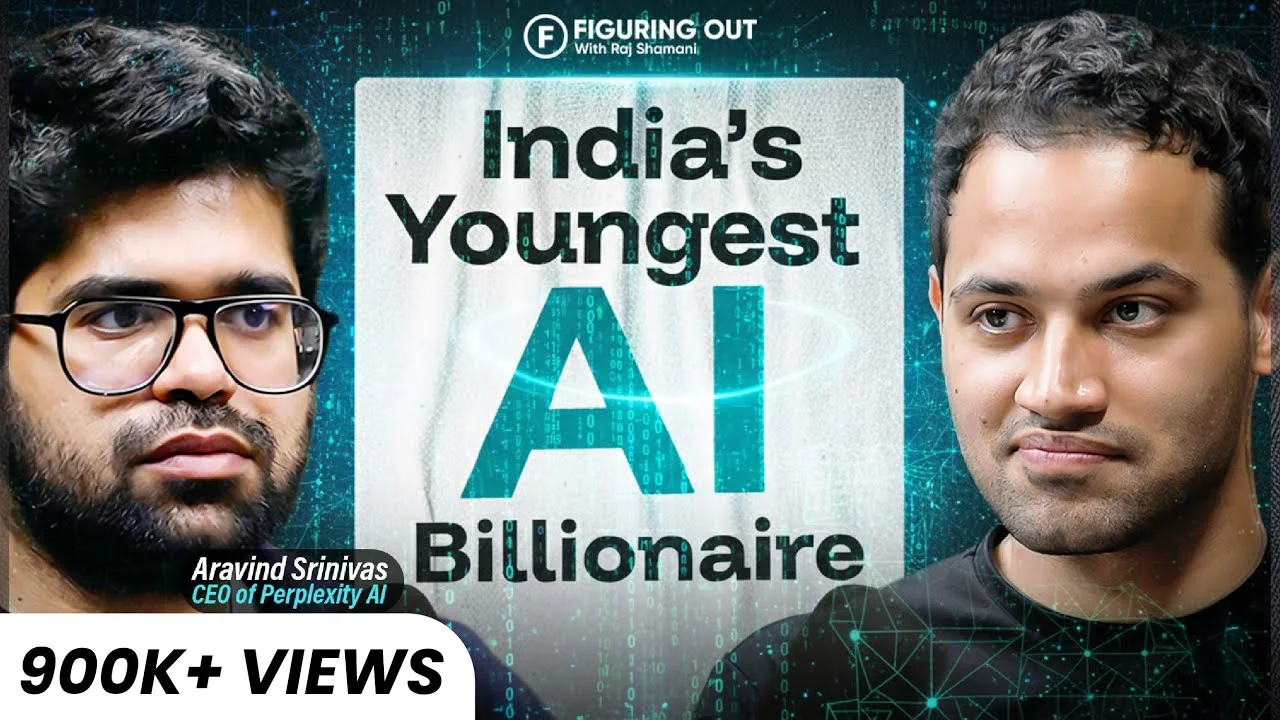
In this conversation, Perplexity CEO Aravind Srinivas discusses the company's name, its competition with Google, political neutrality in search, AI adoption in India, and the future of AI.
Perplexity's Name, Investors, and Search Personalization ⏱ 0:00
•Perplexity's name is a geeky AI metric for understanding; founder admits it's "one of the worst names you can pick for a consumer company" and is 100% aware. Initially no funding; perplexity.ai domain cost $120 for 2 years. Later plan to keep company name Perplexity but possibly rename the product.•Investor Jeff Bezos came in later (not earliest). Founder reached out via a common contact, sent a memo and an imaginary voice-to-voice demo of Jeff talking to the system about Star Trek and Blue Origin. Bezos approved first investment without meeting, allowed his name in the funding announcement, which became the headline. Later Bezos requested an update; founder wrote a six-pager, then had a one-hour meeting where Bezos referenced specific sections, asked about chip space, and said "your success doesn't rely on Google's failure." Bezos advised: "keep moving fast," "retain users," "don't be a leaky bucket," ensure retention increases. Founder met Bezos 2-3 times; describes him as up to date.•Bezos's qualities: incredible clarity of thought, timeless frameworks like "your margin is my opportunity," one-way/two-way door decisions, shareholder letters as masterclass in good writing. Bezos said we overestimate risk and underestimate opportunity; humans are social animals, not truth-seeking by nature, so rewiring is painful. Founder cites regret minimization framework as reason for urgency; at 30, senses cognitive decline compared to IIT cramming 10 lectures in last 3 hours; "regret's going to go up and abilities going to go down."•How Perplexity answers: pulls relevant results from its own index, looks at ranking signals from many search engines, combines via proprietary algorithm, lets model read retrieved links, pull relevant paragraphs, synthesize answer, pull final citations, and keep conversing with context (past sources, answers, queries). Location gives most personalization heavy lifting; low-quality domain filtering improves quality. Ranking algorithms and AB tests (ranking, UI, ads) cause different results; two people same location same query most likely see same answer unless different models, query reformulations, or AB tests. Signals include retention, number of queries, follow-ups.Perplexity vs. Google: Competition, Metrics, and Strategy ⏱ 20:00
•Perplexity's focus is on growing its own product, not on beating Google. The median search length on Google is 2-3 words (2.3 words), while on Perplexity it is 10 words. Perplexity handles 20 million queries per day, with 80% being deep questions. Google processes around 6-8 billion queries daily.•Weaknesses in Google's core search: inability to ship AI answers to a billion users due to innovator's dilemma; AI overviews create a cluttered UI that frustrates users and competes with ad revenue. Perplexity's opportunity lies in answering complex, multi-hop questions that Google wasn't designed for.•Success markers: reaching 2 billion daily queries (two orders of magnitude growth) or capturing a majority of a generation as default search tool. The speaker predicts the next generation will not all use Google; a split market (e.g., 40-30-20-10) among 4+ tools (Google, OpenAI, Perplexity, Meta, xAI) would be a big win.•Funding comparison: Google has $100 billion in cash; OpenAI has raised $20-25 billion (last round ~$10 billion, total ~$13 billion). Perplexity has raised $800-900 million total, with $500 million in the last round. Speaker notes money isn't everything—lower bureaucracy and faster shipping can offset capital disadvantages. Current focus is growth, not revenue.Perplexity, Political Neutrality, and Global Challenges ⏱ 40:01
•Aravind Srinivas contrasts Perplexity's political neutrality with Google's alleged ranking bias, citing instances like Trump news queries reformulated to Harris, autocomplete suggesting "duck" for "Donald," and difficulty finding the Joe Rogan Trump podcast on YouTube.•He acknowledges that Perplexity's lack of bias is easier due to building from a clean slate, but notes that Google's stance may be shifting as Sundar and Sergey meet Trump, and Google's mission now focuses solely on correct information.•Future political threats to Perplexity could arise from user sentiment or government actions anywhere, as censorship and free speech have different relevance in each country; Perplexity will work with individual governments and abide by their rules.•He emphasizes that all companies are capitalistic, competing for government contracts (e.g., Google Cloud employees fired after protesting Pentagon work), and Perplexity will not confuse shareholder responsibility with personal agendas.AI in India: Adoption, Opportunities, and Risks ⏱ 47:13
•India is well positioned in AI adoption: 92% of knowledge workers have adopted AI versus 65% global average, so people already know how to use these tools and don't need training courses.•Challenges: users should earn more by moving beyond hacks and cheat codes to side gigs, raising average income and GDP; they should build new apps and businesses for 100 million people, creating new market caps and jobs.•Three businesses to benefit: healthcare, software development, and financial consulting; AI can analyze portfolios, research news, read sell-side reports from Goldman Sachs or Barclays, and provide investment advice, acting as an arbitrage for those without consultant access.•Businesses facing maximum tension: software consulting and customer support call centers, where AI co-pilots and voice agents can replace human work, potentially causing layoffs but also allowing higher margins for restructuring.AI's Power, Digital Amnesia, and the Future of Intelligence ⏱ 52:28
•Aravind shares the most ridiculous search query about wanting a face covering for biking in winter, which led to a product recommendation and a purchase.•Conspiracy theories about AGI as a god-like tool to control the universe are exaggerated; real dangers include a country using superintelligent AI to solve hard problems like new drugs and selling at a premium, leading to theft, defense issues, and warfare.•Superintelligence is not like Einstein, who solved a few problems; it would be a computer that can solve any problem with massive economic impact, and whichever country has it will be sought by competing superpowers.•Digital amnesia is increasing as people rely on technology; younger generations may have less memory ability, and if free mental capacity is used for creativity and complex problems, it's great, but if unutilized, it's sad.Competition, Google's Vulnerability, and Closing Thoughts ⏱ 57:08
•When asked who loses most if Perplexity wins, Aravind says the one with the most to lose is Google due to its current business model, but Google is aware and working on it; other bets like YouTube and Cloud could increase margins and provide new cash flow.•He does not view the race as zero-sum but acknowledges some zero-sum games with other companies.•Google would face a difficult turbulent period but not be destroyed if someone cracks the AI-native answer engine assistant.•The segment ends with the host thanking Aravind, noting he is called the Joe Rogan of India, and Aravind replying he is the Raj Shamani of India.Key Takeaways
•Perplexity's name is a geeky AI metric for understanding, and the founder admits it's one of the worst names for a consumer company and is 100% aware of that.•Perplexity focuses on growing its own product rather than beating Google; the median search length on Google is 2-3 words while on Perplexity it is longer.•Aravind Srinivas contrasts Perplexity's political neutrality with Google's alleged ranking bias, citing instances like Trump news queries reformulated to Harris.•India is well positioned in AI adoption: 92% of knowledge workers have adopted AI versus 65% global average, so people already know how to use these tools.•When asked who loses most if Perplexity wins, Aravind says Google has the most to lose due to its current business model, but Google is aware and adapting.Conclusion
The video covered Perplexity's identity, its competitive stance against Google, the importance of political neutrality, India's high AI adoption rate, and the potential impact on Google's business model.