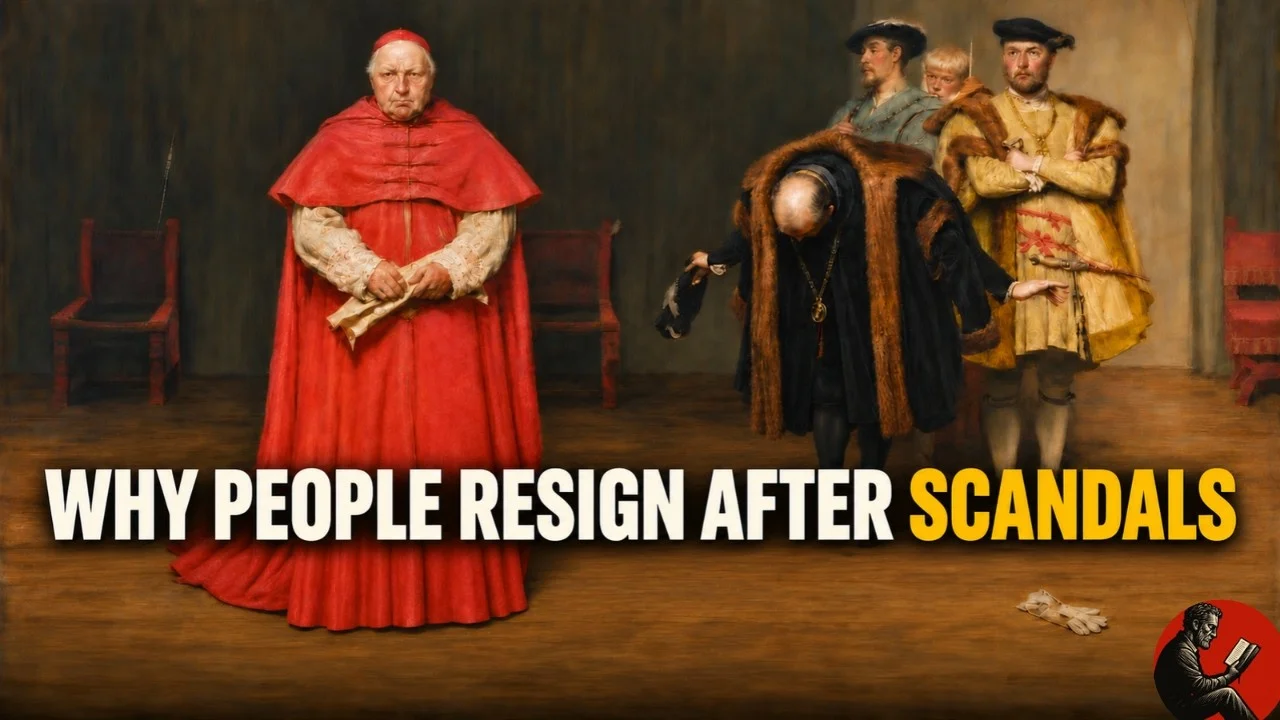
The resignation of a leader after a scandal often happens long before any wrongdoing is proven. Drawing on the case of Jensen Huang and classical social theory, the video examines why authority collapses and why exit becomes the only option.
The Collapse of Accepted Authority ⏱ 0:00
•On November 12, 2026, Jensen Huang resigned as CEO of Nvidia, effective immediately, after co-founding the company in 1993 and leading it for 33 years.•Reports indicated Huang had a close relationship with a businesswoman suspected by US intelligence of passing information to Beijing; on November 8 he emailed staff admitting he had been unfaithful to his wife.•Three days later, reports surfaced about an affair with an executive who reported directly to him; Nvidia lost nearly $550 billion in market value in five days.•Max Weber argued that authority exists only when the dominated obey; for a CEO, that means staff and owners accept his right to give orders.•After the scandal, investors sold shares, lawmakers from both parties called for investigations, and employees read about the affairs in the news; every meeting became about the scandal.•People do not wait for an investigation to end before they stop trusting a leader, so resignations often occur weeks or months before anything is proven.The Scapegoat Mechanism ⏱ 3:05
•In ancient Israel, on the Day of Atonement, the priest took two goats: one was sacrificed, the other sent into the desert carrying the people's iniquities.•The word scapegoat comes from that second goat; a resignation works similarly—as long as a disgraced leader remains, every news story about the scandal is also news about the company, but once he leaves, the news is about him.•In the book of Jonah, Jonah tells the sailors to throw him into the sea so the storm will calm, saying the storm has come because of him—the closest thing in scripture to a letter of resignation.•Machiavelli described how Cesare Borgia had Messer Ramiro d'Orco executed and left in the Cesena town square to shift hatred for his severity onto the minister and cleanse himself in the people's minds.•The person who leaves may be less to blame than those who stay: a minister resigns for a department's failure while board members who should have monitored the CEO keep their positions.Saving Face and the Terms of Exit ⏱ 6:09
•Nvidia's announcement thanked Huang but said nothing about why he was leaving; reports said the board had discussed removing him the night before, but the announcement says he resigned, so both sides gained something.•Being fired is a public humiliation; quitting lets both parties avoid humiliation, which is why resignation statements use similar phrases about family and not wanting to be a distraction.•Erving Goffman defined "image" as the positive social value a person claims based on the stance others assume they have taken during an interaction, and noted that saving face works in both directions.•Resigning has a practical side: the person can agree on money kept as compensation and shares and on what both parties will say publicly; those fired for conduct often lose that money and have no say in the company's account.•Shame differs from guilt in that it needs other people watching; Ruth Benedict noted that shame cultures rely on external sanctions, and a man feels ashamed when openly ridiculed or when he imagines he has been.•Weber wrote that a leader cannot delegate responsibility: an ordinary worker can say he was just following orders, but a leader cannot because he gave the order.When the Group Agrees: Nixon vs. Clinton ⏱ 9:14
•When Argentina invaded the Falkland Islands in April 1982, British Foreign Secretary Lord Carrington resigned within three days because his office had not anticipated the invasion and he was in charge.•In 1974, Richard Nixon faced Watergate and Congress moved to remove him; on August 7, Barry Goldwater, Hugh Scott, and John Rhodes told him his party had turned against him and he would lose a Senate trial, and the following night he announced his resignation.•In 1998, Bill Clinton faced impeachment over an affair with a White House intern, but his party supported him, his approval ratings rose, and he finished his term.•René Girard argued that expelling a scapegoat only works when everyone agrees; if a large part of the group refuses, the struggle continues—the difference between Nixon and Clinton.•Girard cited Caiaphas in the Gospel of John—"it is better for one man to die for the people than for the whole nation to perish"—and argued the Gospels reversed the mythical view by showing an innocent man condemned by a crowd sure it was right.•Scandals today divide the public: one side says the leader has disgraced himself, the other says he is the victim of a witch hunt; as long as his own supporters back him, he can generally stay.•Huang had that support for four days because his board said he would continue, but shareholders kept selling, lawmakers from both parties called for investigations, and the board changed its mind.Key Takeaways
•A leader resigns when the people he depends on decide almost simultaneously that he must leave—the resignation is him saying it before they do.•Weber's insight: a leader's authority lasts only as long as people accept it, and a scandal eliminates that acceptance long before anything is proven.•Resignation functions like the scapegoat ritual: the group in trouble sends one person away to carry the blame, and sometimes that person asks to leave.•Goffman and Benedict explain the face-saving and shame dynamics: quitting avoids public humiliation for both sides, and shame requires an audience.•Girard shows that expulsion only calms a group when everyone agrees—Nixon's party united against him, Clinton's refused, and Huang's board eventually withdrew its support.Conclusion
A resignation after a scandal is not proof of guilt but the moment a leader's accepted authority disappears and those around him agree he must go. The resignation is him saying it before they do.