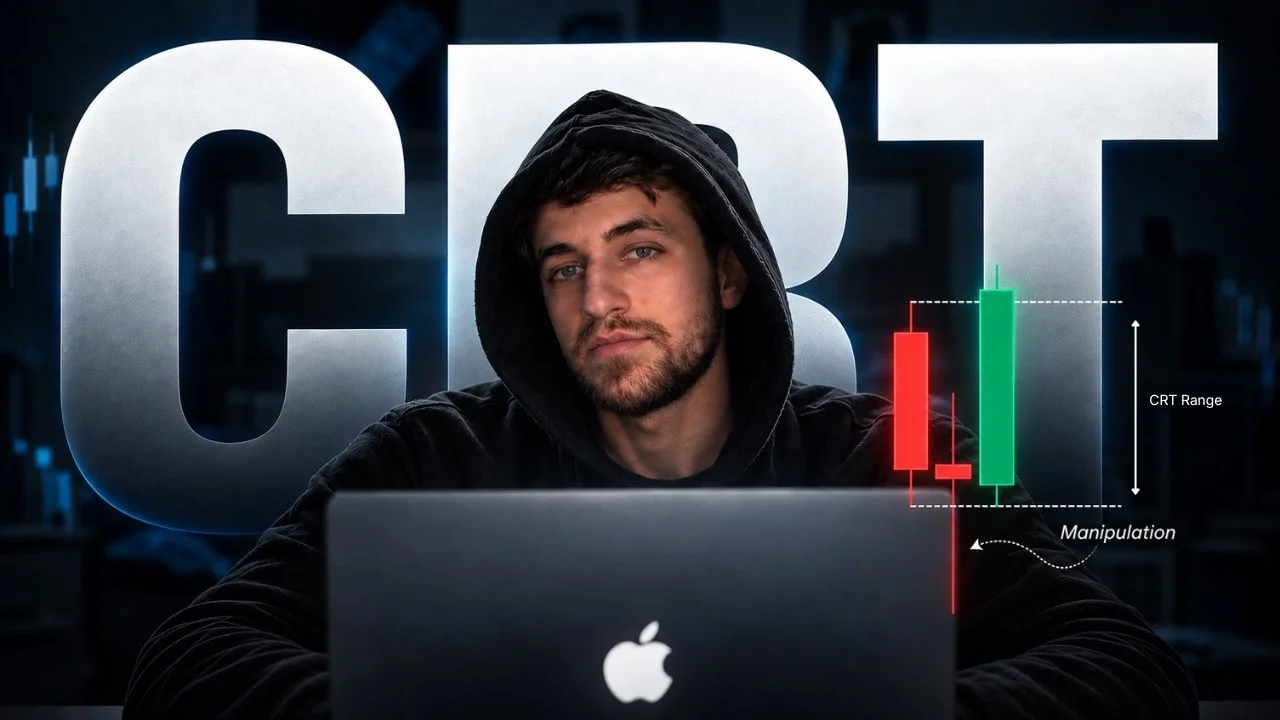
This article breaks down a full trading week using the CRT (Candlestick Range Theory) strategy, showing the speaker's real-time thought process, including both winning and losing trades, to explain when to enter and when to skip setups.
Monday: A Day to Avoid Without News ⏱ 2:00
•Mondays are the worst days, especially when there is no news; the safest option is to skip Monday without news.•The speaker included Monday for educational purposes but warns that on a news-free Monday, it's better not to trade at all.•On the 1-hour timeframe for MNQ, pivot points are marked as areas with the highest concentration of liquidity.•A bullish mood was identified when price broke the hourly low and a massive green candle formed, indicating buy orders were taken and price was ready to turn up.•Despite the bullish bias, the speaker mistakenly expected a downward move on Monday, based on 8 years of experience that Mondays rarely show continuation.•A 30-minute CRT formed, but the speaker shorted and got stopped out when news caused a reversal; the correct trade was a bullish CRT that would have hit take profit.Tuesday: Trading Without Clear Direction ⏱ 7:00
•Tuesdays are usually decent days with less noise than Mondays.•The price was trading between hourly lows and highs, with no clear direction, so the speaker decided to take the first CRT that formed, regardless of price action.•A 15-minute CRT formed: price made a high then closed back within the range; the low was the target.•Entry was on a break of the low, with a risk-reward ratio of 1.5 and stop loss at the high.•The trade resulted in a downward move, hitting take profit.•The speaker emphasized that without a clear vision, one can either skip the day or take the first CRT; he prefers the first signal and is comfortable with the risk.Wednesday: FOMC Day – Best Skipped ⏱ 11:32
•FOMC days are not the best option; the speaker personally wouldn't risk it unless something perfect appears.•On the hourly timeframe, there was no clear trend; price did not break the high, so no bearish CRT was confirmed.•A 15-minute CRT and a 1-hour CRT formed but were not interesting in real time.•The speaker advises to forget about FOMC day completely, as it's not worth the risk.Thursday: Filtering for the Best Setup ⏱ 13:02
•Thursdays have a cleaner continuation and the speaker is less indecisive; Thursday, Friday, Wednesday, and Tuesday tend to have good setups, while Mondays are usually ignored.•On MNQ, the price took off the hourly low, bounced, and continued growing, but no clear CRT formed.•MES showed a clear bearish direction after breaking the hourly high, but no valid CRT appeared.•MGC looked promising: an hourly order block and a sweep of the last half-hour high, with a higher timeframe downtrend.•A 30-minute CRT formed on MGC, and the speaker entered short on a break of the middle candle low, with take profit at the low and 1.5 R stop loss.•The trade hit take profit, and the speaker rated it an A- setup due to clear direction and CRT.Friday: Multiple High-Quality Setups ⏱ 18:04
•On MNQ, a bearish bias was identified after price broke previous highs and showed selling pressure from 29,390 to 30,000.•On MES and MGC, similar bearish setups were observed.•The speaker chose to trade MNQ but also watched MGC.•A 15-minute CRT formed on MNQ: entry on break of middle candle low, take profit at the opposite end, stop loss 1.5 R away.•The speaker missed the entry on MNQ because he waited for a retest that didn't come, but noted the setup was perfect.•MES and MGC also had perfect CRT setups with clear direction, all hitting take profit.•Friday was one of the most perfect days with multiple high-quality setups aligning.Key Lessons and Trade Execution ⏱ 23:04
•The speaker emphasizes the importance of trading only the highest quality setups, not jumping into every CRT.•He shows his actual trades on MNQ, MES, and MGC, matching the setups discussed.•He reiterates that bias and trend are crucial for A+ setups.•Future videos will cover advanced topics like scaling.Key Takeaways
•Mondays without news are the worst trading days and should be skipped.•Pivot points mark areas of highest liquidity concentration and help determine direction.•Without a clear direction on the hourly timeframe, the setup is weaker (B or C level) and riskier.•FOMC days should be avoided altogether unless a perfect setup appears.•Thursdays and Fridays often provide cleaner setups and better continuation.•Stop losses should only be moved to breakeven after a significant move, not after a single candle.Conclusion
A full week of CRT trading shows that filtering for high-quality setups with clear direction and bias is essential, while avoiding low-probability days like Mondays without news and FOMC days.