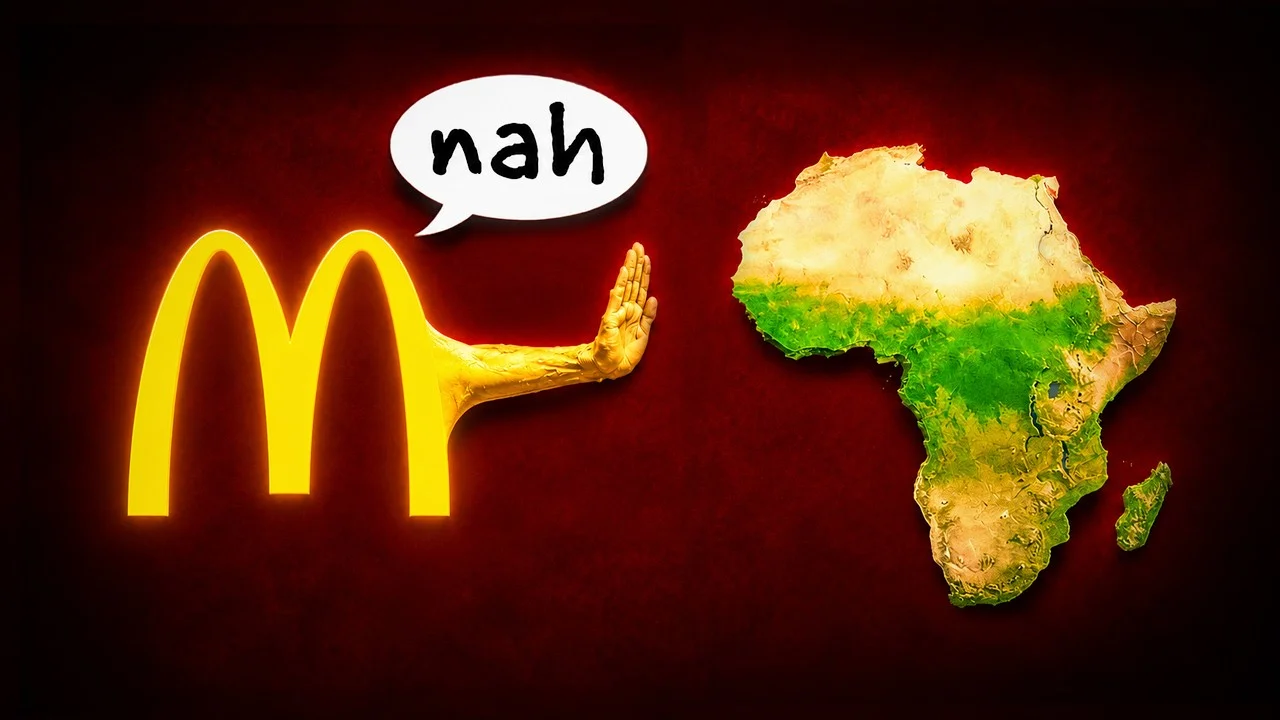
McDonald's operates over 40,000 restaurants worldwide, yet it has a presence in only four African countries. This article explores the reasons behind the chain's limited footprint on a continent of 1.4 billion people.
McDonald's Early Success in Africa ⏱ 1:00
•McDonald's opened its first African location in Morocco in 1992, when a full meal cost about 50 dirham ($6.25) and the minimum wage was about $0.75 per hour.•In Morocco, McDonald's adapted its menu to local customs, serving exclusively halal meat and a traditional post-fast menu during Ramadan; this strategy is known as glocalization.•The chain was celebrated as a job creator, particularly for young people facing high youth unemployment.•In 1995, McDonald's opened its first restaurant south of the Sahara in Johannesburg, South Africa, during the country's historic transition after apartheid.•In 2011, McDonald's sold its South African franchise rights to Cyril Ramaphosa, a former businessman and future president; by 2025, the country had over 400 McDonald's restaurants.•McDonald's also expanded to Egypt and Mauritius, but all four African countries where it operates are among the continent's wealthier nations.Corruption and Political Instability ⏱ 5:34
•In the 1990s, McDonald's spent 7 years preparing to enter Tunisia, conducting market research, obtaining licenses, and establishing supply chains, but the deal collapsed because the ruling Al Materi family wanted the franchise for themselves and warned McDonald's to "choose the right partner or face the consequences."•In 2009, a US ambassador met with Nesrine Al Materi, daughter of the Tunisian president, at a beachfront mansion; the family offered to help McDonald's enter Tunisia in exchange for press coverage of the ambassador's humanitarian projects.•In December 2010, a young street vendor set himself on fire in protest, sparking the Arab Spring; Tunisia's president was ousted, the Al Materi family fled into exile, and years of political instability followed.•To this day, McDonald's has not opened a single restaurant in Tunisia.Supply Chain and Potato Challenges ⏱ 7:36
•McDonald's relies on strict food safety standards and standardized recipes to ensure the same experience everywhere.•The chain prefers specific potato varieties, such as Russet Burbank, Shepody, Innovator, and Zorba, which are mainly grown in the US, Canada, and Europe; these varieties are not cultivated at scale in Africa.•In 2022, KFC in Kenya ran out of fries because its potatoes, shipped from Egypt, were stuck due to COVID-related shipping issues; KFC refused to use local Kenyan potatoes, which are primarily the Shangi variety and do not meet its strict requirements.•Potatoes are the second most popular staple in Kenya after maize, and the country is the fifth largest potato producer in Africa.•Nigeria, with a population of over 230 million and one of the largest economies on the continent, poses extreme cold chain challenges: frequent power cuts in Lagos, average temperatures around 34°C, and poor road conditions make it hard to keep frozen products cold during transport.KFC's Success and McDonald's Future ⏱ 13:13
•KFC has adapted its menu in African countries, for example serving jollof rice in Ghana.•KFC's success is largely due to its focus on chicken: in 2024, chicken was the most consumed meat in Africa, and it is cheaper and more accessible than beef, with shorter production cycles and lower costs.•In Africa, the overwhelming majority of KFC's chicken is locally sourced, resulting in shorter supply lines and fewer imports.•McDonald's is aware of these advantages and is increasingly moving toward chicken-based options as beef prices rise in the US.•McDonald's may target smaller African countries first, where supply chains are more easily secured, before attempting to conquer larger markets like Nigeria.Key Takeaways
•McDonald's operates in only four African countries: Morocco, South Africa, Egypt, and Mauritius.•Corruption and political instability, notably in Tunisia, have blocked McDonald's entry.•Strict supply chain and food safety standards, including specific potato varieties, are difficult to meet in Africa.•Cold chain challenges in countries like Nigeria make operations extremely difficult.•KFC's success in Africa is attributed to its chicken-focused menu and local sourcing.Conclusion
Despite the challenges, McDonald's will likely keep trying to expand in Africa, as one executive suggested it might target smaller countries first where supply chains are more easily secured.