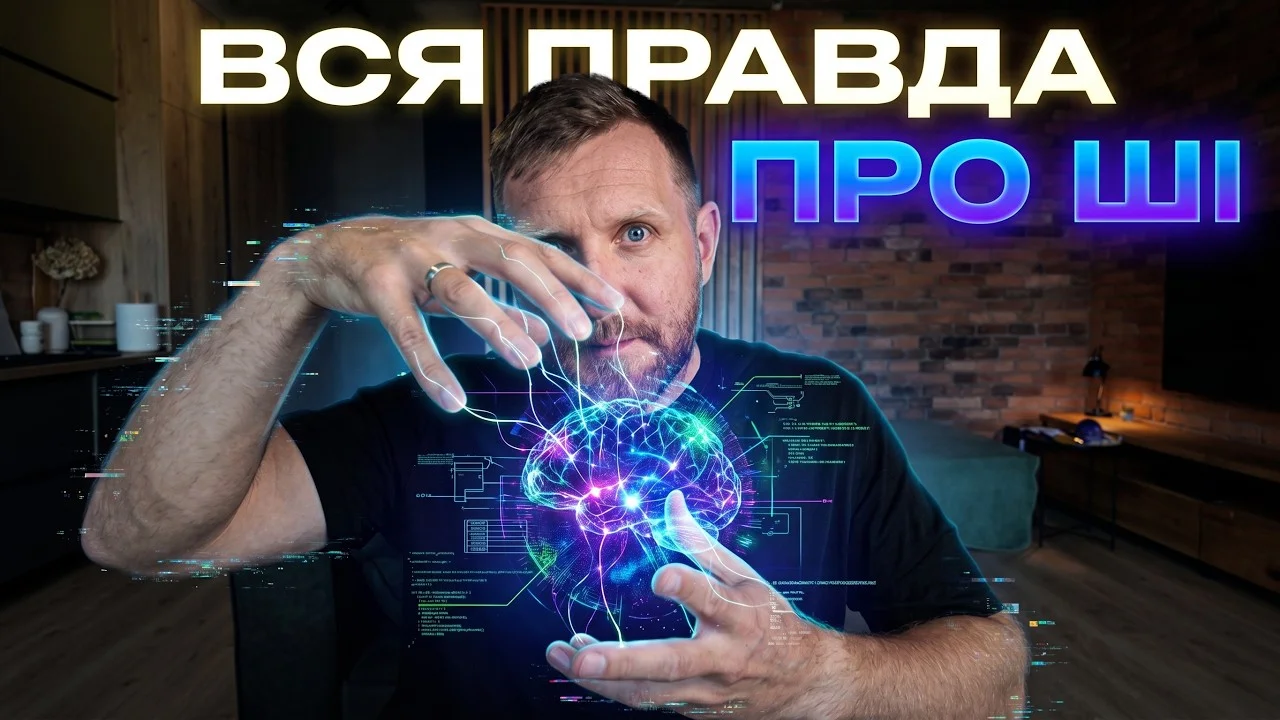
This article explains what artificial intelligence really is, how it relies on data rather than independent thought, and the main problems it creates for individuals and society.
What AI Actually Is and How It Works ⏱ 0:00
•Calling it AI is not entirely accurate, because a form of artificial intelligence that can think for itself does not exist.•What we call AI, ChatGPT, Claude, or Gemini are large models, including large language models and models for images, video, and audio.•AI models are large computer programs whose results are not hard-coded; they are achieved based on the analysis of a massive amount of available data.•For example, when asked to write a text about cats, the program analyzes the request and returns a result based on millions and billions of texts about cats at its disposal.•Models were trained by being shown billions of data points, similar to showing a child pictures and saying "this is a cat" and "this is a dog."•In the "Guess the Number" game, most people get 7 on the first try and 3 or 4 on the second, because the model relies on data about human psychology.•AI sometimes lies confidently because it does not think in facts but mathematically guesses the highest probability.•If asked to find a bug in very specific JavaScript code with no examples in its database, the model will return a function that looks good but is non-functional.•The result depends heavily on the task you set, called a prompt. A vague task like "Write me some HTML code" gives surprising results, while a specific task like writing HTML code for a Hero section using semantic tags and a specific methodology gives more or less ready-to-use code.•There is a saying: "AI is only as smart as its interlocutor."Major Problems Arising from AI ⏱ 4:42
•Problem one: speed. AI is mostly used to speed things up, producing quick results and quick dopamine that passes quickly.•Climbing a mountain on foot for a long time creates dopamine of anticipation and a real explosion of dopamine at the summit that stays for a long time.•Writing code by hand involved thinking, analyzing, making mistakes, learning, and enjoying the process, giving an unreal explosion of dopamine when the result was achieved. Today you write a prompt and get the result, and that is all the dopamine you get.•Problem two: the increasing cost of using AI. There is a constant rise in prices for subscriptions or tokens after an initial free period, similar to a cutting-edge drug that gets users hooked before prices are raised.•The younger generation suffers most, with answers to every question just a single click away and whether the answer is useful or true no longer interesting anyone.•Problem three: degradation. In an IT company where competitors implement AI, programmers, designers, and managers all stop doing their core work, leading to total degradation, and companies cannot stop because they would immediately lose to competition.•Muscles atrophy when a bodybuilder stops training, and the same happens with our brains if we do not train them regularly.•Problem four: the planet Earth problem. AI is creating an even wider gap between the rich and the poor, the rich get richer, the poor stay poor, and the middle class suffers as AI slowly replaces it.•Progress used to occur gradually over say 100 years, giving humanity a chance to counteract consequences like global warming and plastic pollution, but today progress happens over months, weeks, even days, and we cannot plan even 5 years ahead.How to Use AI Responsibly ⏱ 10:20
•Besides problems, these models bring many benefits, but their use must be responsible.•First, take off the rose-colored glasses and consider that such rapid development of such powerful technology could cause consequences unknown to us yet.•Second, remember that fire brings many benefits, but when used irresponsibly, it leaves only ashes behind.•Do not use AI for things you do not understand at all, like generating an image with 16 noses and failing to notice it.•Even where you are an expert in your main profession, do not overdo it because of degradation.•If you delegate your work to AI, AI has already replaced you.•You can use AI for your own benefit, for example, for automating routine processes that do not require analysis, thought, creativity, or brain activity.•Invest in your own mind. In times when technology tries to do everything for you, you must remain "Homo sapiens" and develop a solid understanding of what you are dealing with.•Learn, grow, and remember: live your life, and do your work in your free time.Key Takeaways
•AI models do not think for themselves; they rely on a massive database of information and mathematically guess the highest probability.•AI produces results based on data, so the result depends very much on the task you set and how you set it, called a prompt.•Four main problems are speed and quick dopamine, the increasing cost of AI subscriptions or tokens, degradation of professionals and the younger generation, and a widening gap between rich and poor.•Use AI responsibly: do not use it for things you do not understand, do not overdo it even in your expertise, and invest in your own mind.Conclusion
AI is not pure evil but brings many benefits if used responsibly. Take off the rose-colored glasses, avoid full delegation to AI, and invest in developing your own mind.