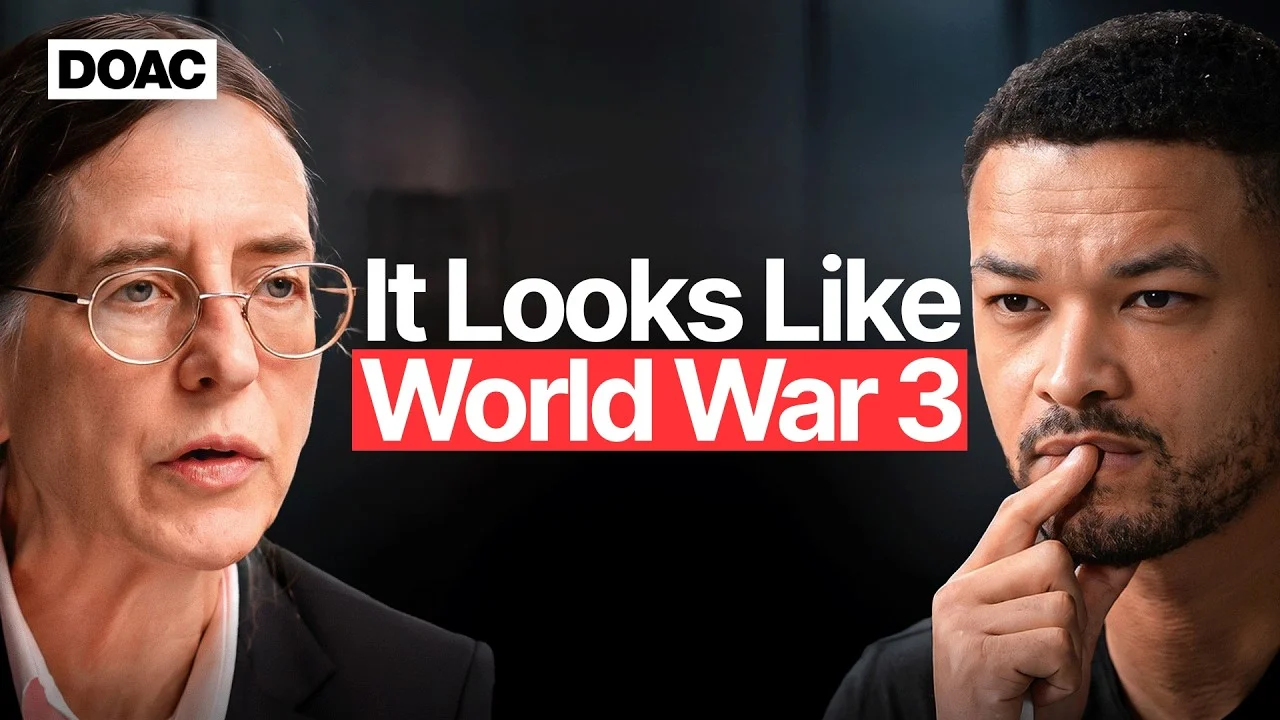
Historian Dr. Sarah Paine discusses the threat of World War III, the collapse of the post-WWII order, and the lessons history offers for avoiding nuclear war and sustaining a rules-based international system.
WW3 Threat and the Collapse of the Post-WWII Order ⏱ 0:00
•The speaker warns that reckless leaders in large countries are lying, and normalizing lies contributed to the Soviet Union's collapse; history is moving fast with Putin invading Ukraine and Trump entering a war with Iran.•The Iran war is called one of the most incompetent wars in human history: it has trashed the US economy, blown the US alliance system, and taken down the world's economy, turning the US from an annoyance to everyone's primary adversary.•Key concepts: pivotal error (e.g., Putin's Ukraine invasion, which burned Russia's Cold War arsenal and strengthened Ukrainian national identity); negative objectives (preventing disasters) are undervalued; situation vs. problem (Iran with 90 million people is unfeasible to solve and should be managed).•The post-WWII rules-based order is collapsing; norms like conceding elections are eroding, and the US is going rogue, prompting rapid European institution building (Baltic eight, remilitarization, space ports, boycott apps) and middle-power organizing led by Canada's Prime Minister Carney.American Hubris and Incentivizing Nuclear Proliferation ⏱ 7:36
•Type A American hubris: the belief that all decisions that matter happen in the US; type B: being good at one thing doesn't make you good at everything—humility and listening to divergent opinions are needed, but the current team is yes-men who are historically unqualified.•The Iran war was a pivotal error: the US lost its alliance system and will never again be the trusted partner; the war's collateral damage includes threatening everyone's economies.•The lesson for the world is 'get a nuke': the US and Putin have incentivized proliferation, as seen in Iran's deep understanding of America (Lego videos) versus American ignorance.•The greatest generation understood the USSR was a lethal threat to be managed, not solved, using sanctions to depress Soviet growth while maximizing growth within the alliance and getting accurate information out.Ukraine, Unlimited Objectives, and the Threat from Russia ⏱ 20:01
•The U.S. should not send combat troops but should position Ukraine to succeed by giving it what it needs; blowing up alliance systems hurts U.S. industries (e.g., Kentucky bourbon makers shut down because Canadians won't buy).•Russia under Putin has unlimited objectives: regime change and genocide in Ukraine (trying to execute the Zelensky family, eliminating purveyors of Ukrainian culture); Putin wants to restore the old Soviet empire.•Unlimited objectives put the opponent on "death ground," turning even a dysfunctional country into a lethal adversary; Russian soldiers brought food for 3 to 10 days and uniforms for a victory parade, expecting a quick win, but met Molotov cocktails.•Russia's history as a continentalist power shows it keeps pushing forward; Putin cannot stop because dictators have no off-ramp—replacing him likely means his death, and like Nicholas II (Russo-Japanese War 1904-1905), he started a recreational war he didn't have to.U.S. Policy, Iran, and the Costs of War ⏱ 26:08
•The U.S. under Trump is acting like a continentalist, claiming Canadian territory and Greenland, and has started a war with Iran that has driven up gas prices—a weekly reminder at the pump.•The war has likely incentivized Iran to get nuclear weapons, and there is fear Trump might drop a tactical nuke; the U.S. would then be the only country to have dropped nukes three times (twice on Japan, once on Iran).•On energy costs, voting is key: 1/3 of Americans voted for the current path, 1/3 voted for anything but this, and 1/3 didn't vote; people need to get off the couch because it matters for their children.•Sanctions are preferable to war—they don't solve problems but shrink the opposing piggy bank and, with allies, grow one's own; they are a form of chemotherapy.Lessons from History: Opportunity Costs, Alliances, and the Case for Diplomacy ⏱ 40:02
•Nicholas II's defeat in war and failure to build railways left Russia unable to deploy troops or receive supplies in WWI; food riots in St. Petersburg led to his overthrow.•China supports Russia because it wants the U.S. out of everyone's business, benefits from Russia weakening itself, and gets resources at reduced prices while making money; historical grievances over territory taken by Russia remain.•The two sides' positions are incompatible: Zelenskyy will not yield an inch, while Putin needs to appear victorious; unlimited wars like WWII (55 million dead) are obscene, and it is far better to deploy diplomats and lawyers to international institutions.•Governments' primary roles are to protect national security and prosperity; honesty and civility matter.China's Wars, the Nuclear Threat, and Dark Personalities in Power ⏱ 60:03
•China's wars and campaigns include the Korean War (1950–53), the 1962 border war with India (which turned India into a permanent enemy), Deng Xiaoping's costly but short war on Vietnam, the Anti-Rightist campaigns, the Cultural Revolution, and the Great Famine created by the Great Leap Forward — yet the generation who did that fighting is now dead.•Continuing the current "direction of travel" leads to World War III; mutually assured destruction has not made the world safe, and a leader like Trump wouldn't back down from Iran because he must appear to have won.•Putin has violated NATO airspace — sending drones into Bulgarian and Romanian territorial waters, where they were shot down — pushing toward Article 5 territory; the world is less careful now than the World War II generation was, and if Putin invaded Poland, world war would follow.•Nuclear-war software lets you pick a weapon's megatonnage and a target city to see how many die; the core problem is dark personalities like Putin reaching power — humans struggle to spot them until they become Hitlers, and the proposed US solution is for the next Congress to impeach and convict Trump.Ukraine, Democracy, and a Message to the Privileged Young ⏱ 60:03
•Zelenskyy is a great statesman and hero for all time who refused Biden's offer of a ride, asking for ammunition instead; the war is one of the clearest-cut wars of aggression imaginable, fought with Russian brutality, and Russia needs "a massive time out" organized by the middle powers.•US aggression — taking Maduro, going into Iran and Venezuela — has made everyone else feel less safe and pushed them to partner with China as "the less lunatic option," the paradox of strength: using power loses it, whereas strength through peace keeps the illusion.•Democracy is the only system with really high per capita living standards, while continentalist dictator rule means your business is taken and you're put on the front line; but tech billionaire immigrants are buying elections — Elon Musk put $160 million into Texas — and "Don't mess with Texas" applies to him.•Trump, not America, turned against Zelensky and killed the US legacy; a third of America voted for him, a third didn't, and a third wouldn't get off the couch — they need to reassess rather than double down, like admitting a bad pizza was bad. The speaker apologizes that her generation is leaving such a mess, and urges young people to read, keep learning, talk across silos, be polite, and vote as a civic duty; dark personalities are few and the rest can get through this together.Russia's Predatory Nature and the Case for Ukrainian Victory ⏱ 80:04
•Russians forced reliance on poor domestic goods; rotting meat, 'importnaya' items, and rotten Hungarian apples made into applesauce were common, while even Romania produced better canned tomatoes.•Russia complains of being threatened despite its history of harming others; Scandinavian countries show how to develop resources, but Russia steals from others; the further back you stop these people, the safer you are.•Trump's claim that Putin is exporting diesel to ease US prices is disinformation: Russia lacks capacity, diesel prices rose due to the Iran war and refinery constraints, and Trump is blaming Ukraine—despicable and lying.•Americans should ask if grocery prices are better or worse; oatmeal cost $10 for a small package, and tariffs on food imports from Mexico and Canada are wrecking the US; morality and core values (life, liberty, pursuit of happiness) have been forgotten.Ukraine's Resilience, Russian Instability, and the Maritime World Order ⏱ 85:13
•Ukraine can win and is winning: it develops its own drones, ballistic missiles, and hit Russian oil refineries, causing up to 50% loss of operating capacity; Musk's Starlink kill switch hurt Starlink's reputation, boosting a French competitor; US Patriot production is too expensive and insufficient, unlike FDR's approach.•Russia's economy is on a high-risk war footing: defense spending is about 40% of the national budget, draining health and education; labor shortages and emigration of hundreds of thousands have caused inflation and interest rates above 20%; $300 billion in reserves are frozen; fuel shortages persist.•Putin's regime is unstable: at 74 under enormous stress, his death would spark a free-for-all among his mafia-like network; with many Russians having military training, civil war and loose nukes are possible; it could take 10 years to put the pieces back together, so the democratic core needs contingency plans.•The world's only positive-sum order is maritime: 90% of trade goes by sea, and a container ship carries 21,000 containers versus 600 on a train; international institutions, though flawed, are feasible; Xi Jinping's genocide against Uyghurs is driven by fear of Soviet-style ethnic fracture, putting men in camps and children in schools to become 'honorary Han'.Key Takeaways
•Leaders in large countries are lying to their populations, and the normalization of lies contributed to the Soviet Union's collapse; history is currently moving very fast.•American hubris comes in two forms: Type A, the belief that all decisions that matter happen in the United States, and Type B, the assumption that being good at one thing makes you good at everything.•The United States should not send combat troops to Ukraine but should position Ukraine to succeed by providing what it needs, while blowing up alliance systems hurts U.S. industries and creates opportunities for Russia.•Under Trump, the U.S. is acting like a continentalist, claiming Canadian territory and Greenland, and has started a war with Iran that has driven up gas prices and created significant opportunity costs.•Nicholas II's defeat in war and failure to build railways left Russia unable to deploy troops or receive supplies in World War I, leading to food riots in St. Petersburg and the collapse of the regime.•China's wars and campaigns include the Korean War (1950–53), the 1962 border war with India that turned India into a permanent enemy, and Deng Xiaoping's costly 1979 invasion of Vietnam, which he used to consolidate power.Conclusion
Dr. Paine argues that history shows the dangers of hubris, the importance of alliances, and the high costs of war, and that the United States must avoid repeating past mistakes to prevent great-power conflict.